Category: Long-Term Care

  • The Juggle Is Real: Why You Should Join Me

    The Juggle Is Real: Why You Should Join Me

    If you’ve ever felt like you’re being pulled in ten different directions at once, you’re not alone.

    You’re building your career. You’re showing up for your family. Maybe you’re raising kids. And at the same time, you’re starting to take on a new role you were never really trained for helping aging parents navigate one of the most complex systems out there.

    That’s the sandwich generation (responsible for bringing up their own children and for the care of their aging parents). And the juggle is very real.

    That’s exactly why I’m excited to be part of The Juggle Is Real: A Community Night for the Sandwich Generation, hosted by Whimble.

    This isn’t your typical “sit and listen” event. It’s designed to feel different in the best way.

    A Night That Actually Gets It

    We’ve all been to events that feel a bit too formal or a bit too removed from real life. This isn’t that.

    The goal of this night is simple: bring together people who get it.

    People who understand what it feels like to:

    • Try to plan for the future while dealing with what’s happening right now
    • Have tough conversations with parents about care, housing, and support
    • Balance ambition at work with responsibility at home
    • Feel like you’re supposed to have all the answers… even when you don’t

    You can expect a relaxed, welcoming atmosphere. Think cocktails, good conversation, and a room full of people who are navigating similar challenges.

    There’s going to be a panel discussion, but it’s not meant to be clinical or overwhelming. It’s meant to be real, practical, and actually helpful.

    What We’ll Be Talking About

    The panel is focused on giving you tools you can actually use.

    Not theory. Not jargon. Just honest conversations about things like:

    • How to start planning before a crisis happens
    • What to do when you’re not sure what your parents need yet
    • How to manage stress and avoid burnout
    • How to build a support system that actually works

    And most importantly, there will be time for questions. Because everyone’s situation is different, and sometimes you just need to ask the thing that’s been on your mind.

    Meet the Panel

    One of the best parts about this event is the mix of perspectives.

    You’re hearing from people who live and breathe this space in very different ways.

    Minnelle Williams

    An Estate and Legacy Educator, Minnelle brings a level of warmth that makes even the hardest conversations feel approachable. With experience as both a Funeral Director and Death Doula, she helps families think about planning in a way that feels human, not overwhelming. Her work is all about making sure people feel prepared, not panicked.

    Elizabeth Mohler

    Elizabeth brings a thoughtful, research-backed perspective on care systems and policy. As a PhD candidate at Western University, she studies how people actually experience care in real life. What I really respect is that she also brings lived experience as a caregiver, which adds a level of honesty you don’t always get in these conversations.

    Emma Brown

    The Founder and CEO of Whimble, Emma built this event from a place of personal experience. After decades of providing backup care for a loved one, she understands just how fragile and complicated the system can be. Her goal is to make care more accessible, reliable, and easier to navigate for families.

    Daniel Clarke (that’s me)

    I’ll be there talking about how we can make finding care a little less overwhelming.

    Through Elderado, I spend a lot of time helping families figure out the difference between long-term care, retirement homes, and home care and more importantly, how to actually find the right fit.

    Because the reality is, most people only learn about this system when they’re already in it. And that’s when it feels the hardest.

    Where Elderado Fits In

    A big part of what I’ll be sharing is how families can take back a bit of control in the process.

    Finding care shouldn’t feel like guesswork.

    Whether you’re:

    • Just starting to think about options
    • Trying to understand the difference between retirement homes and long-term care
    • Looking for home care support to stay at home longer
    • Or in a situation where you need to make a decision quickly

    There are tools and resources that can make this easier.

    That’s why we built Elderado to give families a clear, simple way to search, compare, and connect with care options without feeling overwhelmed or pressured.

    And honestly, even knowing where to start can take a huge weight off your shoulders.

    Why You Should Come

    If you’re part of the sandwich generation, this night is for you.

    Not because you need another thing on your calendar but because you deserve support too.

    You deserve:

    • Clear information
    • Honest conversations
    • A space where you don’t have to explain why this is hard

    And maybe most importantly, you deserve to feel like you’re not doing this alone.

    This event is about learning, yes. But it’s also about connection.

    It’s about walking into a room and realizing there are other people figuring this out too.

    We’re never really taught how to navigate this stage of life. There’s no handbook for balancing career, family, and caregiving. Most people figure it out as they go. But nights like this can make that process feel a little less overwhelming.

    If you’ve been meaning to start the conversation, ask questions, or just connect with people who understand this phase of life, this is a great place to start.

    I hope to see you there.

  • The Green Bench Documentary: Celebrating Elder Wisdom and the Power of Listening

    The Green Bench Documentary: Celebrating Elder Wisdom and the Power of Listening

    The Green Bench Premiere

    On March 10, 2026 Schlegel Village premiered The Green Bench at Centre In The Square in Kitchener to a packed theatre of more than 1,000 attendees!  The documentary follows five residents from Schlegel Villages as they return to places that shaped their lives.

    You need to see this film

    I began to get some perspective of how big The Green Bench Premiere was when I tried to find parking. I arrived a hour before the show and all the lots around the theatre were full!

    When I made my way inside it was abuzz with energy. The seats weren’t green, but they might as well have been. There was a murmur through the crowd of people chatting to their neighbour as we waited for the show to start.

    If you’ve got this far, I’m sure you’ve clued in that I’m no film critic. But you need to see this film, so I’m going to try to make a compelling case.

    Five residents from Schlegel Village return to places that shaped their lives. They reflect on their experiences, the people they met, and the lessons they have learned.

    The audience was literally laughing and crying at various times throughout the film. I felt like I got to know Joan, Doug, Tom, Jan, and Doug – each of their stories is compelling and well told.

    I walked away from The Green Bench with two thoughts:

    1. We all have a story to tell, especially older adults who have a lifetime of experiences. We just need to slow down to take a moment to hear them.
    2. I am going to make more time to create new memories with with people closest to me.

    Ageism exists. Instead of giving us a slap on the wrist and bombarding us with facts about all the way ageism in detrimental to society, The Green Bench uses storytelling to highlight the absurdity of it. Older adults have a lifetimes worth of wisdom to share. We think our problems are ours, and ours alone, but when we take the time to slow down and listen we quickly realize the generations before us have had to work through most of the same problems we’re working though today, they’re just dressed up a little differently. Today’s youth are tomorrow’s older adults.

    Upcoming screenings of The Green Bench are listed below, and you can use THIS LINK to sign up to host a screening.

    What Is The Green Bench Documentary?

    At its heart, The Green Bench is about stories, memory, and connection.

    The documentary follows five residents from Schlegel Villages as they return to places that shaped their lives. Along the way, they reflect on their experiences, the people they met, and the lessons they have learned.

    The journeys featured in the film include:

    • Joan Demetriadis returning to St. John’s to reconnect with her roots and community.
    • Doug Robinson travelling to Brighton and reflecting on the adventures and relationships that shaped his life.
    • Tom Farr returning to Elmira, where his connections to family and faith come together.
    • Doug and Jan Nash visiting Ottawa, sharing stories about family, resilience, and growing older together.

    Each journey shows that every older adult carries a lifetime of experiences worth hearing.

    The film reminds viewers that wisdom is not just something we read in books. It lives in the stories of people around us.

    The Meaning Behind the Green Bench

    The Green Bench documentary celebrated 10 years of #ElderWisdom from the Green Bench.

    When someone sits on the bench, it becomes an invitation. A place where people can slow down, talk, and listen to one another. The goal is to create space for conversations between generations.

    Over the past decade, green benches have appeared in many places, including:

    • Libraries
    • Parks
    • City halls
    • Retirement communities
    • Public spaces across Ontario and beyond

    Thousands of conversations have taken place on these benches. Each one helps us understand each other in a more positive way.

    Why Elder Wisdom Matters

    One of the biggest challenges older adults face is ageism. This is when people make unfair assumptions about someone simply because of their age.

    The #ElderWisdom movement pushes back against that idea.

    Instead of seeing aging as decline, the campaign asks us to recognize something important: older adults hold valuable knowledge that comes from decades of life experience.

    When younger generations take time to listen, several things happen:

    • Stronger community connections form
    • Misunderstandings about aging start to disappear
    • Older adults feel seen, valued, and respected

    In other words, listening helps build a more age-friendly society.

    The #ElderWisdom Pledge

    The Green Bench also invites people to take a pledge:

    “I pledge to restore to a place of reverence the elders of our society, honouring the wisdom our oldest citizens have gained through lifetimes of trials, tribulations, joys and successes. I further vow to end ageism, once and for all counting this unjust form of prejudice unacceptable.”

    Click to take the #ElderWisdom Pledge: www.elderwisdom.ca/pledge/

    It is a simple commitment, but it carries a powerful message.

    If more people take time to listen to older adults, communities become stronger for everyone.

    What Families and Communities Can Learn

    For families caring for older loved ones, the message of The Green Bench is simple.

    Take time to listen.

    Ask questions.
    Sit together.
    Learn from the stories that shaped the people you love.

    Often, the most meaningful conversations happen when we slow down and give someone our full attention.

    And sometimes, all it takes is a bench to start the conversation.

    Upcoming screenings

    • March 23–25 — Together We Care Conference, Toronto
    • Wednesday, May 13 — Maycroft Manor Luxury Care Home, Brighton, UK
    • Wednesday, May 20 — Senior Living Executive Conference, Nashville, TN, USA
    • Tuesday, May 26 — BC Care Providers Association’s 48th Annual Conference
    • June — Hamilton, Ontario
    • June — Ottawa, Ontario
    • June — Elmira, Ontario
    • June — Brampton, Ontario
    • June — London, Ontario
    • Date TBD — St. John’s, Newfoundland
  • AMA at Westney Gardens Retirement Home in Ajax

    AMA at Westney Gardens Retirement Home in Ajax

    Ask Me Anything About Retirement Homes and Long-Term Care

    Join Me at Westney Gardens in Ajax on Sunday, March 8

    If you have ever wondered how retirement homes work, what long-term care homes are really like, or how the long-term care waitlist in Ontario works, you are not alone.

    Most of us did not learn about elder care in school. We usually start asking questions only when we need to help a parent, grandparent, spouse, or even ourselves.

    When that moment comes, the system can feel overwhelming. There are new terms to learn, strong opinions from friends and family, and many decisions that suddenly feel urgent.

    That is exactly why I am hosting an Ask Me Anything (AMA) about retirement homes and long-term care this weekend.

    Event Details

    What: Ask Me Anything about Retirement Homes and Long-Term Care
    Where: Westney Gardens Retirement Home, Ajax
    When: Sunday, March 8, 2026
    Time: 1:00 PM to 4:00 PM

    The AMA will take place during the Westney Gardens Open House, so you can also explore the home, meet the team, and learn more about retirement living.

    Why I’m Hosting This AMA

    Through my work with Elderado, I spend a lot of time visiting retirement homes and learning about how elder care works across Ontario.

    I talk to families who are trying to understand their options. I meet staff who care deeply about the residents they support. And I see how confusing the system can be when people are trying to make important decisions.

    There are many questions families commonly ask, such as:

    • What is the difference between a retirement home and a long-term care home?
    • How does the long-term care waitlist in Ontario actually work?
    • What kind of care services are available in retirement homes?
    • How much does a retirement home and long-term care cost?

    These are important questions, and they are not always easy to find the answer to. This AMA is meant to be relaxed, open, and welcoming. Whether you are actively looking for care, planning ahead, or simply curious, you are welcome to stop by.

    Who Should Attend

    This event may be helpful if you are:

    • Planning ahead for the future
    • Helping a parent or loved one explore senior living options
    • Curious about retirement homes
    • Trying to understand the long-term care system in Ontario

    Even if you are not sure where to start, that is completely normal. Most people feel the same way.

    Stop By and Say Hello

    If you are in Ajax this Sunday, I would love to meet you.

    Drop by Westney Gardens Retirement Home between 1 PM and 4 PM on Sunday, March 8 during their open house. Ask your questions, learn something new, and take a look around.  Luke and the team at Westney Gardens will be available to take you for a tour if you’re interested.

    Elder care decisions can feel heavy, but having the right information can make them a little easier.

    Start Exploring Your Options Today

    If you are beginning to explore retirement homes or long-term care for yourself or a loved one, you can also use Elderado to help guide your search.

    Elderado makes it easier for families to search, filter, compare, and contact retirement homes and long-term care homes in Ontario.

    You can start exploring here:

    elderado.ca/search

    It is free to use, and designed to help families navigate elder care with more confidence.

    See Which Retirement Homes Have Availability

    If you are searching for retirement homes with immediate availability, you can also explore the Retirement Living Availability Registry (RLAR).

    The RLAR helps families quickly see which retirement homes currently have availability, saving time and making the search process easier.

    You can view the RLAR here:

    elderado.ca/availability-registry

    It is a simple way to get a real-time snapshot of retirement living availability in your area.

  • Ontario Announces New Investments to Improve Dementia Care in Long-Term Care Homes

    Ontario Announces New Investments to Improve Dementia Care in Long-Term Care Homes

    Families often worry about how their loved one with dementia will be supported in long-term care. This week, the Ontario government announced new funding and programs aimed at improving dementia care in long-term care homes across the province.

    Here is what you need to know about it:

    Improving Dementia Care Program (IDCP)

    The Ontario government has announced a $9 million investment over three years to launch the Improving Dementia Care Program (IDCP).

    The program is starting with 17 long-term care homes in 2026, with plans to expand to nearly 50 homes by 2027–28.

    The goal is simple: help staff better support residents living with dementia by focusing on how people feel, not just their medical needs.

    What makes this program different?

    The IDCP focuses on emotion-based care, which means:

    • Understanding a resident’s personal history and preferences
    • Building stronger relationships between staff, residents, and families
    • Reducing stress, confusion, and responsive behaviours
    • Improving overall quality of life inside the home

    Staff in participating homes will receive specialized training to better understand dementia and respond in ways that support dignity and comfort.

    Organizations across the seniors’ sector, including the Alzheimer Society of Ontario, have welcomed the investment, highlighting how staff training plays a critical role in delivering person-centred dementia care.

    Who is receiving Improving Dementia Care Program funding in 2026?

    The following 17 long-term care homes have been selected for the first year of the Improving Dementia Care Program:

    Central Region

    • Cooksville Care Centre, Mississauga (Butterfly)
    • Grove Park Home for Senior Citizens, Barrie (BSO 5STaR)
    • Union Villa, Unionville (BSO 5StaR)
    • Vera M. Davis Community Care Centre, Bolton (Butterfly)

    East Region

    • Extendicare Medex, Ottawa (BSO 5StaR)
    • Glebe Centre, Ottawa (Butterfly)
    • Glen Hill Strathaven, Bowmanville (BSO 5StaR)
    • H.J. McFarland Memorial Home, Picton (BSO 5STaR)
    • Lakeview Manor, Beaverton (Caring Connections Durham)

    Northeast Region

    • Algoma Manor Nursing Home, Thessalon (Butterfly, BSO 5 STaR)
    • Temiskaming Lodge, Temiskaming (Butterfly)

    Northwest Region

    • Princess Court, Dryden (Eden Alternative)
    • Wiigwas Elder and Senior Care, Kenora (Butterfly)

    Toronto

    • Isabel and Arthur Meighen Manor (BSO 5STaR)
    • The O’Neill Centre (Butterfly)

    West

    • Lee Manor Home, Owen Sound (Colour It Your Way)
    • The Elliott Long Term Care Residence, Guelph (Butterfly)

    Examples of Emotion-Based Dementia Care Models in Ontario Long-Term Care Homes

    As part of Ontario’s new Improving Dementia Care Program, some long-term care homes will begin adopting emotion-based models of care. These approaches are designed to improve the well-being of residents living with dementia by focusing on their experiences, relationships, dignity, and sense of belonging.

    Rather than treating dementia care as only a medical issue, these models recognize that how a person feels each day matters just as much as clinical care.

    Here are some of the models families may start hearing about in long-term care homes across Ontario.

    Butterfly Model

    The Butterfly Model, originally developed in the United Kingdom, focuses on creating smaller, home-like living environments inside long-term care homes.

    Homes using this approach often redesign spaces to feel warmer and more familiar, including colourful environments and fewer institutional features.

    Key benefits:

    • Creates a more comfortable, home-like atmosphere
    • Helps reduce confusion and stress
    • Encourages meaningful daily interaction
    • Supports emotional well-being for residents living with dementia

    The goal is to make residents feel like they are living in a home, not an institution.

    BSO 5STaR Model

    The BSO 5STaR model, developed by Behavioural Supports Ontario, focuses on strengthening staff skills while improving the living environment for residents.

    This approach promotes adaptable and familiar spaces that help reduce distress while supporting residents’ remaining abilities.

    Key benefits:

    • Staff receive specialized dementia training
    • Environments are designed to reduce anxiety and agitation
    • Care adapts as resident needs change
    • Encourages independence wherever possible

    This model helps care teams better understand behaviours and respond in supportive ways.

    Caring Connections Durham

    Caring Connections Durham was designed specifically for long-term care homes across Durham Region.

    This relationship-focused model places emotional well-being at the centre of care and works to build strong connections between residents, staff, and families.

    Key benefits:

    • Strong focus on relationships and community
    • Improved communication with families
    • Greater sense of belonging for residents
    • More supportive and collaborative care environments

    The model recognizes that connection and familiarity play an important role in dementia care.

    Eden Alternative

    The Eden Alternative, created by American physician Dr. Bill Thomas and his wife Jude Thomas, aims to address three common challenges in institutional care:

    • Loneliness
    • Helplessness
    • Boredom

    Unlike some models, this approach does not require physical renovations. Instead, it focuses on changing the culture of a home using what are called the Seven Domains of Well-Being:

    • Identity
    • Growth
    • Autonomy
    • Security
    • Connectedness
    • Meaning
    • Joy

    Key benefits:

    • Improves overall quality of life
    • Encourages resident choice and independence
    • Promotes meaningful activities and relationships
    • Creates a more vibrant home culture

    Many homes adopt Eden principles to shift how daily life is experienced by residents.

    Colour It Your Way

    Colour It Your Way, developed in Grey County, is a resident-centred approach that empowers staff to provide compassionate and personalized care.

    The focus is on understanding each resident as an individual and adapting care to meet their unique needs.

    Key benefits:

    • Highly personalized care experiences
    • Greater flexibility for staff to respond to residents
    • Supports dignity and individuality
    • Encourages compassionate caregiving practices

    This model reinforces the idea that no two dementia journeys are the same.

    Why This Matters When Choosing a Long-Term Care Home

    Not every long-term care home follows the same dementia care approach. As programs like the Improving Dementia Care Program expand, families may begin to see more homes adopting these models.

    When touring a home, it can be helpful to ask:

    • Which dementia care model does your home use?
    • Are staff trained in emotion-based care?
    • How does the home support relationships and daily quality of life?

    Understanding a home’s care philosophy can help families choose an environment where their loved one will feel respected, supported, and truly at home.

    More Specialized Dementia Supports: Behavioural Specialized Units (BSUs)

    Alongside the new Improving Dementia Care Program, Ontario is also expanding Behavioural Specialized Units (BSUs) in long-term care homes across the province.

    The government is investing:

    • $3.35 million in 2025–26, and
    • $9.82 million annually starting in 2026–27

    This funding will add 153 specialized dementia care beds designed to support residents with more complex dementia-related needs.

    Long-term care homes receiving new BSU funding

    The expansion will take place in five long-term care homes:

    • Algoma Manor in Thessalon: 13 new BSU beds
    • Bruyère Health Saint-Louis Long-Term Care in Ottawa: 24 beds (pending completion of renovations and designation approval)
    • Cassellholme in North Bay: 24 beds
    • The Village of Ridgeview Court in Milton: 32 beds
    • Baycrest’s Apotex Centre, Jewish Home for the Aged in Toronto: 60 new BSU beds, bringing the home’s total to 83 BSU beds

    These specialized units play an important role in supporting residents living with dementia who may experience responsive behaviours such as severe anxiety, wandering, or agitation.

    What is a Behavioural Specialized Unit?

    A BSU is a dedicated area within a long-term care home staffed by teams with advanced dementia training. Care is tailored to each resident’s physical, emotional, and cultural needs.

    Benefits of BSUs include:

    • Individualized therapies and care plans
    • Staff trained specifically in dementia and behavioural supports
    • Safer and calmer living environments
    • Reduced need for hospital transfers

    By expanding BSUs, Ontario aims to help more residents receive the right level of dementia care within long-term care homes instead of hospitals, improving comfort for residents while also helping free up hospital beds for acute care needs.

    Why Dementia Care Matters in Long-Term Care

    Dementia is one of the most common health conditions affecting people living in long-term care homes.

    Today, more than 60% of residents in Ontario long-term care homes live with dementia, and that number is expected to grow significantly in the coming decades. Experts predict the number of Ontarians living with dementia could triple by 2050.

    Because of this, improving dementia care has become a major focus for Ontario’s long-term care system.

    What This Means for Families

    For families navigating long-term care, these investments signal an important shift.

    Dementia care is moving toward a more person-centred approach, where quality of life, emotional well-being, and meaningful connection are just as important as medical care.

    For caregivers, this may lead to:

    • Better trained staff supporting loved ones
    • Fewer hospital transfers
    • Improved communication between families and care teams
    • More personalized daily care experiences

    Emotion-focused care aims to help residents feel safer, more understood, and more connected in their day-to-day lives.

    Part of Ontario’s Larger Long-Term Care Plan

    These dementia care investments are part of Ontario’s broader plan to strengthen long-term care, which includes:

    • Hiring and training more staff, including PSWs
    • Improving quality and oversight in homes
    • Building modern and safer long-term care homes
    • Expanding access to services for seniors and families

    The province is also working toward 58,000 new and upgraded long-term care beds to help address growing waitlists.

    What Caregivers Should Do Next

    If your loved one is living with dementia or may need long-term care in the future, it can help to:

    • Ask homes about their dementia care approach
    • Learn whether staff receive specialized dementia training
    • Ask if behavioural or specialized supports are available
    • Stay involved in care planning conversations

    Not all homes offer the same programs or environments, and understanding these differences can make a big impact on quality of life.

    How Elderado Helps Families Navigate Long-Term Care

    Finding the right long-term care home can feel overwhelming.  On Elderado families can search and compare long-term care homes across Ontario.

    Explore long-term care options near you with the Elderado Long-Term Care Map.


  • Eldercare Planning: Bringing the Whole Picture Together

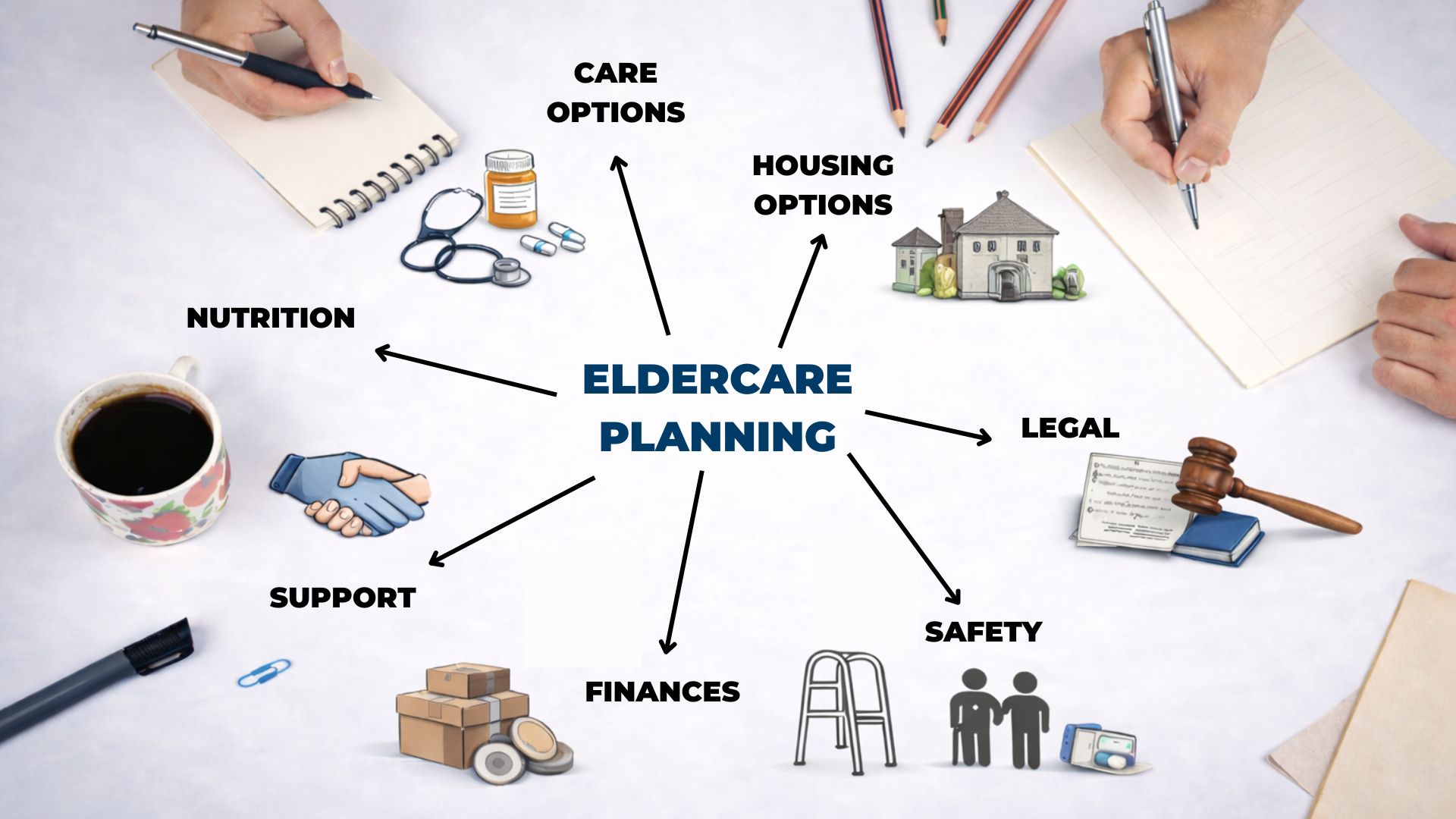
    Eldercare Planning: Bringing the Whole Picture Together

    When families begin exploring options for aging — retirement living, long-term care, home care, and community supports, many start by doing their own research. Online platforms like Elderado play an important and valuable role in this process, giving families access to information, comparisons, and visibility into options that may otherwise feel hard to find.

    For many people, this kind of research is empowering. They want to understand what’s available, take their time, and make informed decisions independently. That approach is not only valid, but it’s also an essential step.

    At the same time, families frequently discover that researching options is just one part of a much larger journey.

    What Often Comes Before — and After — the Research

    What online research can’t always show is how many interconnected pieces surround eldercare decisions, such as:

    • When is the right time to make a move, or not move at all?
    • How current health needs may change in six months or two years
    • How public and private care systems intersect (or don’t)
    • What supports are available beyond housing alone
    • How family dynamics, finances, and future planning affect today’s choices

    This is where eldercare planning complements independent research.

    What Is Eldercare Planning?

    Eldercare planning is a holistic, person-centred process that looks at the full context of an older adult’s life and builds a coordinated plan around it. Rather than focusing on a single decision, it brings together multiple layers, including:

    • Health and care needs (current and anticipated)
    • Housing options and timing across private and public systems
    • Family capacity, roles, and stress points
    • Financial considerations and cost-saving opportunities
    • Legal and future planning touchpoints
    • Quality of life, values, and personal preferences

    The goal is to help ensure that the decisions made through research truly fit the individual and remain sustainable over time.

    Seeing What’s Easy to Miss

    Because Eldercare Planners work across systems every day, they are often able to identify things families may not yet see, such as:

    • Early signs that care needs are changing
    • Housing choices that may not align with future realities
    • Gaps between public services and private options
    • Supports, benefits, or programs that could reduce strain or cost

    They can also help families pace decisions, knowing when to act quickly and when it’s safe to slow down.

    Support Through Complex and Emotional Conversations

    Even the most thorough research doesn’t make difficult conversations easier. Many families struggle with:

    • Talking about safety, memory changes, or care resistance
    • Balancing independence with support
    • Navigating differing opinions among family members

    An Eldercare Planner provides steady, neutral guidance, helping families have productive conversations, reduce conflict, and keep plans moving forward when emotions or uncertainty cause delays.

    Bridging Public and Private Systems

    One of the greatest challenges in eldercare is navigating the silos between public and private sectors. Families often find themselves caught in the space between:

    • What they qualify for publicly
    • What they can access privately
    • What they can realistically afford long-term

    Eldercare Planners help families understand how these systems connect, how to layer services effectively, and how to avoid costly missteps, while maintaining dignity, safety, and choice.

    Never Navigating Alone

    Eldercare Planners regularly coordinate with:

    • Health care providers
    • Care agencies and housing operators
    • Legal, financial, and community professionals

    When additional expertise is needed, families are connected to trusted professionals, so care feels coordinated rather than fragmented.

    The Strength of a National Network

    What makes Eldercare Planners of Canada unique is not just individual expertise, but collective commitment.

    As a national network, members:

    • Collaborate across regions
    • Share best practices and evolving system knowledge
    • Hold one another to high professional standards
    • Work together to raise the quality and consistency of eldercare planning in Canada

    For families, this means greater confidence that the guidance they receive is informed, ethical, and aligned with their best interests.

    Research Plus Personalized Guidance

    Elderado’s online research and Eldercare Planners are strongest when they work together.

    Research helps families understand what exists.
    Eldercare Planners help families understand what makes sense for them, now and in the future.

    For those who want to research independently, Eldercare Planners can step in before or after key decisions to ensure nothing important has been overlooked. For those feeling overwhelmed, planners provide clarity, coordination, and reassurance.

    Together, they help families move forward with confidence, knowing they’re supported every step of the way.

    About the Author

    Amy Friesen is an award-winning entrepreneur, innovator, and best-selling author, redefining how Canadians navigate aging and senior living. As founder of Tea & Toast—named Top Assisted Living Navigation Service in Canada in 2025, and creator of Eldercare Planners of Canada, she brings clarity, confidence, and compassion to families facing complex eldercare decisions. Featured in national media and known for her bold ideas, Amy inspires change through speaking, writing, coaching, and mentoring.

  • Senior Living Certified Real Estate Agents

    Senior Living Certified Real Estate Agents

    When an older adult is considering downsizing into a retirement home or long term care the right real estate agent can make the transition much easier. A knowledgeable agent who understands how long-term care and retirement homes work can help families navigate a stressful and complex process.

    To help families find that kind of support, Elderado created the Senior Living Certified Quiz. Agents who score at least 18 out of 20 earn the Senior Living Certified – Level 1 designation, receive a digital badge, and are included in our directory of trusted real estate professionals.

    Real estate agents can request to the the Senior Living Certified Quiz here: https://tally.so/r/EklDGq

    Senior Living Certified – Level 1 Real Estate Agents

    Riyad Ali

    Brian Cowan

    Jessica Whitehead

    Keisha Telfer

    Daniel Sutherland

    Valeria Perepeliuk

    Bryen Daly

    Lynn Marie Robinson

    Nancie McLeod

    Geeta Rajpal

    Shayna List

    Rai Mohan

    Corina Goss

    Adam Gordon

    Damir Strk