Long-Term Care in Ontario: How Public, Non-Profit, and For-Profit Homes Compare on Staffing and Spending
Families looking for long-term care (LTC) options in Ontario regularly ask us whether ownership matters when it comes to the care their loved ones will receive. A new Statistics Canada report sheds light on this. It analyzes staffing levels and expenses in Canadian LTC homes—including a detailed look at Ontario—before and during the COVID-19 pandemic.
Types of Long-Term Care Ownership in Ontario
First, let’s define the three ownership types of LTC homes, as laid out in the report:
Public LTC Homes: These are owned by municipalities, regional health authorities, or provincial governments. In Ontario, municipal homes fall into this category.
Non-Profit LTC Homes: Operated by charitable, faith-based, or community organizations.
For-Profit LTC Homes: Owned by private companies or corporations, these homes may generate profits for owners or shareholders.
All LTC homes in Ontario—regardless of ownership—receive public funding for nursing and personal care. Residents pay for accommodation costs through co-payments.
Before the pandemic, Ontario LTC residents received:
Public homes: 2.93 hours of direct daily care
Non-profit homes: 2.92 hours
For-profit homes: 2.71 hours
During the pandemic:
Public homes: 3.47 hours
Non-profit homes: 3.04 hours
For-profit homes: 2.94 hours
Nationally, the trend is similar: public homes provided the most direct care, followed by non-profits, then for-profits. On average across Canada, for-profit homes provided 50 fewer minutes of care per resident per day than public homes before the pandemic. The gap began narrowing to 34 fewer minutes during the pandemic.
By Role: Registered Nurses (RNs), Registered Practical Nurses (RPNs), and Personal Support Workers (PSWs)
In Ontario:
Public homes increased RN care by 10.19% during the pandemic.
All homes increased RPN and PSW care, but public homes saw the largest gains.
For-profit homes lagged behind in RN and RPN care time increases .
Why does this matter? Higher RN staffing is linked to fewer hospitalizations, lower mortality, and better overall health outcomes for residents.
How Homes Spend Their Money
Wages and Benefits
In Ontario during the pandemic:
Public homes: 60.86% of expenditures went to wages; 15.16% to benefits.
Non-profits: 62.3% on wages; 8.83% on benefits.
For-profits: 58.18% on wages; 9.66% on benefits .
Subcontracting
For-profit homes spent more on subcontracting staff:
For-profit: 5.6% of expenses on subcontracting
Non-profit: 4.1%
Public: 2.3%
Policy Changes in Ontario
Ontario’s Fixing Long-Term Care Act (2021) set a target of 4 hours of direct care per resident per day by 2025, up from an average of 2.75 hours pre-pandemic. This is a critical step, and data shows that public homes are already leading the way.
What This Means for Ontario Families
Public LTC homes generally provide more hours of care, especially from highly trained staff like RNs.
Non-profit homes tend to fall in the middle, providing more care than for-profits but less than public homes.
For-profit homes provide less direct care on average and spend more on subcontracting.
When evaluating LTC options, ownership type can give families a clue about the level of care their loved one might receive. However, it’s just one piece of the puzzle. At Elderado, we help families navigate these choices to find the best home for yourself or a loved one.
This blog is based on Staffing levels and expenses in Canadian long-term care facilities by ownership status before and during the COVID-19 pandemic, Statistics Canada, July 2025. Read the full report here.
Long‑Term Care Cost Help in Ontario: Guide to the Rate Reduction Program
Updated July 3, 2025
Finding a long‑term care home in Ontario can feel overwhelming—especially when you see the price tag. The basic accommodation rate is now $2,085.37 a month, and preferred rooms cost even more. But if your income is limited, you may not have to pay the full amount.
This guide explains—in plain language—how the Long‑Term Care Rate Reduction Program works and how it can help lower your monthly bill.
Why Long‑Term Care Costs Matter
Ontario sets the daily “co‑payment” you pay for a long‑term care bed. On July 1, 2025, the basic rate increased to $68.56 per day. That’s $25,024.44 a year—and it only covers room and board. Many families worry they can’t afford it.
What Is the Rate Reduction Program?
The Long‑Term Care Rate Reduction Program is a provincial subsidy that lowers the basic accommodation fee for low‑income residents. Here’s the quick version:
Who it helps:
Residents in basic rooms
Couples sharing a two‑bed room that has been re‑designated as basic
Who it doesn’t help:
Regular semi‑private or private rooms (those come with extra premiums)
How it works: The province reviews your net income and family situation each year, then reduces your monthly bill so you only pay what you can afford.
Who Can Qualify?
You likely qualify if:
You're single with no dependants, and your annual net income is $26,812 or less
You're supporting a spouse or child at home, and your income after supporting dependents is $26,812 or less
Income threshold shown for 2025. The exact cut‑off is subject to individual circumstances.
Other rules:
You must already live in the long‑term care home (apply within your first 90 days).
You—or your legal representative—must sign and file the application.
You need to re‑apply every year between July 1 and September 28.
How Much Could You Pay?
The ministry uses this simple formula:
Reduced Monthly Fee = (Your Net Income ÷ 12) – $149 Comfort Allowance – Dependant Deductions
Net income: Line 23600 on your tax Notice of Assessment, minus certain exclusions (like Registered Disability Savings Plan withdrawals).
Comfort allowance: You keep at least $149 per month for personal expenses.
Dependant deductions: Extra money you keep if you support a spouse or child at home.
Example:
Maria earns $24,000 a year and has no dependants.
$24,000 ÷ 12 = $2,000
$2,000 – $149 = $1,851 ← That’s her new monthly fee, saving her $234 every month.
Most residents still pay something, but far less than the full basic rate.
How to Apply
1.Collect benefits first. Make sure you’re already receiving:
Old Age Security (OAS)
Guaranteed Income Supplement (GIS) or Ontario Disability Support Program (ODSP) if under 65
2.Tell the home you’re applying. Staff will give you the latest Rate Reduction Application forms.
3.Gather documents. You’ll need your latest Notice of Assessment and proof of any income changes.
4.Fill out the form. Ask staff for help if you’re unsure.
5.Submit within 90 days of moving in (or between July 1‑Sept 28 to renew).
6.Watch the mail. You’ll get a letter showing your new reduced rate once the ministry processes your application.
Frequently Asked Questions
Do I have to re‑apply every year?
Yes. The program runs July 1 to June 30. If you don’t re‑apply, you’ll be charged the full basic rate until your new application is approved.
Families across Ontario planning for long-term care will see slight increases to accommodation costs in LTC homes starting July 1, 2025. These new rates, released by the Ministry of Long-Term Care, reflect standard inflation adjustments and help cover rising food and accommodation costs.
Whether you're helping a parent transition into care or budgeting for your own future, understanding these new rates—and how they compare to previous years—can help you make informed decisions.
2025 Long-Term Care Co-Payment Rates in Ontario
Here’s a breakdown of the new daily and monthly rates for long-stay residents in LTC homes, starting July 1, 2025:
*The high end of the range is for newer beds. Newer beds are classified as "NEW" or "A" by the Ministry of Long-Term Care, while older beds are classified as "B", "C", "Upgraded D" or "D".
How Much Have LTC Rates Increased?
The 2025 co-payment for basic accommodation increases by $1.61 per day, rising from $66.95 to $68.56—a 2.4% increase. This change mirrors Ontario’s inflation rate and is consistent with historical trends:
Annual LTC rate increases are typically tied to the Consumer Price Index (CPI), capped at 2.5% per year.
Over the past decade, Ontario families have seen modest yearly increases of 1.5–2.5%, depending on inflation.
For example:
In 2023, the basic daily rate rose by $1.55
In 2024, it increased by another $1.60
These regular adjustments help homes manage the rising costs of meals, maintenance, and staffing while ensuring care remains accessible.
Financial Support: What If You Can’t Afford the New Rates?
Ontario offers a Rate Reduction Program for residents who cannot afford the full basic rate. Here’s how it works:
If you’re already receiving a rate reduction, you must reapply for the 2025–2026 cycle.
The current term ends June 30, 2025, and the new rate begins July 1.
Applications are handled through your LTC home, and staff will help with the paperwork.
To be eligible, your income must fall below a certain threshold, and the subsidy only applies to basic accommodation, not semi-private or private rooms.
Many people confuse long-term care homes with retirement homes—but they are very different. Long-term care homes are regulated, publicly subsidized, and designed for people with high medical or physical needs. Prices are consistent across Ontario, but every long-term care home has a waitlist, and features such as the amenities, culture, and rooms will vary from home to home.
Compare LTC homes by location, room type, and availability
See inspection reports and services offered
Contact homes with your questions
Whether you’re planning ahead or responding to a sudden health change, being informed is important.
✅ Key Takeaways
Basic LTC rate increases to $68.56/day ($2,085.37/month) on July 1, 2025
Semi-private and private rooms also see small increases
Rate Reduction Program applications must be renewed by June 30
Year-over-year increases follow inflation, typically up to 2.5%
Compare and plan easily with Elderado.ca
🔍 Looking for Long-Term Care in Ontario?
Elderado is a free tool that helps families find and compare every long-term care home in Ontario. From current waitlists to sample menus and virtual tours, Elderado brings clarity to a complex system. Start your search today.
The Accessible Housing Network (AHN) is a coalition of over 70 nonprofit organizations across Canada, united to make a powerful but simple message: all new houses must be designed with accessibility as the priority. Co-founder Kate Chung emphasizes universal design as the norm and not the exception, which makes houses home for everyone, regardless of age and ability.
Common Accessibility Challenges in Canadian Homes
From steps that prevent wheelchair users from entering a home at all to slim bathroom doors that won't allow walkers to pass through them, common design errors have serious consequences. Immovable countertops in kitchens, inaccessible showers, and the lack of bathrooms on main levels in multi-story homes all point to how current standards fail those who are recovering from surgery, living with mobility impairments, or aging in general.
What Is Universal Design in Home Design?
Universal design is creating spaces that anyone can use without needing to adapt. From creating kitchens that are accessible by standing individuals and wheelchair users, to light switches and countertops within reach for all, universal design removes barriers before they exist. It's intuitive, inclusive, and flexible designed for everyone, not the "average" individual.
Is Universal Design More Expensive?
Contrary to public perception, it's not. The Canada Mortgage and Housing Corporation (CMHC) indicates that accessible design costs almost the same to incorporate into new apartments and little more than 1% added for houses. Upfront accessibility costs are best by saving dollars in the long run by reducing falls, hospital stays, caregiver fatigue, and expensive revisions or long-term care.
Why Don't We See More Universal Design in Ontario?
A blame game between different levels of government is at the heart of the issue. The federal, provincial, and municipal governments point fingers at one another and nothing is accomplished. In spite of national efforts like the Accessible Canada Act and organizations like CMHC, nothing is accomplished unless all levels are prepared to act.
Global Examples of Universal Design in Action
Australia and Norway lead the way. Australia's building code mandates accessible homes for all under the phrase "livable design." In Norway, state-subsidized housing loans are made available only for universally designed homes. Even Toronto is beginning to institute accessibility features in government-subsidized housing, but private construction continues to be behind.
Tips for people looking for homes for the rest of their life
When thinking long-term, it’s important to consider whether a home can adapt with you over time. Features like no-step entries, doorways that allow for mobility aids, and bathrooms that could accommodate future upgrades all make a difference. The accessibility design specifications adopted by the City of Toronto are a helpful tool when making any renovation or real estate decision even if no laws require them yet.
How You Can Make a Difference in Accessible Housing
Change will not happen without public pressure. Contact your town councillors, provincial Parliament members, and Parliament members. Schedule meetings, write letters to ask for them, or get them to visit your apartment complex to observe for themselves the accessibility issues. Most never consider accessibility until they or people close to them are affected by it and, at that point, it is too late. According to Kate Chung, an institution bed is no home. All human beings deserve to live a life of dignity and independence.
To learn more about the Accessible Housing Network and how you can support their advocacy, visit: Accessible Housing Network
Discover how Age-Friendly Consulting (AFC) creates an even safer, more enriching environment for seniors and older adults. Learn about the benefits and future impact of their work.
What Does Age-Friendly Consulting Do?
Age-Friendly Consulting, founded by Debra Sayewich, is dedicated to helping businesses and communities adapt their environments and services to meet the needs of an aging population. Their work ensures accessibility, inclusivity, and that support is provided to all, helping older adults navigate the system.
Their work helps to:
Build relationships with trust and respect
Get older adults the services and supports that are best suited for them
Provide support in one's area or region, either rural or urban
Why start Age-Friendly Consulting?
As an Anishinaabe Indigenous person, Sayewich saw firsthand the various broken promises that were made to First Nations people. Her motivation behind starting Age-Friendly Consulting was to bring people together, achieve a sense of balance, and build relationships for all services provided. There was a deep desire to intertwine all professions for all stages and all ages of life.
Services include:
Home and Health Care
Community Resource (i.e., Friendship Centre, End-Of-Life)
Transportation
How does the AFC community remain supportive and aligned with its core values?
Sayewich emphasizes the importance of interviewing all AFC members. Sometimes, people will look for community partners, services, and resources on the internet at the last minute when they are in desperate need of these supports. Bringing all of these supports and services together and making them accessible helps members greatly.
During the COVID-19 pandemic, many short-lived businesses emerged and disappeared, unlike the consistent support offered by AFC. AFC has a very unique collaborative culture, where members readily assist each other in finding support or referrals for services they may not personally offer, fostering a strong and positive working relationship.
AFC takes pride in its strong, healthy working relationships. The organization's reputation is highlighted through its invitations to speak at different hospitals, showcasing its presence and credibility in the community.
Changing the Narrative Around Aging and Senior Care
Aging is often misunderstood, but it doesn’t have to be. Sayewich shares her insights on the biggest misconceptions surrounding aging and senior care, the personal passion that drives her work, and why she feels optimistic about the future for older adults.
What are the biggest misconceptions about aging and senior care?
Age is just a number — it doesn’t define a person's abilities, dreams, or worth. As such, we have no right to prejudge what someone can or cannot do and where they should be living. Challenging ageist stereotypes is essential to building a more inclusive, respectful society where every older adult is valued for who they are, not limited by assumptions about their age.
While being a harmful stereotype, ageism can be considered a form of elder abuse, stripping older adults of dignity, opportunity, and respect. Instead of seeing aging as a decline, we should embrace the wisdom and experience that comes with it. Through the concept of OAKS (Older Adults Knowledge Sharing), Sayewich encourages us to educate ourselves on what abuse of older adults may look like, as it can be physical, emotional, or verbal.
Why is this cause important?
Aging is a privilege, not guaranteed to everyone, and it's up to us to help create a world where every person is supported with dignity throughout their life. True change begins by listening to all voices, regardless of wealth, status, or circumstance. Whether someone is living in a mansion or facing homelessness, aging support and services should be accessible to all. Compassion and community care must guide how we support people at every stage and age of life. Being able to spend extended quality time with older loved ones creates precious memories for us, further reinforcing the importance of supporting older adults as they age.
What makes you optimistic about the future and quality of life for seniors?
The optimism for the future of senior care lies within the growing spirit of support and inclusion in our communities. Sayewich believes that when we truly listen, we uncover conversations that need to happen and opportunities to make a real difference and do real good. Whether someone is a newcomer, a lifelong resident, or facing unexpected life challenges, access to care and support should never depend on wealth or status. By recognizing the gaps and working together to bridge them, we can help ensure that everyone, at every stage of life, is valued and supported.
Cultural Respect and Innovation: A New Vision for Senior Care
Creating a better future for seniors means more than improving services — it means rethinking how we honor culture, community, and individual dignity. Sayewich shares why innovation in senior care can go hand-in-hand with cultural respect, inclusion, and learning from Indigenous traditions. Drawing inspiration from First Nations traditions, she highlights how a more compassionate and equitable community approach can shape the next generation of senior living.
What area related to aging would you like to see more innovation happening?
Modern innovation in senior care must focus on greater diversity, cultural sensitivity, and true intergenerational inclusion. Sayewich emphasizes the need to meet older adults where they are, not just through social media and modern technology, but through meaningful, personal connections like phone calls and community outreach. Recognizing that many seniors, especially in rural areas, face barriers such as limited transportation and digital access, there is an emphasis placed on asking the right questions, listening deeply, and creating services that are accessible for people in all stages, all ages, and all communities.
What was something First Nations communities had that should be adopted?
There is a deep respect within First Nations communities for their elders, honoring them as the foundation for future generations. In these communities, older adults are recognized for the pathways they have built, and efforts are made to bring services and supports together in their honor. While progress like the development of health centers is a positive step, it is acknowledged that challenges remain, such as the need for water and better basic services. It is important to truly listen to the voices of elders, beyond headlines or social media, to ensure their needs are met with dignity and understanding.
Would you like to see more LTC and retirement homes catering to the identity of First Nations Communities?
It is vital to have long-term care and retirement homes that truly reflect the culture, language, and traditions of First Nations communities. While some communal living spaces for older adults already exist, there is no one-size-fits-all solution for these communities. Every First Nations community is unique, with its own needs, traditions, and preferences. Sayewich highlights that the first step must always be to listen — to ask older adults what they want and to build services that honor their voices, ensuring dignity, respect, and cultural continuity.
Who should consider joining the Age-Friendly Consulting community?
Individuals, organizations, and services that provide support and assistance to aging adults would be a great fit to join the AFC community.
This includes:
Therapy Services
Community Resources
Legal Counsel
Home Modification Services
Downsizing and Estate Movers
How can someone learn more?
Age-Friendly Consulting is listed under the Federal Government website as an Indigenous business. Their information and literature are publicly available, helping them maintain a strong presence.
The senior care industry in Ontario wouldn’t function without the dedication, skill, and compassion of women. Across long-term care and retirement homes, women are the backbone of the sector, making up the majority of personal support workers (PSWs), nurses, and social workers who provide daily care and life-enhancing services to older adults.
Did you know?
96% of personal support workers in Ontario are women.
91% of nurses in the province are women.
87% of social workers—who provide crucial emotional and practical support—are women.
These professionals don’t just show up for work; they show up with empathy, resilience, and a deep commitment to the well-being of seniors.
Beyond Caregiving: Women Driving Innovation in Senior Care
While frontline caregiving is essential, women are also the visionaries behind transformative initiatives in the senior care space. They are leading innovations that improve the quality of life for older adults in Ontario:
🔹 Tina Mavriyannakis, Founder of The Smile Room – A champion for senior oral health, Tina is ensuring thousands of older adults have access to much-needed dental care, preventing pain and serious health complications.
🔹 Mallory McGrath, Founder of Viive Planning – Estate and end-of-life planning can be overwhelming, but Mallory is changing the conversation and approach, making it easier for families to prepare for the future with dignity and clarity.
🔹 Jennifer McCrae, Founder of Soul Transitions – Helping families navigate grief and end-of-life transitions, Jennifer provides support and guidance during some of life’s most difficult moments.
These women are reshaping how we think about aging, caregiving, and the end-of-life journey. Their work ensures that seniors receive the respect, care, and support they deserve.
The Strength of Women in Senior Care
Despite the progress society has made, one truth remains: when it comes to answering the call for strength, compassion, and leadership in senior care, women step up—again and again.
From the PSWs providing hands-on care to the entrepreneurs revolutionizing elder services, women continue to drive meaningful change in Ontario’s long-term care and retirement home sectors.
Celebrating Women in Senior Care
On this International Women’s Day, let’s take a moment to recognize, support, and celebrate the incredible women who are making a difference in the lives of seniors. Their work is not just essential—it’s life-changing.
The Ministry of Long-Term Care in Ontario is planning to test a new system to help people find spots in long-term care (LTC) homes that match their culture, religion, language, or ethnicity, and there is an open call for comment HERE. This project, called the Long-Term Care Homes Cultural Pilot Project, will try to make it easier for people to get into homes where they feel more at home culturally.
Some LTC homes in Ontario focus on serving specific cultural or religious groups. But recently, these homes have seen fewer residents who match the culture they aim to support, and fewer spots are available that meet applicants' cultural needs. This makes it harder for these homes to offer the cultural, religious, and language support their residents need.
The current system puts people on a waiting list for LTC homes based on how urgently they need a spot. In this pilot project, the Ministry wants to test a new way of organizing these waitlists for people in crisis (those in category 1). For the homes selected to participate, people on the crisis waiting list who share the culture or religion that the home primarily serves could be prioritized, even if others on the list are also in crisis.
To make this pilot work, the Ministry would change the rules for ranking applicants. In designated homes, people with an urgent need for care would still be ranked first, but if two or more people have the same level of urgency, the applicant who matches the home’s cultural focus would get priority.
The goal is to see if this new ranking system can help improve access to culturally appropriate long-term care for Ontarians.
CLICK HERE to read the full proposal or to comment. Comments are open until November 26.
Disclaimer: Elderado is not suggesting or encouraging the use of cannabis in any form.
Since the legalization of recreational cannabis in Canada in 2018, its use among seniors has been steadily increasing. Cannabis, once a taboo topic, is now becoming a conversation starter, including in settings like long-term care homes where health, comfort, and quality of life are key concerns. But with this rise in popularity comes questions about the rules and regulations surrounding cannabis use in these environments. Can residents of long-term care homes in Ontario legally use cannabis, and if so, under what conditions?
The short answer is, sort of – the Fixing Long-Term Care Act states:
(2) Nothing in this Regulation prevents a resident from cultivating, acquiring, consuming, administering, possessing, storing or disposing of recreational cannabis in accordance with the licensee’s policies and procedures as required by subsection (1).
One long-term care home told us:
"Residents are able to consume alcohol and cannabis unless the doctor deems that it would not be safe due to a health condition/medication. Residents would either store their alcohol/cannabis locked in their room, or locked in the medication room with the nurse, depending on a capacity assessment that is completed (goes over risk, abilities, etc.). Residents have choice and can consume at their leisure, however there are rules in place for where they can/can’t."
In this blog, we'll explore the key regulations and considerations related to cannabis use in long-term care homes in Ontario, referencing both the Cannabis Control Act and the Fixing Long-Term Care Act. We’ll also look at the increasing usage of cannabis by seniors, supported by recent studies.
The Growing Popularity of Cannabis Among Seniors
Since Canada legalized cannabis in 2018, the stigma around its use has slowly faded, and many people, including seniors, have begun exploring its potential benefits. According to a 2021 study by the Canadian Institute for Health Information (CIHI), the use of cannabis among seniors (aged 65 and older) more than doubled from 2017 to 2019. Many seniors are turning to cannabis as an alternative treatment for conditions like chronic pain, insomnia, and anxiety, with both recreational and medicinal cannabis use rising.
A 2020 study published in the Journal of the American Geriatrics Society found that 15% of Canadian seniors reported using cannabis, with most of them doing so for medical reasons. For long-term care residents, the potential benefits of cannabis include helping to manage pain, reduce the need for opioids, and improve overall well-being.
The Cannabis Act and Long-Term Care Homes
The Cannabis Act, which came into effect in October 2018, legalized the recreational use of cannabis across Canada. It allows adults to possess and share up to 30 grams of dried cannabis or its equivalent in other forms, grow up to four plants per household, and purchase cannabis from licensed retailers. However, the act also gives provinces and territories the authority to implement additional rules and restrictions, particularly when it comes to where cannabis can be consumed.
In Ontario, cannabis use is regulated by a combination of laws, including the Cannabis Control Act, 2017, the Cannabis Licence Act, 2018, and the Smoke-Free Ontario Act, 2017. While adults are generally allowed to use cannabis in private residences, the rules for public consumption are stricter and aligned with those for tobacco. In institutional settings like long-term care homes, the regulations can vary depending on the facility’s policies and whether the use is recreational or medicinal. Exemptions to public consumption rules may apply in certain long-term care or retirement homes under specific conditions.
The Fixing Long-Term Care Act, 2021
The Fixing Long-Term Care Act, 2021 is a key piece of legislation in Ontario that governs long-term care homes. It establishes standards for the safety, care, and rights of residents in these facilities. When it comes to cannabis use, long-term care homes must balance the residents' rights to make personal choices with the need to ensure the safety and well-being of all residents.
There is no blanket prohibition on cannabis use in long-term care homes, but individual homes may have specific policies that residents must follow. These policies are usually designed to ensure that cannabis use does not interfere with the care environment, the safety of residents, or the legal obligations of the home. For instance, some homes may require residents to consume cannabis only in designated areas, and smoking or vaping cannabis indoors is generally prohibited under Ontario’s Smoke-Free Ontario Act.
Medicinal Cannabis in Long-Term Care Homes
For residents who use cannabis for medical reasons, the situation can be more straightforward. Under Canadian law, individuals with a medical authorization can legally access cannabis products to treat various health conditions. Long-term care homes in Ontario are required to accommodate residents' medical needs, including those who have been prescribed cannabis by a healthcare professional.
However, the use of medical cannabis in long-term care homes may come with additional regulations. Homes must ensure that cannabis products are stored securely, administered safely, and do not pose a risk to other residents. In some cases, residents may be required to provide a medical prescription, and the home’s staff may be involved in managing the resident's cannabis use, similar to how they handle other medications.
Key Considerations for Residents and Families
If you or a loved one is considering using cannabis while living in a long-term care home in Ontario, here are a few key points to keep in mind:
Check the Home's Policies: Each long-term care home may have its own rules about cannabis use. Be sure to ask about these policies before bringing cannabis into the home.
Consider Medical Authorization: If you plan to use cannabis for medical purposes, having a prescription from a healthcare provider can simplify the process. It also ensures that the long-term care home is aware of your medical needs and can provide appropriate support.
Respect Other Residents: Remember that cannabis use, especially smoking or vaping, can affect others. Be mindful of the designated areas for cannabis use, and always follow the home’s guidelines.
Safety First: Long-term care homes have a responsibility to maintain a safe environment for all residents. This means that cannabis products, like any other medications, must be stored securely to prevent accidental ingestion by others.
Conclusion
The Cannabis Act provides the legal framework for cannabis use across Canada, while the Fixing Long-Term Care Act governs how long-term care homes manage cannabis use among residents. If you or a loved one is living in a long-term care home and considering cannabis, it’s important to understand the home’s policies and ensure that your use complies with all laws, rules, and guidelines.
Cannabis use among seniors has been on the rise since its legalization in 2018, with many finding it beneficial for managing chronic pain and other health conditions. While cannabis is generally legal in Ontario, the use of cannabis in long-term care homes is subject to specific regulations that balance individual rights with the safety and well-being of all residents.
Wellesley Central Place is hosting a Pride Party, and you're invited!
Who? You are invited.
What? 2SLGBTQI+ Rainbow Seniors at Pride. It's a free events highlighting local queer performances with food, ice cream, music, & Special Guest Sofonda!
When? Saturday, June 15, 2024 from 1:00PM–3:00PM.
Where? The Rekai Centre at Wellesley Central Place, 160 Wellesley Street East, Toronto. (Google Maps)
Why? For a celebrations of 2SLGBTQI+ Rainbow Seniors at Pride.
Home to the first 2SLGBTQI+ Rainbow Wing in Long-Term Care in North America
The Rainbow Wing at Wellesley Central Place became the first Long-Term Care Home in North America to offer a wing designated to members of the 2SLGBTQI community in 2022. To facilitate this change staff were provided cultural education about providing care for the 2SLGBTQI+ community. Additional support and programs catering to the inclusive needs of our residents continue to be offered to staff. The physical changes to the Rainbow Wing have already begun with reflective artwork. The Rainbow Wing helps Wellesley Central Place to provide residents as well as the general community with the assurance that they offer an inclusive environment that respect and values the needs of the 2SLGBTQI+ community.
The Rekai Centres
The Rekai Centres, a non-profit, charitable corporation owns and operates two Long-Term Care Homes in downtown Toronto. The Rekai Centres strive to enrich the lives of their residents by transforming its long-term care model, ensuring that they remain part of their downtown community.
Are Resident Support Personnel going to replace PSWs in long-term care?
Resident Support Personnel
Resident Support Personnel, or RSPs, provide some personal support services to low-risk residents (for example, helping brush a resident's hair or teeth). RSPs have acted as a stopgap solution to help support largely understaffed healthcare teams in long-term care. The Ministry is currently seeking feedback to amend the Fixing Long-Term Care Act, 2021 to give RSPs a more formalized role.
The Ministry is working to stabilize the role of resident support personnel beyond July 1, 2025. To achieve this, they consulted the Regulatory Registry from September 29, 2023, to November 20, 2023. The consultation focused on whether these personnel should be allowed to permanently provide personal support services to low-risk residents or if their role should be limited after July 1, 2025.
The feedback from the consultation generally supported maintaining the role of resident support personnel in long-term care as a supplement to personal support workers. Key points from the feedback include:
Resident support personnel provide timely care and help reduce the workload of personal support workers and nurses, allowing them to focus on specialized tasks.
This role offers a pathway for individuals to enter and explore careers in the long-term care sector.
Concerns were raised about whether resident support personnel have sufficient training to provide direct care without supervision.
There is a call for the Ministry to provide additional guidance on the role of resident support personnel.
Resident Support Personnel Plan
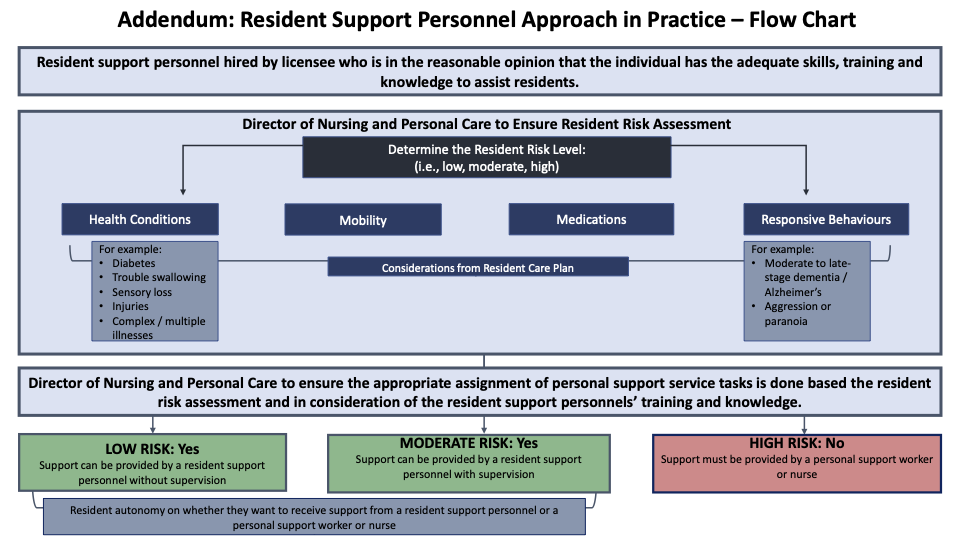
The Ministry is planning to change a rule so that long-term care homes can keep using resident support personnel after July 1, 2025. Here's what they are proposing:
Long-term care homes can hire people to work as resident support personnel, even if they don't have personal support worker education, as long as they have the right skills and the Director of Nursing agrees.
The Director of Nursing will make sure that the right staff member is assigned to each resident, based on their care plan and needs.
Resident support personnel can help low-risk residents with personal care, but they might be supervised by a nurse or personal support worker, depending on the resident's needs.
Resident support personnel cannot provide personal care to high-risk residents.
Care plans must always be based on what residents need and prefer, including their choice of caregiver (like a nurse or personal support worker).
The ministry will give guidelines to homes on how to safely use resident support personnel, including what tasks they can and cannot do.
The ministry also supports resident support personnel in becoming personal support workers through the Learn & Earn Accelerated Program, and they will look for more ways to help them advance their skills.
What do you think of the plan to formalize the role of RSPs in long-term care? Is it a good idea to improve staffing levels, or a slippery slope that could leave us with even fewer healthcare professionals in long-term care homes?
Want your voice heard? Make sure you respond to the public call for comment that's open until June 15, 2024.