Author: Elderado

  • How to file a complaint about long-term care in Ontario?

    You need to file a complaint about something in a long-term care home, how do you do it?

    How do I file a complaint about long-term care?

    1. File the complaint with the long-term care home.
    2. Contact the Long-Term Care Family Support and Action Line.
    3. Escalate your complaint to the Patient Ombudsman.

    1. File the complaint with the long-term care home

    The first step is filling the complaint with the home. Every long-term care home is required to post the process to file a complaint in a place where it is easy for residents and the public to see. If you can't find the process, speak to office staff at the home. If your complaint is in regard to harm or risk of harm to a resident, the home must investigate the complaint right away. They must also immediately send the complaint to the Ministry of Long-Term Care.

    For all complaints, a member of staff must let you know that the home has received your complaint within 10 business days.

    If the home finds your complaint is valid, they must call or write to let you know:

    • what they are doing to resolve your complaint now
    • what they plan to do to resolve your complaint in the future
    • when you can expect the complaint to be resolved

    If the home believes there is no cause for complaint, they must explain why.

    2. Contact the Ministry of Long-Term care with your complaint

    If you are not happy with the home’s response to your complaint, the next step is to contact the Ministry of Long-Term Care. For the quickest response, call the Long-Term Care Family Support and Action Line at: 1-866-434-0144. The Long-Term Care Family Support and Action Line is available 7-days a week from 8:30 a.m. – 7:00 p.m.

    If your concern is not time sensitive, you can contact the Ministry of Long-Term Care by email, at mltc.correspondence@ontario.ca, or by mail, at:

    Director
    Long-Term Care Inspections Branch
    Long-Term Care Operations Division
    Ministry of Long-Term Care
    438 University Avenue, 8th floor
    Toronto, ON M7A 1N3

    3. Escalate to the Patient Ombudsman

    If you weren't satisfied after speaking to the home, and the Long-Term Care Family Support and Action Line didn’t resolve the issue, you can escalate it to the Patient Ombudsman. You submit your complaint online HERE or call 1-888-321-0339. The Patient Ombudsman acts as a neutral body of last resort for complaints about the healthcare system in Ontario.

    Find more information about filing a complaint about something happening in a long-term care home in Ontario on Ontario.ca.

  • Housing prices need to remain high for retirees, nurses get a raise, and the Ontario NDP calls on the provincial government to protect retirement home residents

    Trudeau says housing needs to retain its value to protect people's retirement, Long-term care nurses get a raise, the NDP calls for an amendment to stop retirement home evictions. It's Friday May 31, 2024, this is the week in elder care news.

    Trudeau says housing needs to retain value for peoples' retirement

    Prime Minister Trudeau commented on the Globe and Mails City Space Podcast, “Housing needs to retain its value…It’s a huge part of people’s potential for retirement and future nest egg.” Many Canadians view their homes as their single largest asset and as a way to support their retirement, but this makes it more challenging for renters and Canadians looking to purchase their first home.

    You can listen to the podcast HERE.
    You can read the full story HERE.

    Ontario long-term care nurses get a raise

    Nurses in Ontario long-term care homes are getting a much deserved raise! A recent arbitration decision grants members of the Ontario Nurses’ Association a pay raise of approximately 11.5% over two years. The top rate for nurses will increase $5.82 to $54.60 over 2 years.

    Learn more HERE.

    NDP call for amendments to the Residential Tenancies Act to prevent the eviction of Ontario retirement home residents

    The Ontario NDP are calling for changes to amend the Residential Tenancies Act to prevent the eviction of Ontario retirement home residents. The demand comes in the wake of the eviction of more than 200 residents of Heritage Glen Retirement Residence in Mississauga. Chartwell says it has helped more than 170 Heritage Glen residents find alternative accommodations as part of an assistance package, but some residents and their families say the eviction has turned their life upside down.

    Find the full story HERE.

  • A new approach to caring for seniors with dementia, Community Paramedicine, and a new class of PSWs

    A new approach to caring for seniors with dementia, Community Paramedicine helping seniors stay out of the hospital, and a new class of PSW graduates. It's May 24, 2024, this is the week in elder care news.

    A new approach to long-term care for seniors with dementia

    A new long-term care home has opened in Châteauguay, Quebec, that is using a 'small household' model to care for residents. Each of the 10 small households have 12 residents that share a large communal space and kitchen, which makes it welcoming for family and friends to visit, and even cook a meal together. Families say it feels welcoming, and they notice their loved ones feel cared for – not pushed aside. 46 long-term care homes like this have been planned for Quebec.

    Find the full story HERE.

    Community Paramedicine for Long-Term Care program is helping keep seniors out of the hospital

    Sudbury’s community services committee says the Community Paramedicine for Long-Term Care program has reduced emergency department visits by 24%. Last year Community Paramedicine attended to 975 calls, and of those calls there were 700 instances where residents were able to avoid going to the hospital. The program is helping keep seniors out of the hospital who don't need to be there, and saving the healthcare system money.

    HERE is a link to the full story.

    165 new PSWs graduate from Fanshawe College

    Fanshawe College said it graduated 165 students in the winter term. Many of the new PSWs will be working in retirement homes and long-term care, and we want to take a moment to celebrate them, and wish them a long and fulfilling career.

    Read more HERE.

  • GERIMEDRISK Expands, a Peterborough LTC home forced to halt admissions, and a special perfomance at Leacock Lodge

    GERIMEDRISK expands across Ontario, a Peterborough long-term care home is forced to halt admissions, and Leacock Lodge residents got a special performance. It's Friday May 17, 2024 this is the week in Elder Care News.

    GERIMEDRISK expands across Ontario

    GERIMEDRISK received $4.1 million in Provincial funding to expand from Kitchener to all of Ontario. GERIMEDRISK connects health-care professionals with geriatric specialists to work collaboratively to address the needs of patients. GERIMEDRISK also helps prevent overlap of medication that could give an adverse reaction and send seniors to hospital.

    Find the full story HERE.

    St. Joseph’s at Fleming forced to suspend admissions

    New resident admissions have been suspended at Peterborough’s St. Joseph’s at Fleming long-term care. Brad Robinson, director of Ontario's long-term care inspections branch, issued the suspension on new resident admissions based on his belief there is a risk of harm to the health and well-being of the home’s residents, or anyone who might be admitted as a resident.

    Find the full story HERE.
    Find the 118-page inspection report HERE.

    Leacock Retirement Lodge get a special performance

    Leacock Retirement Lodge was rocking as Rick Stephenson and the Orillia Concert Band performed hits made famous by Frank Sinatra. The band and Stephenson presented back-to-back performances at the St. Paul's Centre in Orillia over the weekend, but recognized some residents aren't able to travel to concert venues, so they brought the show to them! "The smiles on the residents' faces as the band and Rick performed made playing the third day in a row worth every second," said a band official.

    Find the full story HERE.

  • Ontario Caregiver Support Benefit – $400/month for caregivers proposed by MPP Wayne Gates

    Could you use an extra $400/month as a caregiver?

    Wayne Gates, MPP for Niagara Falls, and the official Opposition critic for long-term care, introduced legislation for an Ontario Caregiver Support Benefit. The Caregiver Support Benefit would provide a $400/month caregiver allowance to help offset some of the financial challenges of caregiving for a loved one. Caregivers are often spending 10-20 hours a week or more providing care, and 77% of caregivers are having to dip into their savings. According to Gates the Caregiver Support Benefit can save Ontario $480-million on long-term care.

    Ontario Caregiver Support Benefit supporters

    The Caregiver Support Benefit is supported by a number of organizations including the Ontario Caregivers Coalition, the Young Caregivers Association, the Alzheimers Society, the Canadian Centre for Caregiving Excellence, the Canadian Cancer Society, MS Canada, and Community Living Ontario. It's also supported by Liberal MPP John Fraser & Green Party Leader Mike Schreiner.

    If you support the motion for an Ontario Caregiver Support Benefit, Wayne Gates is asking you to write a letter of support to your MPP, which can be done HERE.

    Conservative Response

    Conservative MPP Nolan Quinn provided a rebuttal to the Caregiver Support Benefit. Although Quinn agreed the status quo for home care is not working, Quinn promoted investments in the current budget, including $2-billion over the next 3 years for Home and Community Care.

    What do you think?

    So what do you think? Is the Ontario Caregiver Support Benefit a good step to supporting caregivers, or would you rather see those resources go towards home and community care?

  • 2 new long-term care homes, an $8,400 hospital bill, and over billing at a retirement home – This week in Elder Care News

    It's Friday May 10, 2024, this is the week in elder care news.

    Temiskaming Lodge and Extendicare Countryside long-term care homes open in Northern Ontario

    Temiskaming Lodge and Extendicare Countryside both celebrated their grand openings this week, bringing a combined 384 beds to Northern Ontario.

    Temiskaming Lodge serves culturally diverse seniors including Francophone and Indigenous residents. The home has access to translators, bilingual staff members, and partnerships with local cultural centres to deliver culturally-specific themed meals and programming.

    Extendicare Countryside’s eight resident home areas consist of 20 private rooms and six standard rooms, for a total of 32 residents each. Resident care offerings include a designated Memory Care Unit, delivering high-quality, person-centered care for residents with dementia by creating spaces that provide comfort and warmth.

    Both of these openings are part of Ontario's plan to build 58,000 new and upgraded beds across the province.

    Temiskaming Lodge Press Release.

    Extendicare Countryside Press Release.

    Family says $8,400 fine because of Bill 7 will not be paid

    Michele Campeau says the $8,400 bill her mom, Ruth Poupard, has received related to Bill-7 from Hôtel-Dieu Grace is a "scare tactic" that she's not falling for. Ruth continues to wait in the hospital for a bed at one of the five long-term-care homes the family wants. Hôtel-Dieu Grace Healthcare CEO Bill Marra said Bill 7 is important legislation and necessary to free up essential resources.

    You can find the full story HERE.

    Retirement home resident overbilled thousands of dollars

    Chantal Monk discovered she was being charged thousands of dollars by Chartwell Rockcliffe Retirement Residence for services being provided through the public health system. The money has since been refunded and the home has apologized for what it characterized as a clerical error. The Retirement Homes Regulatory Authority determined the home didn't intentionally overbill Chantal.

    From the article:

    Wayne Hillier, deputy registrar of the province’s Retirement Homes Regulatory Authority (RHRA), in his ruling blamed poor communications and lack of consistent documentation by staff, which led to a belief by the family of a resident that the home had intentionally overcharged them.

    You can read more about this story HERE.

  • A summary of Scenarios for Seniors’ Care: Future Challenges, Current Gaps and Strategies to Address Them – C.D. Howe Commentary no. 656

    In April 2024 the C.D. Howe Institute published a 32-page Commentary – Scenarios for Seniors’ Care: Future Challenges, Current Gaps and Strategies to Address Them. You can find the full commentary HERE. In this blog we will summarize some of the key points.

    Just the highlights

    • $1 of every $4 of provincial healthcare spending goes to caring for people over 75 years-old
    • A 13% reduction in ALC (Alternate Level of Care) days would be sufficient to prevent hospital bed shortages
    • About 30% of new residents moving into long-term care could be delayed or prevented from having to move with expanded home & community care
    • About half of seniors currently living in retirement homes have needs that would qualify them for public home & community care
    • It costs tax payers less if seniors receive advanced care services at home, or in retirement homes, than in long-term care or hospitals
    • Ontario should look to Quebec, where there are more senior care spaces, lower vacancy, lower rent, and they provide more support to senior households through tax credits

    Scenarios for Seniors' Care

    Canada’s healthcare system is poised to face significant challenges due to the country’s rapidly aging population. The Commentary by the C.D. Howe Institute, Scenarios for Seniors’ Care: Future Challenges, Current Gaps and Strategies to Address Them by Rosalie Wyonch examines these challenges, explores existing gaps, and proposes strategies to meet the needs of the growing senior population.

    Key issues include a surge in demand for seniors’ care due to the aging baby boomer population, coupled with constrained fiscal resources and insufficient capacity in retirement and long-term care (LTC) homes.

    Challenges with Alternate Level of Care (ALC) Patients

    ALC patients are individuals occupying hospital beds even though their care needs could be met in alternative settings, such as LTC homes or through home care. ALC patients represent a significant challenge to Canada’s healthcare system, occupying between 12.7% and 27.5% of acute-care beds across provinces and accounting for 15.5% of all acute-care bed-days.

    High Costs and Inefficiencies

    • The cost of caring for ALC patients in hospitals ranges from $730 to $1,200 per day.
    • In comparison, LTC costs taxpayers about $225 to $253 per day.
    • Hospitals are ill-suited to handle the long-term care needs of seniors and provide suboptimal environments, often contributing to health declines.

    Systemic Barriers to Discharge

    • A lack of available LTC beds and inadequate home and community care services prolongs hospital stays for ALC patients.
    • Physician incentives and risk aversion can favor longer hospital stays, as clinicians prefer to avoid complications related to insufficient post-discharge care.

    Opportunities to Improve ALC Patient Care

    Invest in Home and Community Care

    • Expanding home care services and increasing subsidies can prevent unnecessary hospital admissions and expedite discharges.
    • Support services can help seniors stay in their homes longer.

    Increase LTC and Retirement Home Capacity

    • Building more LTC spaces and expanding public and private retirement homes can relieve pressure on hospitals.
    • Enhanced tax credits or subsidies can improve access.

    Enhance Informal Caregiver Support

    • Financial assistance and respite services can reduce caregiver burnout and prevent unnecessary hospitalizations.
    • Tax credits and training programs for caregivers can help.

    image

    Home and Community Care: Gaps and Recommendations

    Canada's investment in home and community care is lower than that of other OECD countries, contributing to gaps in service and unmet needs.

    (OCED is Organisation for Economic Co-operation and Development, and includes the United Kingdom, Germany, France, Belgium, Netherlands, Sweden, Australia, South Korea, USA, and more)

    Unmet Needs

    • About 6.1% of Canadian households receive formal home care services, while 2.8% have unmet home care needs.
    • Unmet needs are highest in British Columbia and Ontario (3.1%).

    Funding Sources and Costs

    • Government sources cover 52.2% of home care services, while 27% are paid out-of-pocket.
    • Nursing care services are more likely to be government-funded than personal support services.

    Regional Variations in Care

    Ontario

    • Public home care services are delivered based on assessments by health professionals.
    • Third-party agencies handle service delivery.

    Quebec

    • Seniors can access discounted home help through the Financial Assistance Program for Domestic Help Services.
    • Rent in retirement homes can be partially eligible for tax credits.

    British Columbia

    • Home care services are subsidized based on eligibility and income level.
    • Personal care and household tasks are included in home support services.

    Alberta

    • Home care is narrowly focused on medical support, offering limited assistance for household tasks.

    Strategic Recommendations for Home and Community Care

    Invest in Public and Private Services

    • Increase investment in public home care services while enabling private sector expansion.
    • Vouchers, tax credits, and subsidies can help make private services accessible.

    Reduce Informal Caregiver Burden

    • Provide respite services and financial assistance to informal caregivers.
    • Foster innovative technology to support seniors and caregivers.

    Tailor Solutions by Region

    • Replicate successful provincial models, such as Quebec's tax credits, to improve accessibility in other provinces.

    image

    Tax Credits for Seniors’ Care

    The report emphasizes that tax credits can help make senior care more accessible and affordable. However, Ontario lags behind Quebec in providing comprehensive tax credits.

    Quebec's Model

    Home Support Services Tax Credit

    • People over 70 can claim up to 38% of eligible expenses (up to $7,020).
    • Eligible expenses include personal care, housekeeping, meal preparation, and nursing.
    • Rent in retirement homes is partially eligible if it includes supportive services.

    Independent Living Tax Credit

    • Seniors can claim 20% of expenses for home modifications to improve accessibility.

    Respite Services Credit

    • Caregivers can claim 30% of expenses for respite services.

    Ontario's Model

    Ontario Seniors Care at Home Tax Credit

    • Seniors over 70 can claim 25% of eligible expenses up to $1,500.
      • Eligible expenses include personal support, assistive devices, and medical equipment.

    Federal Home Accessibility Tax Credit

    • Seniors can claim up to $10,000 for accessibility modifications.

    Recommendations for Ontario's Tax Credits

    1. Adopt Quebec’s Refundable Tax Credit Model

    • Include rent deduction in retirement homes for services like housekeeping and personal care.
    • Raise the reimbursement rate to provide comprehensive support.

    2. Expand Eligible Services

    • Include more services like personal care, nursing, meal preparation, and housekeeping.

    3. Increase Overall Support

    • Raise the value of tax credits to reflect Quebec's support levels.
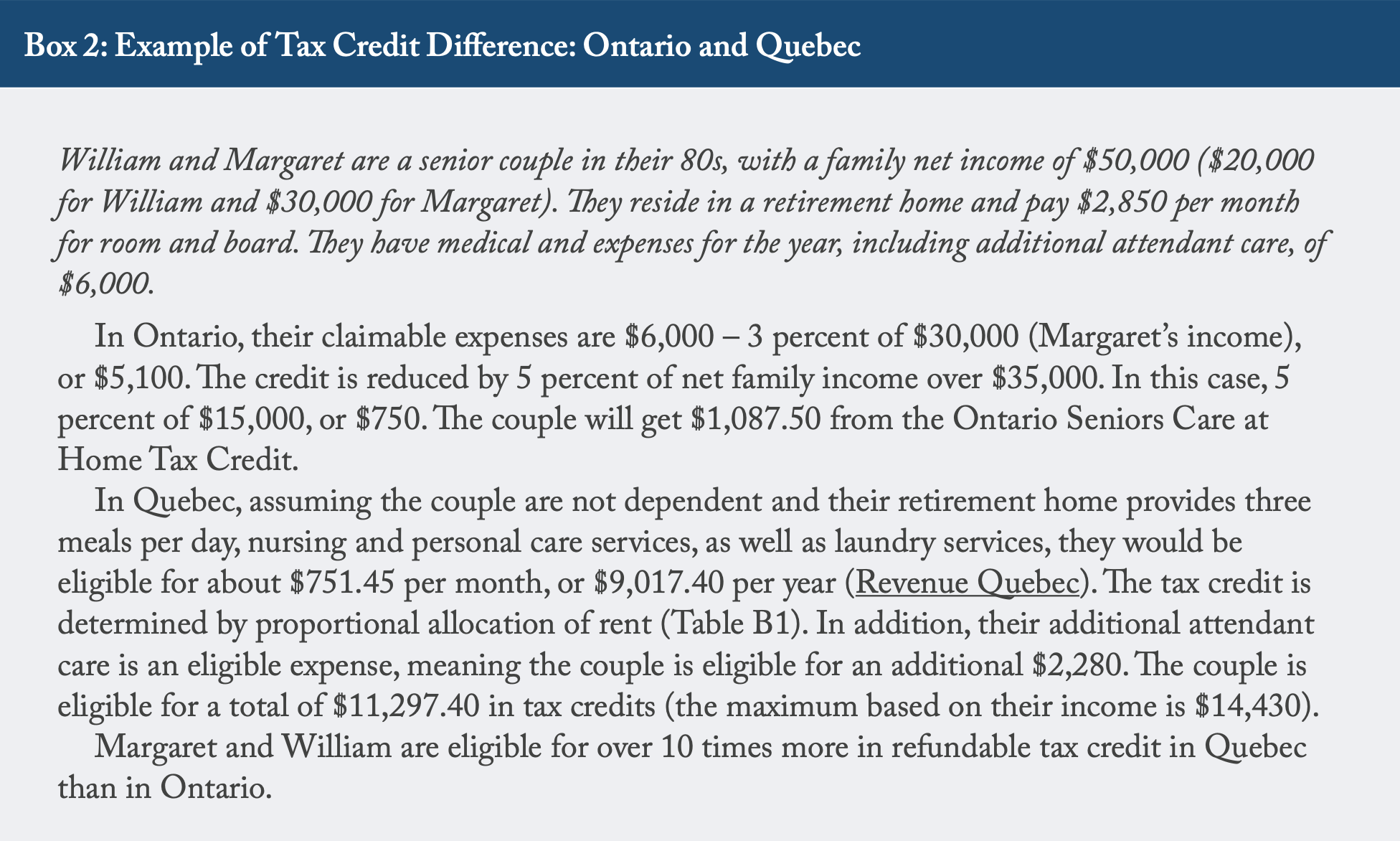
    image
    This is an example from the C.D. Howe Commentary that highlights the difference in tax credits available for Quebec seniors and Ontario seniors.

    Key Statistics on Senior Households and Spending Patterns

    Understanding the economic challenges faced by seniors is crucial to shaping effective policies.

    Household Composition and Spending

    • 13.5% of Canadian households include a senior over the age of 75.
    • 42% of senior households consist of a single person, and 35% are couples.
    • Average household spending is $14,440 on housing and $3,260 on healthcare.

    Affordability Challenges

    • Below-median income senior households spend 46% of their expenditures on shelter and food.

    Housing Adequacy and Core Need

    • Senior households have higher rates of inadequate, unsuitable, or unaffordable housing.
    • In Ontario, 52.3% of senior renters face housing challenges, and 23.9% live in core need housing.

    Conclusion

    The report Scenarios for Seniors’ Care: Future Challenges, Current Gaps and Strategies to Address Them provides a comprehensive overview of the challenges and opportunities in senior care. Addressing these challenges will require strategic investments in home and community care, expanding long-term care and retirement home capacity, and leveraging tax credits to make senior care more accessible. By taking a proactive approach, Canada can better meet the needs of its growing senior population while ensuring fiscal sustainability and a high quality of life for all seniors.
  • Strides for Sick Kids, an innovative idea to open up hospital beds, and a report on caregivers in Canada

    It's May 3, 2024, this is the week in elder care news.

    Seasons Cambridge resident Joan Tomlinson kicks off Strides for Sick Kids

    Joan Thomlinson is aiming to walk 98 laps around the outdoor walking track at Seasons Cambridge while raising money for Sick Kids. Joan calls it 'Strides for Sick Kids'. Last year Joan walked 97 laps and raised $1600. Joan turned 98 this year, and she is aiming to raise $2098 by walking 98 laps. Good luck Joan!

    Read more about Strides for Sick Kids HERE.

    HERE is a link to Joan's Strides for Sick Kids fundraising page.

    Muskoka Algonquin Healthcare proposed a Hospital Reactivation unit to free up hospital beds

    Muskoka Algonquin Healthcare has proposed a Hospital Reactivation Unit to free up hospital beds, while also improving quality of care for ALC patients. An ALC patient could be someone in the hospital waiting for long-term care. ALC patients take up 30-50% of Muskoka Algonquin Healthcare acute care beds. Key elements of the Reactivation Unit include a dining room for communal meals, access to a gym or rehabilitation staff for physical therapy, and activity spaces like TV lounges for recreation.

    Learn more about Muskoka Algonquin Healthcare's plan HERE.

    The Canadian Centre for Caregiving Excellence calls for caregiver compensation, respite, home care, and improved workplace policies

    The Canadian Centre for Caregiving Excellence released a report on the results of their survey of 3,100 caregivers. (Click HERE to read the full report) Respondents provided an average 5-hours of care per day. 50% of caregivers experienced financial stress in the past year, and one quarter reported poor mental health. The Canadian Centre for Caregiving Excellence says the report highlights the need for compensation for caregivers, respite so they can take a break, easily accessible home care, and workplace policies to support people juggling work and care.

    Read the full story HERE.

  • Canadian Dental Care Plan (CDCP) for Seniors – who, what, when, where, and how?

    The Canadian Dental Care Plan rolled out today, providing 1.7-million seniors in Canada with dental insurance. What is it, who is eligible, and how do I join?

    What is the Canadian Dental Care Plan?

    The Canadian Dental Care Plan, or CDCP, is a federal initiative to extend dental insurance to Canadians who don't have private insurance. It covers most dental care such as cleanings, x-rays, fillings, root canals, and dentures. Complex dental services, like crowns and partial dentures, require federal pre-authorization, which will be available in November.

    CDCP is free for eligible Canadians, but like private dental insurance, it doesn't necessarily mean a visit to the dentist is free. Depending on your income there may be a co-pay. Also, the dentist may charge rates higher than the CDCP fee, which will come out of your pocket.

    Who is eligible for the Candian Dental Care Plan?

    To be eligible you need to meet all the following criteria:

    • Don't have access to dental insurance
    • Have an adjusted family net income of less than $90,000
    • A Canadian resident for tax purposes
    • Filed taxes for 2023

    As of today, only seniors 65+ are eligible for CDCP. In June this will extend to people with disabilities and kids under 18, and in 2025 all Canadians will be able to sign up.

    Coverage

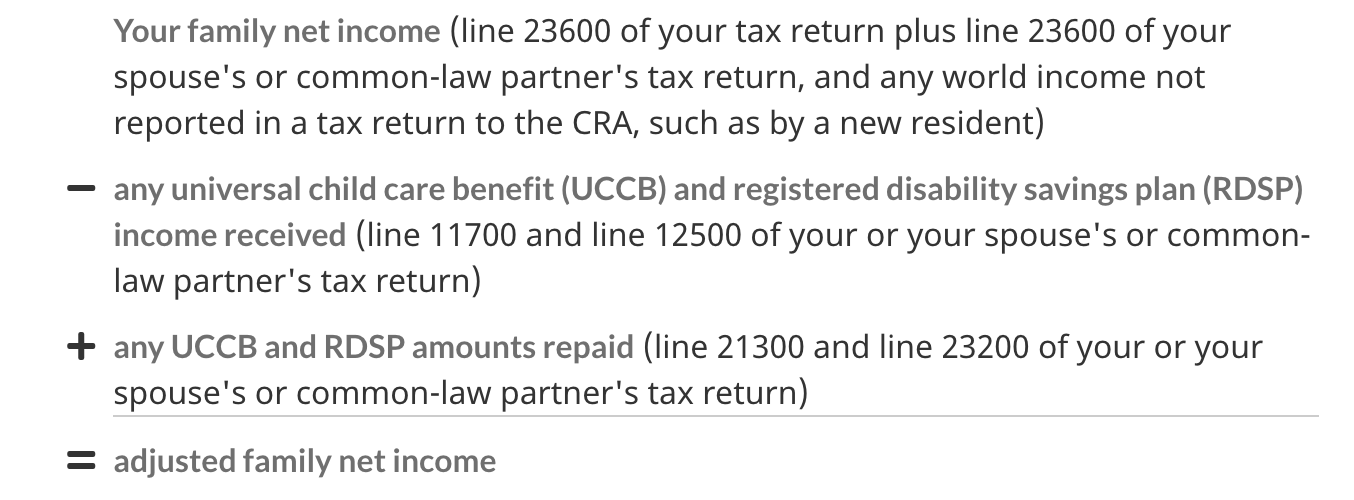
    Coverage is based on something called adjusted family net income. Adjusted family net income is:

    Your family net income

    minus Any universal child care benefit and registered disability savings plan

    plus Any universal child care benefit and registered disability savings plan amounts repaid

    From Canada.com:
    image

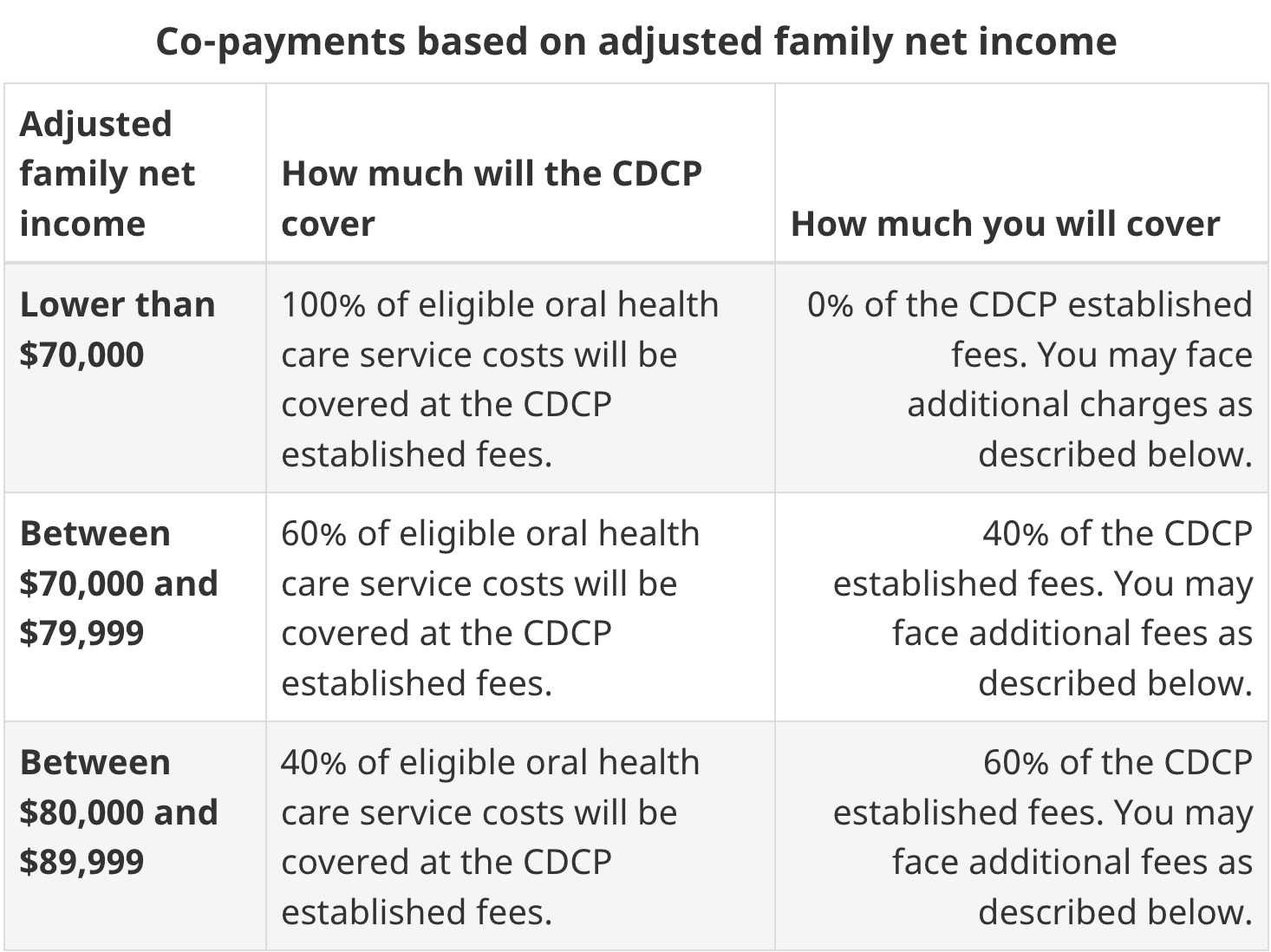
    If your adjusted family next income is:

    • less than $70,000 you get 100% of eligible coverage
    • $70,000 or more but less than $80,000 you get 60% of eligible coverage
    • $80,000 or more but less than $90,000 you get 40% of eligible coverage.

    image

    Just because you qualify for 100% of CDCP coverage doesn't necessarily mean a visit to the dentist is free. Oral health care providers may charge more than the CDCP fee. In that case you will be responsible to pay the difference out of pocket.

    How do I join the Canadian Dental Care Plan?

    To get started you need to apply. Once accepted, you can make an appointment with a dentist, independent hygienist, or denturist. You'll need to check the Provider Search to find an oral health care provider that accepts CDCP. Only about 16% of oral health care providers currently accept CDCP, so there's a chance you will need to find a new dentist. And as a reminder, make sure you ask your oral health provider about any costs that won’t be covered by the plan.

  • This week in elder care news – April 26, 2024

    Stressful wait times for long-term care, the provinces plan to fix it, and a new mobile dental care program. It's April 26, 2024, this is the week in elder care news.

    Long wait times for long-term care making it difficult on families and seniors

    Stories of excessive wait times for long-term care that can jeopardize the health of seniors, and put significant stress on families continue to be reported. Monica Sarabura shared the story of her 93 year-old mother, Theresa, waiting for long-term care. It's not just long wait times, but conflicting information about applying for care, and care options that have been frustrating for Monica and her family. So often the responsibility falls on family caregivers to be the primary source of care while waiting for a bed in long-term care for weeks, months or even years.

    Find the full story on The Hamilton Spectator.

    Ministry of long-term care fast-tracks construction of new homes

    The Ministry of long-term care is trying to open up more beds to ease long wait times, and free up space in our hospitals. Stan Cho, the Minister of Long-Term Care, announced an additional $155-million in funding to fast track the construction of long-term care homes. Eligible projects will receive an additional construction subsidy of up to $35 per bed, per day for 25 years.

    Learn more at insauga.com.

    Toronto Public Health offers mobile dental care to 2,600 residents

    Toronto Public Health delivers smiles with free mobile dental care to long-term care residents. Mayor Olivia Chow announced the mobile dental care program for the 2,600 residents of the 10 long-term care homes operated by the City of Toronto. We love seeing innovative solutions that help provide care to our seniors.

    Read more HERE.