They show up during some of life’s toughest moments—offering support, guidance, and sometimes just a reassuring presence when things feel impossible. And yet, they rarely get the appreciation they deserve.
Well, we’re here to change that—one handwritten letter and one Tim Hortons gift card at a time!
We’re sending 100 handwritten letters, each with a Tim Hortons gift card, to 100 amazing social workers. And the best part? YOU get to decide who gets them!
How It Works (Super Easy, We Promise!)
If you know a social worker who deserves a little surprise in their mailbox, here’s what to do:
Fill out the form with the name of a social worker you want to nominate.
Don’t know their name? No stress—just tell us where they work, and we’ll do our best detective work to find them.
The first 100 names submitted will get a handwritten letter and a Tim Hortons gift card. Boom. Instant day-maker!
Why Are We Doing This? (Because Social Workers Are Awesome!)
Let’s be real—social workers do some of the hardest, most heartwarming, and most emotionally intense jobs out there. They help people through life’s messiest moments, and they do it all with way too little recognition (and probably way too much caffeine ☕).
A simple letter and a cup of coffee won’t change the world, but it might just brighten someone’s day. And honestly, if there’s anyone who deserves a little surprise appreciation, it’s a social worker.
The Magic of a Little ‘Thank You’
Did you know that feeling appreciated makes people happier, less stressed, and more motivated? True story. And in a field like social work—where burnout is way too common—a little unexpected kindness can go a LONG way.
That’s why we’re inviting YOU to be part of this mission. Let’s make sure 100 social workers feel the love!
Be a Part of This Feel-Good Movement! 🚀
We won’t stop until 100 social workers have received a well-deserved thank-you. But we need your help to make it happen!
⏳ Deadline: Until we reach 100 names or March 9th, 11:59 PM 📢 Share this post! Send to a friend, a coworker, or someone who knows a social worker who deserves this surprise.
A small act of kindness can go a long way—so let’s do this! 💌☕
On January 17 and 18, Chartwell hosted a National Open House event – and I crashed it!
Friday
I set out to hit as many Chartwell retirement homes as I could. Along the way I made a video at each home I toured to give you a peek inside, and tell you more about retirement living.
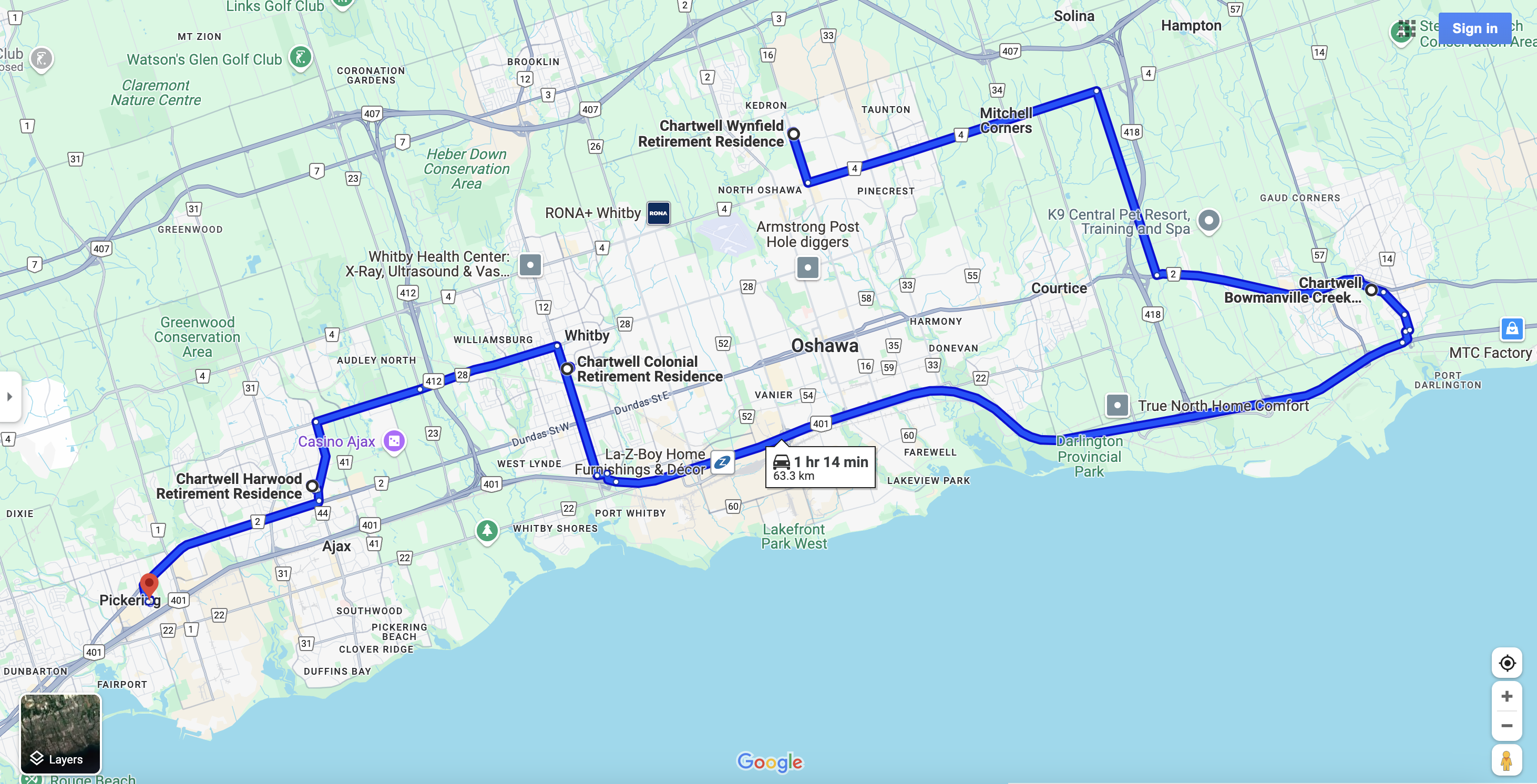
My planned route on Friday started at Chartwell Wynfield in North Oshawa. From there I'd head east to Chartwell Bowmanville Creek in Bowmanville, before working my way back west. I'd hit Chartwell Colonial, Chartwell Harwood, and finish my day off at Chartwell Pickering City Centre. It was an ambitious plan – I'd never toured more than 2 retirement homes in a day, but I figured I could manage.
Chartwell Wynfield – Options to check out a retirement home
Suites start at $4,521/month (at the time of writing)
Studios, one-bedroom, one-bedroom plus den, and two-bedroom suites
Amenities include an indoor pool, indoor putting green, demonstration kitchen, and cafe
At Chartwell Bowmanville Creek I shared 3 things to keep an eye out for when you're looking at retirement homes:
Do staff acknowledge residents? Homes where staff acknowledge the residents when they pass in hallways tend to have a warmer feel and higher resident satisfaction. And bonus points if staff acknowledge residents by name.
Are there spaces outside your room where you can see yourself spending time? A lot of residents are downsizing, the transition to a smaller living area is a lot smoother if there's other places in the retirement home where you're comfortable.
Are activity calendars and menus posted throughout the home up to date? It's not the end of the world if they're not, but it can be a sign the home lets the details fall through the cracks.
And don't forget to trust your gut. This is your home, if it doesn't feel right, keep looking – you can always circle back.
Suites starting from $4,226/month (at the time of writing)
Studios, one-bedroom, one-bedroom plus den, and two-bedroom suites
Amenities include a library, fitness room, pub & lounge, and courtsey van
At Chartwell Harwood I tackled one of the most popular topics when it comes to retirement living – PRICE!
Not all retirement home prices are created equal.
Some homes have a la carte pricing, while others are all inclusive.
Typically, as your care needs increase, so does the price.
You may be able to offset some of these costs if you qualify for free home care from Ontario Health atHome, but that's likely not going to be enough – whether you're in a retirement home or private residence.
I want to give props to Chartwell for including prices on their website. Only about 1/3 of retirement homes do this. I think public price transparency should be required across the board.
Suites start at $3,288/month (at the time of writing)
Studio, one-bedroom, and two-bedroom suites
Amenities include a library, fitness studio, activities and games room, and a tranquil backyard.
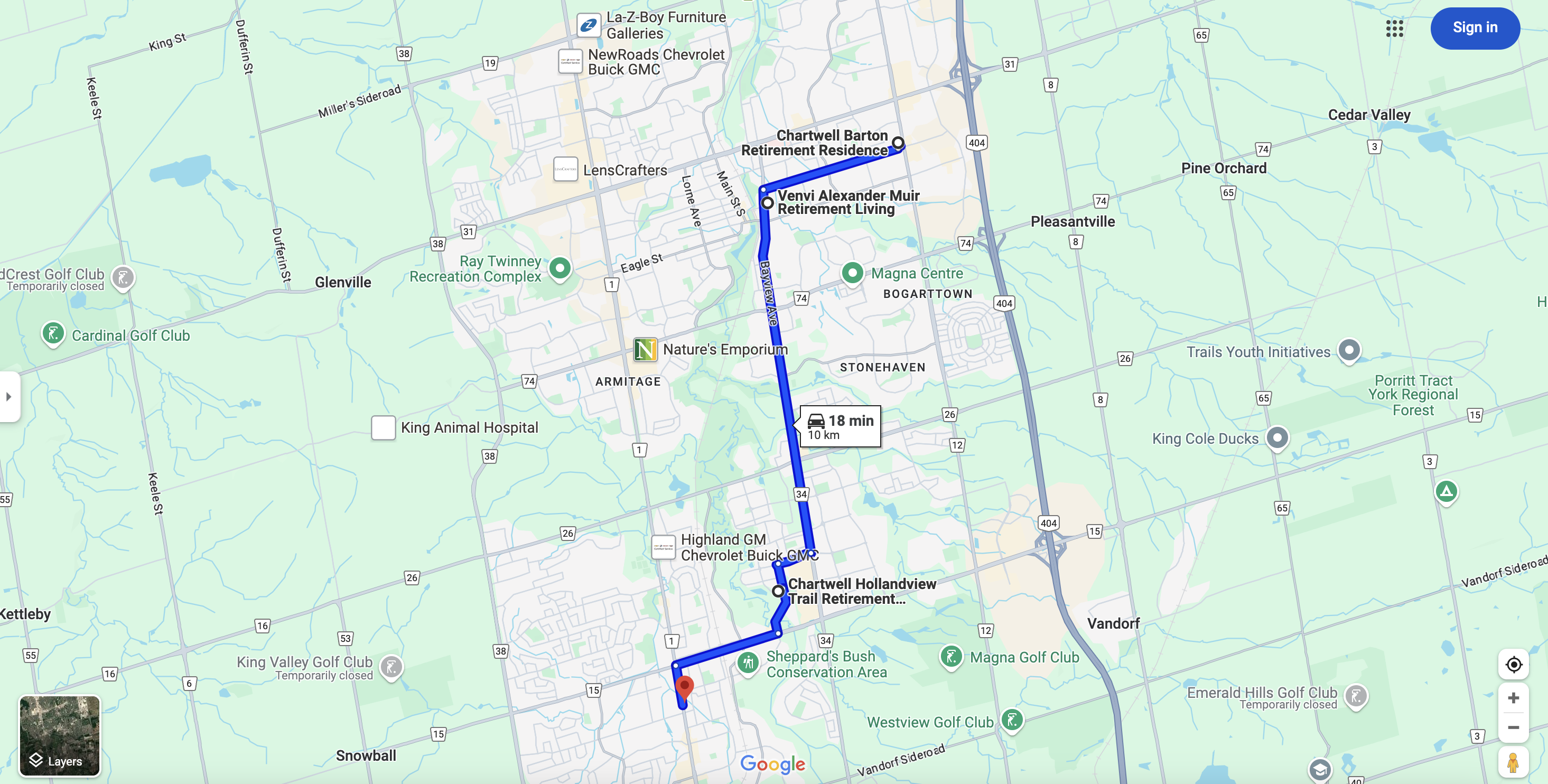
At Chartwell Barton I went over the difference between long-term care and retirement homes.
Long-term care is subsidized by the provincial government and typically cheaper, while retirement homes are private care and costs go up as care needs rise.
Most long-term care has a sterile feeling, while some retirement homes can rival high end real estate.
Long-term care has long waitlists, while retirement homes average less than 85% occupancy.
Alexander Muir – Are you in the same cohort as the other residents?
Amenities include a lounge, theatre, billiards room, and patio
At Alexander Muir I talked about the importance of being in the same cohort as your fellow residents to get the most out of retirement living.
Leigh and Lori from Discerning Seniors are big advocates of this, and they were the ones who brought it to my attention.
If you're active or social, you'll probably have more fun with other active and social residents. If that's you, you should have a look at an activity calendar and the amenities. Find something you can see yourself doing if you moved in, and ask the salesperson if you can drop in and take part. I bet they say yes. I get it, this can be a little outside our comfort zone, but if you're serious about moving in, it's worth it to get an idea of the neighbours and amenities.
Chartwell Hollandview Trail – Do you know about the Residents Bill of Rights?
A bit about Chartwell Hollandview Trail in Aurora.
Independent living and assisted living
Suites starting from $5,450/month (at the time of writing)
Studios, one-bedroom, one-bedroom plus den, and two-bedroom suites
Amenities include a country kitchen, a variety of common areas, a grand piano, and movie theatre
At Chartwell Hollandview Trail I talked about the Residents Bill of Rights – it goes hand-in-hand with the RHRA. There's a few rights I think are worth highlighting:
The right to apply for publicly funded care.
The right receive care from an external care provider.
The right to have his or her choice of care services provided by staff who are suitably qualified and trained.
The right not to be restrained except in accordance with the law.
The right to have his or her lifestyle and choices respected as long as nobody crosses a reasonable line.
Nothing crazy, but it's important to know your rights.
Chartwell Park Place – Questions to ask on a retirement home tour
Suites start at $2,995/month (at the time of writing)
Studio and one-bedroom suites
Amenities include a library, movie room, lounge, and pub
At Chartwell Park Place I touched on having questions prepared when you tour a retirement home. It's easy to get caught up in the moment during a tour, so it helps to have questions prepared when you come in for a tour.
Do I have quality of life questions? Medical concerns (both in the short term and long run)?
The more open you can be, the better the salesperson can help. Asking questions is gonna help you find the retirement home that's right for you.
On February 22, 2025 I got to attend the A Night To Remember Gala hosted by A Rose For Grandma. There was good food, great people, and my favourite part was the caregivers who shared their stories. It was both inspiring and humbling to hear so many people share their why!
Dementia support in the BIPOC community
A Rose For Grandma Wellness Hub is working to improve dementia care for Black, Indigenous, and People of Colour (BIPOC) communities, who often face significant challenges in accessing high-quality care. Barriers such as limited access to healthcare, transportation difficulties, and language differences contribute to delayed diagnosis and reduced access to support. Cultural stigma around dementia can also discourage families from seeking help, while BIPOC communities are often underrepresented in dementia research, limiting the development of culturally appropriate resources and care strategies.
A Rose For Grandma Wellness Hub is taking a collaborative approach, working with individuals living with dementia, their families, healthcare providers, governments, and other organizations. The goal is to create culturally responsive care that reflects the unique beliefs and needs of BIPOC communities, while also advocating for better representation in research and improved access to services. By addressing these gaps, the Wellness Hub aims to improve the overall quality of life for people living with dementia and their families.
Supporting local, community charities
I think the Alzheimer's Society, Heart & Stroke Foundation, and other big charities do incredible, important work, but we can't overlook local charities in the community that are likely underfunded, but sure can stretch a dollar.
What was clear from A Night To Remember was the tangible impact A Rose For Grandma is able to have.
There's a million worthy causes. The next time you are looking for a charity to support, don't shy away from taking a look at smaller, local organizations.
They might not have the name recognition or the best website, but you may find they're having an oversized impact on a shoestring budget.
Aspira Retirement Living hosted an open house event yesterday – I checked it out!
Before yesterday I hadn't spent a ton of time in Aspira retirement homes, so I was excited to find out they were hosting a National Open House event on February 22, 2025.
But Aspira, I do have to call out that it's got to be easier for people to know you have an open house going on. If you posted about it on your social media accounts I couldn't find it.
My original plan was to start at Aspira Douglas Crossing Retirement Living in Uxbridge, and then work my way south, but plans changed when I found out they're under outbreak. Instead I decided I would start at Aspira Empire Crossing Retirement Living in Port Hope, and then make my way west.
Aspira Empire Crossing Retirement Living in Port Hope
Aspira Empire Crossing retirement home in Port Hope, Ontario offers independent living. Suites start at $3,990/month.
A few notes from my tour:
Pet friendly
Every suite has a balcony or walk out
Smaller, intimate home, with good sized suites
Small, but engaging activity space
About 10 year old building
Independent living – need to be independent, or cognitively and physically able to ask for help
After a quick stop at McDonalds – for whaver reason my guilty pleasure on these big retirement home days, I was off to Aspira Traditions of Durham in Oshawa.
Aspira Traditions of Durham retirement home in Oshawa
Aspira Traditions of Durham offers independent living and assisted living. Studio suites in independent living start at $3,425/month.
A few notes from my tour:
Big spacious dining room
2 seatings at meal times
South facing suites on upper floors have a view of green space and Lake Ontario
A lot of residents were actively engaged in open house activities
Wide hallways so 2 people in wheelchairs can easily pass each other
Spacious bathrooms compared to many retirement homes
April 1, 2023
On April 1, 2023, a 79 year-old resident died after being locked out of Traditions of Durham overnight. 3 ex-employees and the retirement home itself have been charged with criminal negligence causing death. This is an incredibly tragic event, and my thoughts are with the deceased and their loved ones.
I don't have any insights into this case beyond what has been widely reported in the news (for example CBC). But my understanding is that there have been widespread changes to the care and management teams. One of those new team members is Razeea Khan, Sales Advisor at Traditions of Durham. She joined less than a year ago. Razeea and I have crossed paths a dozen times at networking events. I would trust my loved one would be safe in a home where Razeea worked. You need to have a level of trust with any retirement home, long-term care home, or home care provider, and I'd have more trust knowing Razeea is there. Take that for what you will.
Aspira Lynde Creek Gardens retirement home in Whitby
Aspira Lynde Creek Gardens offers independent living. Studio suites start at $2,985/month.
A few notes from my tour:
Nestled in a private community, surrounded by life lease townhomes
Coffee shops, grocery stores, and more within a 10-15 minute walk
Recently renovated with a warm, open aesthetic when you walk in the front doors
Backs onto a ravine with walking trails close by
Location, location, location
For me personally, there's a lot Aspira Lynde Creek Gardens has going for it. I love the location. If you drive, you could pick up your groceries, drop into the LCBO, grab a coffee, play pickleball, and walk some great trails whenever you want, AND only have to fill your gas tank 4 times a year. But the even bigger benefit of it is that for as long as I can walk, all that stuff is close enough that I can make a morning out of walking there. I like the idea of retiring somewhere peaceful, but having most of what I need within a long walk, and in that maner Aspira Lynde Creek Gardens delivers.
Next Open House Event
I don't know when the next big retirement home open house event will be, I'll keep my ear to the ground. But if you come across an open house for a retirement home in your area, check it out. It doesn't hurt to have an idea of what retirement living can look like – it might surprise you.
The Ministry of Long-Term Care in Ontario is planning to test a new system to help people find spots in long-term care (LTC) homes that match their culture, religion, language, or ethnicity, and there is an open call for comment HERE. This project, called the Long-Term Care Homes Cultural Pilot Project, will try to make it easier for people to get into homes where they feel more at home culturally.
Some LTC homes in Ontario focus on serving specific cultural or religious groups. But recently, these homes have seen fewer residents who match the culture they aim to support, and fewer spots are available that meet applicants' cultural needs. This makes it harder for these homes to offer the cultural, religious, and language support their residents need.
The current system puts people on a waiting list for LTC homes based on how urgently they need a spot. In this pilot project, the Ministry wants to test a new way of organizing these waitlists for people in crisis (those in category 1). For the homes selected to participate, people on the crisis waiting list who share the culture or religion that the home primarily serves could be prioritized, even if others on the list are also in crisis.
To make this pilot work, the Ministry would change the rules for ranking applicants. In designated homes, people with an urgent need for care would still be ranked first, but if two or more people have the same level of urgency, the applicant who matches the home’s cultural focus would get priority.
The goal is to see if this new ranking system can help improve access to culturally appropriate long-term care for Ontarians.
CLICK HERE to read the full proposal or to comment. Comments are open until November 26.
Ontario Health atHome has acknowledged that they are critically short on medical supplies that can have serious implications for seniors receiving home care. If you or a loved one is dealing with a shortage of medical supplies, Ontario Health atHome has advised you follow these steps:
Call you care coordinator.
If your care coordinator is not able to help, call the medical supply escalation hotline at 1-866-377-7567.
Additionally, Ontario Health atHome has added a reimbursement form for medical supplies to their website HERE. If you follow that link you will find the reimbursement form, as well as other contact information. Ontario Health atHome has stated:
"Patients, their families and caregivers should not have to incur the cost of purchasing much-needed medical supplies on their own due to delivery issues. That is why we will be reimbursing any patient, caregiver or family member who has paid out of pocket for medical supplies due to delivery issues."
We hope everyone dealing with the medical supply shortage are able to get the supplies you need.
2024 marks the first ORCA Conference for Elderado. Daniel created a daily video to recap what happened. ORCA Con was an opportunity to learn, network, and share ideas. It was attended by leaders from retirement homes, commercial partners, and other industry stakeholders. It took place at Deerhurst Resort in Huntsville, Ontario from September 10 – 12, 2024.
Today was an easy introduction to my first ORCA Conference with a round of golf at Deerhurst Highlands. I'm here solo, but I hit the jackpot getting paired with Krystal, Arta, and Ashley. Kids might say the vibes were high, but so was our score. I'm looking forward to a full day of keynotes, panels, and information sessions tomorrow.
What do they actually talk about at a retirement home conference? I’m at the Ontario Retirement Communities Association Conference, and these are my top 3 takeaways from today’s education program.
79% of families want transparent pricing and fee info before contacting a retirement home.
“We’re actually paying for more expensive care that nobody wants.” Hospital care, and even long-term care is very expensive for tax payers, and rarely is it the care we want.
“When we improve life for seniors we improve life for everyone because we all want to be seniors one day.” The Minister of Seniors and Accessibility, Raymond Cho, shared these words during his opening remarks to kick off the day.
Day 3 at ORCA Con focused on staff retention. Staffing shortages are a big problem among frontline staff like PSWs, nurses, and housekeepers. I was impressed by how openly different retirement homes shared the challenges they are facing, and what they tried. (And yes, it wasn't lost on anyone in the room that higher pay is an important factor)
Rachel Merucci from TBH Legal joined us to answer all our questions about adult guardianship. Adult guardianship in Ontario is a legal mechanism designed to protect individuals who are unable to make certain decisions for themselves due to physical or mental incapacity. It allows a designated guardian to make decisions on behalf of an adult who has been deemed incapable, with the goal of safeguarding the person’s well-being and managing their affairs. Someone might need an adult guardian instead of a Power of Attorney (POA) if they didn’t establish a POA before becoming mentally or physically incapable.
What if it's too late to create a Powers of Attorney?
We all know we should have a Will and Powers of Attorney (POA), but what do we do if we need a POA and don’t have one? That’s what Adult Guardianship is for.
Powers of Attorney vs. Adult Guardianship
In general, Powers of Attorney are created by someone when they are mentally capable in case they need it in the future, and they pick who they want to step in to make decisions for them. An adult guardian is someone who steps up and asks to be picked for the responsibility because their loved one has been proven to be mentally incapable.
What are the two types of Adult Guardians?
Adult guardianship appears to be modelled after Powers of Attorney. There's guardianship of personal care, and personal care of property.
What age does someone need an Adult Guardian?
In Ontario as soon as someone is 18 years-old they are assumed to be mentally capable to make their own decisions. If someone is not mentally capable they could require an adult guardian at 18 years-old.
Why might you need to be an Adult Guardian?
Caregivers to incapable adults have to have the legal authority before they can step in to make decisions, apply for benefits, pay bills, etc.
How do I become an Adult Guardian?
There are two ways to become an adult guardian – through a judge in court, or through an application process through the Office of the Public Guardian and Trustee.
What is the process to become Adult Guardian of Property?
If you are to apply to be an adult guardian of procerty through the application process, the process involved picking a capacity a assessor for your loved one, answering questions about the incapable adults expenses and assets, and reading and understanding the responsibilities of an adult guardian. Everything is sent to the Office of the Public Guardian and Trustee, who is responsibile for granting adult guardianship.
How long does it take to be granted Adult Guardian of Property?
It usually takes about 1 month to complete the Adult Guardian of Property application, and once the application has been submittied it typically takes 3 weeks to 6 months to be approved.
Is the process to become an Adult Guardian different at different ages?
No, it's the same at all ages as long as the incapable adult is at least age 18.
It’s remarkable how our experiences in volunteering can have such a profound impact on our lives. Several years ago, I volunteered at Evergreen Hospice in Thornhill, Ontario. But the experience was more than just rewarding; it gave me great insights into how to help my father deal with his end-of-life issues.
Ten years ago, he was trying to manage cancer. Unfortunately, he also wound up falling down the stairs at his home. After a very challenging month in hospital that also included a fall from his bed, he was taken to a local hospice. My father died peacefully, without any suffering, four days later, surrounded by friends and family.
Had it not been for the time volunteering at the hospice, I don’t think my father would have had the same experience. In 2014, hospice wasn’t on people’s radar as it is now. I recall some of my father’s visitors, upon entering the hospice, wondering aloud what they were visiting.
After working in the publishing industry for over two decades, I sold my business and worked at a funeral home. Again, I credit the time spent volunteering at the hospice that helped move me in this direction. Many people felt it was an odd job choice, but I saw it as an opportunity to support people during their most difficult times. As a funeral director’s assistant, I attended well over 500 funerals and met with hundreds of families in their homes, hospitals, retirement homes and hospices.
When surrounded by death, you get a profound appreciation for life.
While working at a funeral home, I felt my creative spark reignite, leading me to write a book. From here, I decided to launch a business that captures people’s stories in a magazine. I called it Time For My Story, and it has led to the creation of a new initiative called The Legacy Expo.
I fully acknowledge that death is one of those topics that most people have a hard time discussing. My initial goal for the event was to demystify and destigmatize the subject of death. I wanted to help transform the way people view death and legacy planning. I knew that fostering open discussions in a low-key, grassroots environment would make things much more accessible for people.
Another one of my goals was to educate and empower attendees when it came to making difficult decisions. For example, dealing with finances and logistics when someone has just died can be a harrowing and emotionally taxing experience for many people. I view it as knowledge is power. By giving people critical information now, they can make better decisions regarding end-of-life care and dealing with funerals and wills.
As a result of my work in publishing, I knew the power of community and was determined to help create a supportive environment for attendees and exhibitors. It was crucial that people would be able to share their journeys, learn from each other, and find solace in a collective experience.
I am pleased to tell you that the first Expo brought together 17 exhibitors in May of this year. It did indeed foster a positive and supportive environment. Most importantly, we had a wide range of businesses and nonprofits exhibiting. This included local funeral homes, grief counsellors, planners, insurance companies, and two technology companies. On the nonprofit side, we had a variety of exhibitors, including Canadian Blood Services, Hospice Toronto, and the Bereavement Ontario Network.
The combination of for-profit and nonprofit created a dynamic environment that benefited everyone in attendance. We had about 150 people attend the Expo, and they found it very informative, just as I had hoped. There was also a great deal of interaction between the exhibitors. It has now led to working relationships and strengthening the overall sense of community within the deathcare field.
Building on the foundation of the first Expo, I have set my sights on creating something a little larger. This September 28 at Thornhill United Church, we are showcasing over 40 exhibitors from various companies and nonprofits.
Because the subjects of death and grief are complex for many to discuss, I have also decided to focus on the importance of hosting a face-to-face gathering only. While some video footage of the first Expo can be seen on YouTube, I have decided not to livestream this event. I also decided to make the event free of charge so that it can be accessible to all.
As the Baby Boomers in North America age, discussions around end-of-life will become more frequent. My vision is that The Legacy Expo inspires others in cities around Canada to start their expos to further the conversation.
Disclaimer: Elderado is not suggesting or encouraging the use of cannabis in any form.
Since the legalization of recreational cannabis in Canada in 2018, its use among seniors has been steadily increasing. Cannabis, once a taboo topic, is now becoming a conversation starter, including in settings like long-term care homes where health, comfort, and quality of life are key concerns. But with this rise in popularity comes questions about the rules and regulations surrounding cannabis use in these environments. Can residents of long-term care homes in Ontario legally use cannabis, and if so, under what conditions?
The short answer is, sort of – the Fixing Long-Term Care Act states:
(2) Nothing in this Regulation prevents a resident from cultivating, acquiring, consuming, administering, possessing, storing or disposing of recreational cannabis in accordance with the licensee’s policies and procedures as required by subsection (1).
One long-term care home told us:
"Residents are able to consume alcohol and cannabis unless the doctor deems that it would not be safe due to a health condition/medication. Residents would either store their alcohol/cannabis locked in their room, or locked in the medication room with the nurse, depending on a capacity assessment that is completed (goes over risk, abilities, etc.). Residents have choice and can consume at their leisure, however there are rules in place for where they can/can’t."
In this blog, we'll explore the key regulations and considerations related to cannabis use in long-term care homes in Ontario, referencing both the Cannabis Control Act and the Fixing Long-Term Care Act. We’ll also look at the increasing usage of cannabis by seniors, supported by recent studies.
The Growing Popularity of Cannabis Among Seniors
Since Canada legalized cannabis in 2018, the stigma around its use has slowly faded, and many people, including seniors, have begun exploring its potential benefits. According to a 2021 study by the Canadian Institute for Health Information (CIHI), the use of cannabis among seniors (aged 65 and older) more than doubled from 2017 to 2019. Many seniors are turning to cannabis as an alternative treatment for conditions like chronic pain, insomnia, and anxiety, with both recreational and medicinal cannabis use rising.
A 2020 study published in the Journal of the American Geriatrics Society found that 15% of Canadian seniors reported using cannabis, with most of them doing so for medical reasons. For long-term care residents, the potential benefits of cannabis include helping to manage pain, reduce the need for opioids, and improve overall well-being.
The Cannabis Act and Long-Term Care Homes
The Cannabis Act, which came into effect in October 2018, legalized the recreational use of cannabis across Canada. It allows adults to possess and share up to 30 grams of dried cannabis or its equivalent in other forms, grow up to four plants per household, and purchase cannabis from licensed retailers. However, the act also gives provinces and territories the authority to implement additional rules and restrictions, particularly when it comes to where cannabis can be consumed.
In Ontario, cannabis use is regulated by a combination of laws, including the Cannabis Control Act, 2017, the Cannabis Licence Act, 2018, and the Smoke-Free Ontario Act, 2017. While adults are generally allowed to use cannabis in private residences, the rules for public consumption are stricter and aligned with those for tobacco. In institutional settings like long-term care homes, the regulations can vary depending on the facility’s policies and whether the use is recreational or medicinal. Exemptions to public consumption rules may apply in certain long-term care or retirement homes under specific conditions.
The Fixing Long-Term Care Act, 2021
The Fixing Long-Term Care Act, 2021 is a key piece of legislation in Ontario that governs long-term care homes. It establishes standards for the safety, care, and rights of residents in these facilities. When it comes to cannabis use, long-term care homes must balance the residents' rights to make personal choices with the need to ensure the safety and well-being of all residents.
There is no blanket prohibition on cannabis use in long-term care homes, but individual homes may have specific policies that residents must follow. These policies are usually designed to ensure that cannabis use does not interfere with the care environment, the safety of residents, or the legal obligations of the home. For instance, some homes may require residents to consume cannabis only in designated areas, and smoking or vaping cannabis indoors is generally prohibited under Ontario’s Smoke-Free Ontario Act.
Medicinal Cannabis in Long-Term Care Homes
For residents who use cannabis for medical reasons, the situation can be more straightforward. Under Canadian law, individuals with a medical authorization can legally access cannabis products to treat various health conditions. Long-term care homes in Ontario are required to accommodate residents' medical needs, including those who have been prescribed cannabis by a healthcare professional.
However, the use of medical cannabis in long-term care homes may come with additional regulations. Homes must ensure that cannabis products are stored securely, administered safely, and do not pose a risk to other residents. In some cases, residents may be required to provide a medical prescription, and the home’s staff may be involved in managing the resident's cannabis use, similar to how they handle other medications.
Key Considerations for Residents and Families
If you or a loved one is considering using cannabis while living in a long-term care home in Ontario, here are a few key points to keep in mind:
Check the Home's Policies: Each long-term care home may have its own rules about cannabis use. Be sure to ask about these policies before bringing cannabis into the home.
Consider Medical Authorization: If you plan to use cannabis for medical purposes, having a prescription from a healthcare provider can simplify the process. It also ensures that the long-term care home is aware of your medical needs and can provide appropriate support.
Respect Other Residents: Remember that cannabis use, especially smoking or vaping, can affect others. Be mindful of the designated areas for cannabis use, and always follow the home’s guidelines.
Safety First: Long-term care homes have a responsibility to maintain a safe environment for all residents. This means that cannabis products, like any other medications, must be stored securely to prevent accidental ingestion by others.
Conclusion
The Cannabis Act provides the legal framework for cannabis use across Canada, while the Fixing Long-Term Care Act governs how long-term care homes manage cannabis use among residents. If you or a loved one is living in a long-term care home and considering cannabis, it’s important to understand the home’s policies and ensure that your use complies with all laws, rules, and guidelines.
Cannabis use among seniors has been on the rise since its legalization in 2018, with many finding it beneficial for managing chronic pain and other health conditions. While cannabis is generally legal in Ontario, the use of cannabis in long-term care homes is subject to specific regulations that balance individual rights with the safety and well-being of all residents.