Blog

  • Eldercare Planning: Bringing the Whole Picture Together

    Eldercare Planning: Bringing the Whole Picture Together

    When families begin exploring options for aging — retirement living, long-term care, home care, and community supports, many start by doing their own research. Online platforms like Elderado play an important and valuable role in this process, giving families access to information, comparisons, and visibility into options that may otherwise feel hard to find.

    For many people, this kind of research is empowering. They want to understand what’s available, take their time, and make informed decisions independently. That approach is not only valid, but it’s also an essential step.

    At the same time, families frequently discover that researching options is just one part of a much larger journey.

    What Often Comes Before — and After — the Research

    What online research can’t always show is how many interconnected pieces surround eldercare decisions, such as:

    • When is the right time to make a move, or not move at all?
    • How current health needs may change in six months or two years
    • How public and private care systems intersect (or don’t)
    • What supports are available beyond housing alone
    • How family dynamics, finances, and future planning affect today’s choices

    This is where eldercare planning complements independent research.

    What Is Eldercare Planning?

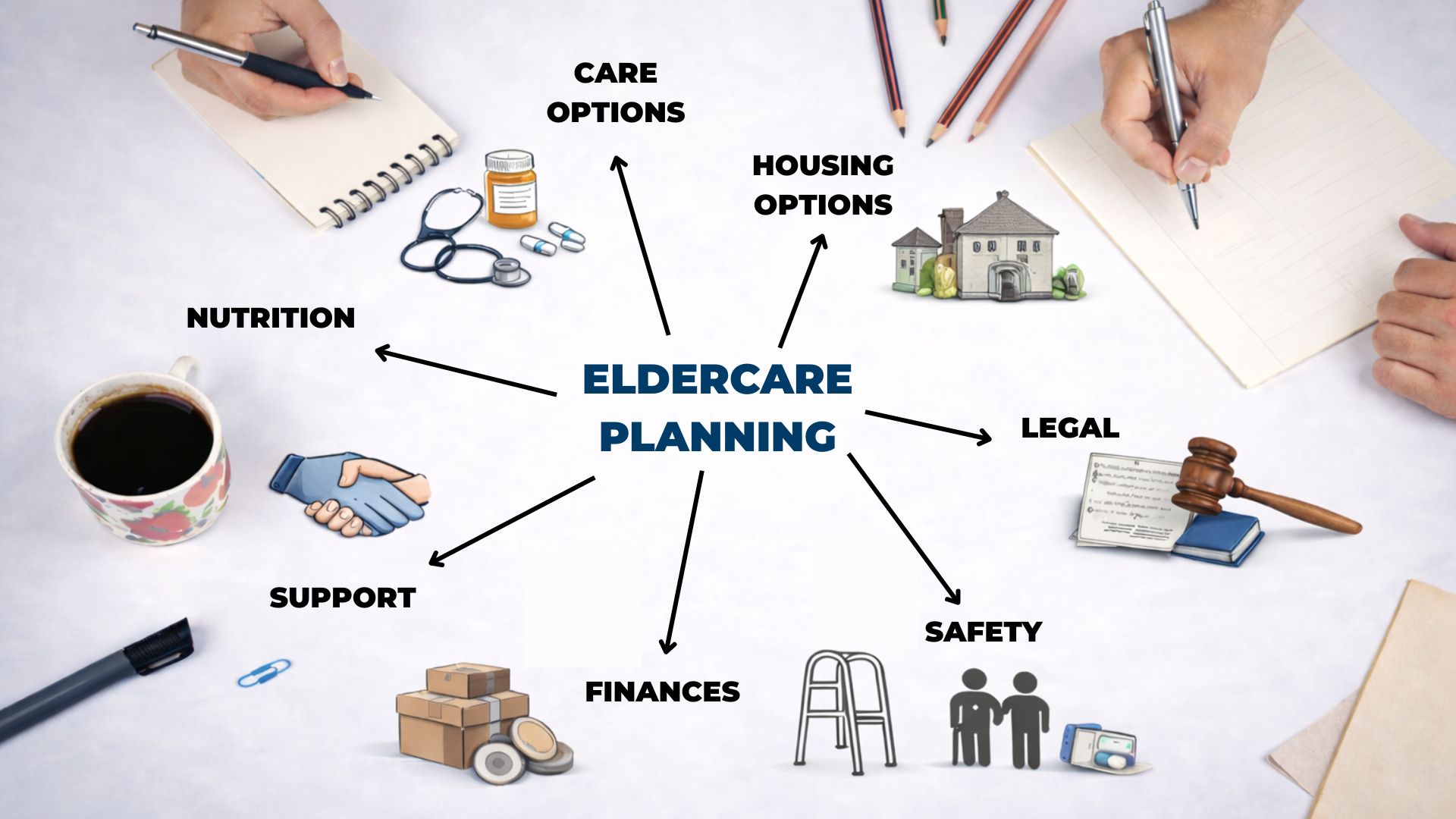
    Eldercare planning is a holistic, person-centred process that looks at the full context of an older adult’s life and builds a coordinated plan around it. Rather than focusing on a single decision, it brings together multiple layers, including:

    • Health and care needs (current and anticipated)
    • Housing options and timing across private and public systems
    • Family capacity, roles, and stress points
    • Financial considerations and cost-saving opportunities
    • Legal and future planning touchpoints
    • Quality of life, values, and personal preferences

    The goal is to help ensure that the decisions made through research truly fit the individual and remain sustainable over time.

    Seeing What’s Easy to Miss

    Because Eldercare Planners work across systems every day, they are often able to identify things families may not yet see, such as:

    • Early signs that care needs are changing
    • Housing choices that may not align with future realities
    • Gaps between public services and private options
    • Supports, benefits, or programs that could reduce strain or cost

    They can also help families pace decisions, knowing when to act quickly and when it’s safe to slow down.

    Support Through Complex and Emotional Conversations

    Even the most thorough research doesn’t make difficult conversations easier. Many families struggle with:

    • Talking about safety, memory changes, or care resistance
    • Balancing independence with support
    • Navigating differing opinions among family members

    An Eldercare Planner provides steady, neutral guidance, helping families have productive conversations, reduce conflict, and keep plans moving forward when emotions or uncertainty cause delays.

    Bridging Public and Private Systems

    One of the greatest challenges in eldercare is navigating the silos between public and private sectors. Families often find themselves caught in the space between:

    • What they qualify for publicly
    • What they can access privately
    • What they can realistically afford long-term

    Eldercare Planners help families understand how these systems connect, how to layer services effectively, and how to avoid costly missteps, while maintaining dignity, safety, and choice.

    Never Navigating Alone

    Eldercare Planners regularly coordinate with:

    • Health care providers
    • Care agencies and housing operators
    • Legal, financial, and community professionals

    When additional expertise is needed, families are connected to trusted professionals, so care feels coordinated rather than fragmented.

    The Strength of a National Network

    What makes Eldercare Planners of Canada unique is not just individual expertise, but collective commitment.

    As a national network, members:

    • Collaborate across regions
    • Share best practices and evolving system knowledge
    • Hold one another to high professional standards
    • Work together to raise the quality and consistency of eldercare planning in Canada

    For families, this means greater confidence that the guidance they receive is informed, ethical, and aligned with their best interests.

    Research Plus Personalized Guidance

    Elderado’s online research and Eldercare Planners are strongest when they work together.

    Research helps families understand what exists.
    Eldercare Planners help families understand what makes sense for them, now and in the future.

    For those who want to research independently, Eldercare Planners can step in before or after key decisions to ensure nothing important has been overlooked. For those feeling overwhelmed, planners provide clarity, coordination, and reassurance.

    Together, they help families move forward with confidence, knowing they’re supported every step of the way.

    About the Author

    Amy Friesen is an award-winning entrepreneur, innovator, and best-selling author, redefining how Canadians navigate aging and senior living. As founder of Tea & Toast—named Top Assisted Living Navigation Service in Canada in 2025, and creator of Eldercare Planners of Canada, she brings clarity, confidence, and compassion to families facing complex eldercare decisions. Featured in national media and known for her bold ideas, Amy inspires change through speaking, writing, coaching, and mentoring.

  • A Journey Into Community: My Visit to Presentation Manor

    A Journey Into Community: My Visit to Presentation Manor

    Introduction: A Symphony of First Impressions

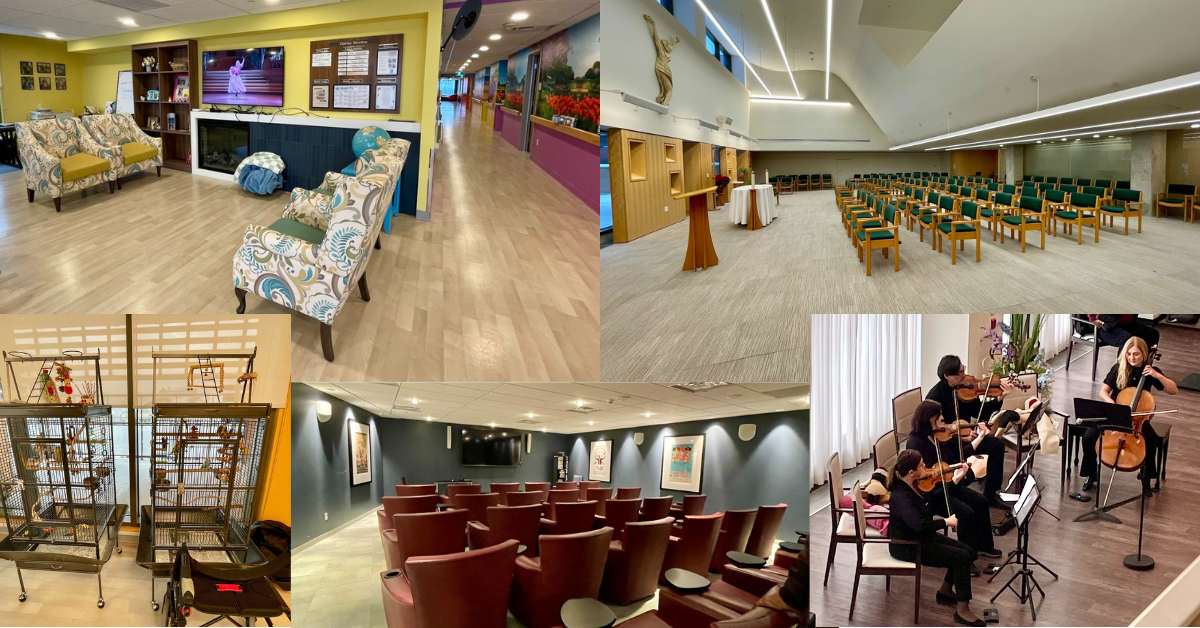
    As I sat in the lobby ahead of my tour, the air filled with the swell of live classical music drifting up from the grand room below. A quartet consisting of three violinists and a cellist was performing a vibrant repertoire ranging from Vivaldi to ABBA. Complete with puppets for a few lighthearted laughs, it was a worldly and whimsical performance that set a joyful tone for the day. While taking in the music, I immediately noticed the thoughtful layout of the space around me. With various seating areas, a large stone fireplace and plenty of room to move, it felt both grand and homey. As this was my first official tour of a retirement community, I was not entirely sure what to expect. I took the opportunity to simply soak in the cheerful atmosphere and observe the daily rhythms of the house. 

    Independent Living at Presentation Manor: Autonomy and Resident-Led Vitality

    As I began the tour with my host, Bremen, I had a real sense of the social fabric of the home. He stopped to say hello to many of the residents and it was clear he knew them personally. The majority of the residence is dedicated to Independent Living and consists of 178 suites, ranging from 325 square foot studios to expansive 749 square foot two-bedroom apartments. 

    Life here is defined by what I observed as resident-led vitality and autonomy. One of the best examples of this is the tuck shop. It is entirely run by the residents themselves and the money earned goes directly back into home initiatives that the residents decide upon together. There is also a gorgeous media room where movies are shown and the space also doubles as a lecture hall. I was told that talks are often held there by residents who are former professors. The room itself is quite inviting. The comfy leather chairs and dim lighting made me think it would be a perfect spot for an afternoon nap between social events.

    For those in Independent Living, the package is comprehensive. It covers three meals per day, weekly housekeeping, and well-being monitoring. Residents who need a little extra help can pay for services a la carte. You can pay for a variety of services you may need, including continence care, mobility assistance and help with medications. For those receiving care through Ontario Health at Home, the providers come directly to the suites. 

    Assisted Living at Presentation Manor: Personalized Support with a Private Touch

    The home features 51 Assisted Living suites. While the physical rooms look like the Independent units, the experience is tailored for those who need more support throughout the day. One detail I found particularly thoughtful was the dining arrangement. Instead of the large and bustling main hall, Assisted Living residents have their own separate dining rooms. These are much smaller and serve approximately 12 residents each and are spread out throughout the Assisted Living area. Each of these dining rooms has its own lounge and even its own outdoor terrace. This means residents do not have to travel far to enjoy some fresh air or a change of scenery. I also learned that if a resident is feeling under the weather, the home offers a complementary tray service for up to three days. The staff can even support complex needs like Hoyer lifts. This essentially means they can provide almost complete care as a resident’s needs change over time. Care can be provided almost “everywhere and anywhere” with nursing stations on each floor and/or care providers coming to the rooms. To maintain the homey feel I noticed in the lobby, they purposefully avoid dispensing medication in the main dining room. They do not want a clinical feel to interrupt the social enjoyment of a shared meal. In Assisted Living, many care services are part of the monthly package, and additional services can be added as needed.

    Memory Care at Presentation Manor: A Sanctuary of Seasons and Nostalgia

    The Memory Care wing is a self-contained sanctuary with its own dedicated elevator. Walking into this section, I was struck by how warm and welcoming it felt. It did not feel like a unit in a hospital. It felt like a friend’s house. The communal kitchen and dining area has its own terrace and two pet birds who cheerfully sang as we entered.

    The design here is incredibly thoughtful. The common areas have a decor reminiscent of decades past and the hallways are painted in colours and designs correlating to the four seasons to help with navigation. Each resident’s door is painted differently. There are even plans to have them painted to match the front doors of the residents’ former homes to provide a sense of recognition. I was also surprised by the size of the Memory Care suites. They are large enough that there is plenty of room for overnight guests, who are welcome to stay on cots provided by the home. Because moving into Memory Care is such a significant life change, the manor offers a 30-day trial stay. It is one of the many ways they clearly work in the best interests of the families during a difficult transition. The care services that are included in Memory Care are quite extensive and generally adhere to an all-inclusive model of pricing, with some very personalized support for an additional fee.

    Overall Impressions: An Inclusive Village

    My tour concluded back in the grand room from which I had first heard the music. This room is the main dining hall and it is beautiful. With soaring high ceilings and gorgeous natural light pouring in from floor-to-ceiling windows, it is a stunning space that feels both elegant and inviting. The home itself is a low-rise building spread over a lovely property. This architectural choice prevents it from ever feeling institutional or cold.

    One cannot talk about this home without mentioning the chapel. Custom-built for the manor, it is a beautiful and large space that highlights how important spiritual care is here. It makes sense given the number of residents who are retired clergy members. However, the home remains incredibly inclusive. They welcome people of all religions and ethnicities. They even have a world map on display showing that the residents have roots in many countries around the world. Seeing that global representation really drove home the sense of community. Being an independent non-profit retirement home, Presentation Manor seems to have the freedom to be creative and adaptive. The focus is always on the person. It is a place that strives to be more than just a residence. It is a place that strives to be a true home.

  • Meet Ellen Pisani: Navigating the Heart of Elder Care in East Toronto

    Meet Ellen Pisani: Navigating the Heart of Elder Care in East Toronto

    My name is Ellen Pisani, and I am incredibly excited to join the Elderado team for a six-week placement. This opportunity is the capstone of my Community and Health Services Navigation certificate program through Cambrian College. From the moment I came across Elderado, I was struck by the innovative, person-centered work being done by Daniel and his team. I knew immediately that I wanted to contribute to this groundbreaking approach and learn from the leaders currently reshaping how we support our seniors.

    A Personal Journey into Advocacy

    My passion for healthcare navigation is not just professional; it is deeply personal. Over twenty years ago, when I was 31 years old and caring for a one-year-old at home, a sudden and serious health crisis landed me in the ICU. In a staggering coincidence, my mother had experienced a similar life-threatening illness just 18 months prior.

    During those intense years, our family was thrust into the complexities of the medical system. We learned very quickly that medical expertise is only one piece of the puzzle; the ability to navigate the bureaucracy, advocate for patient needs, and bridge the communication gap between providers and families is equally vital. That experience changed my perspective forever. I realized that no one should have to walk through the corridors of the healthcare system alone.

    A Lifelong Commitment to Community

    Since those experiences, I have gravitated toward roles that allow me to support others during their most vulnerable moments. For example, I have spent time volunteering in roles within palliative care and Meals on Wheels.

    When the pandemic hit, I felt a familiar call to action. I worked at various vaccine clinics, not just as staff, but as a navigator. In a time of uncertainty, I found fulfillment in helping my community members manage their anxiety and guiding them through the logistical hurdles of the healthcare response. These experiences solidified my resolve to go back to school and formalize my skills in the Navigation field.

    Bridging the Gap in Elder Care

    As my own parents age, the necessity of skilled navigation has become even more apparent. I see firsthand how the “silver tsunami” is affecting families in my own community. The transition from independent living to a retirement residence or long-term care home is often fraught with emotional exhaustion and confusion.

    Through my studies at Cambrian, I have gained a deeper understanding of the healthcare system, dementia care, and advocacy techniques. However, I also recognize the practical challenges: understanding the difference between retirement and long-term care, managing the vast range of amenities and care approaches, and the sheer difficulty of finding a home with immediate availability, within budget. Too many families learn these lessons “the hard way” during a crisis. My goal is to be the guide that helps them plan with confidence instead of reacting in fear.

    My Six-Week Mission at Elderado

    During my time with Elderado, I will be conducting a deep dive into the senior living landscape of East Toronto. I will be visiting 12 different retirement homes in my local community to learn about their unique offerings, cultures, and approaches to care.

    I will be documenting my journey through a series of blog posts right here on the Elderado site. My objective is to provide a clear and helpful look at the options available in East Toronto so that families can find the right fit for their loved ones. I am honoured to learn from Daniel’s innovative team, and I look forward to helping you navigate the future of elder care with clarity and compassion. Stay tuned for my first site visit report!

  • Lunch at Bloom Oshawa: Experiencing Retirement Living Firsthand

    Lunch at Bloom Oshawa: Experiencing Retirement Living Firsthand

    We got to enjoy Lunch at Bloom Oshawa with Jacquie Platten, Retirement Living Consultant at Bloom Oshawa, and six real estate agents.  All six agents support older adults downsizing in Durham, and got at least 18 out of 20 on the Senior Living Certified Level 1 quiz – demonstrating a commitment to help their clients understand the fundamentals of retirement living and long-term care. Instead of hosting a presentation, we wanted to actually walk around the home, ask questions, make observations, and enjoy the same lunch that was served to residents that day.

    Thank you to Bloom Oshawa for hosting us, and to Jacquie for show us around and giving us a sense of what life looks like at Bloom Oshawa.

    Bloom Oshawa Retirement Community

    This was my 4th time at Bloom Oshawa, and I’ve always found it to be warm and inviting. It’s designed around lifestyle, care, and community, making it an ideal setting to host our first Lunch at event for Senior Living Certified real estate agents. Being in the home allowed everyone to move beyond brochures and websites to get a feel for day-to-day life.

    For families starting to explore retirement living, talking to someone with this firsthand experience in touring retirement homes can makes the difference between feeling overwhelmed and confident.

    Why Lunch at Bloom Oshawa with real estate agents?

    A lot of us don’t know where to start when we decide to downsize into a senior living home, and we’ve found real estate agents are one of the most common professionals families turn to for help. While this falls outside the normal scope of work, we’ve come across a number of agents who have learned the system to educated themselves about what long-term care is, what to look for at a retirement home, and how to apply for both? We want to support agents going the extra mile for their clients who are downsizing into a senior living home by creating opportunities to spend time inside a retirement home.

    Senior Living Certified Real Estate Agents

    All of the real estate agents who attended Lunch at Bloom Oshawa earned the Senior Living Certified Level 1 badge by successfully completing an online quiz focused on retirement living and long-term care in Ontario.

    The quiz is designed to confirm a practical baseline understanding of:

    • What is a long-term care home?
    • What is a retirement home?
    • What is the difference between long-term care and retirement homes?

    It is about helping families to identify agents who can help older adults and their loved ones take the first step to find the right retirement home or long-term care come. Agents who pass the quiz receive a Senior Living Certified badge and may be invited to participate in Elderado events like Lunch at Bloom Oshawa.

    Why the Senior Living Certified badge matters

    For families, the badge signals that an agent has taken the time to understand the basics of senior living before offering guidance.

    For real estate agents, it demonstrates a commitment to serving older clients with care and professionalism.

    For retirement homes, it helps ensure that the professionals touring the residence with families understand the senior living landscape.

    Want to become Senior Living Certified?

    The Elderado Senior Living Certified Level 1 quiz is free, and open to real estate agents who work with older adults or families planning a transition.

    Request to take the Senior Living Certified Level 1 quiz: https://tally.so/r/EklDGq

    Lunch at Bloom Oshawa itinerary

    Lunch at Bloom Oshawa began with a roundtable where we talked about retirement living.  We tabled all the lingering questions we’ve each had about retirement living, before Jacquie walked us through the steps a new resident takes when they decide to move in.  After that we got to go on a tour that included a walk through of a 1 bedroom model suite, and a number of the amenities, which included the horticulture room, library, bistro, kids play area, salon, gym, and pool.  After that we sat down to lunch in the private dining room.  We started with soup. The two daily specials were Asian stir fry or Meat Lovers Pizza, or a selection of sandwiches from the a la carte menu.  For dessert we had warm, fresh baked cookies.

    Amenities at Bloom Oshawa Retirement Community

    On our tour we got to see all the amenities at Bloom Oshawa. Touring these areas together helped answer the question, how do residents actually spend their time?

    “One of my favourite amenities is the courtyard. I’ve never seen a retirement home with that type of courtyard. ” — Riyad Ali, The DR Group

    “One of the amenities that I love most was the play area for kids, where all the seniors can have a little bit of time to take to play with their grandkids. ” — Valeria Perepeliuk, North2South Realty

    “What I loved most, being a dog lover myself, is that dogs are allowed, and in the courtyard they have an area for your dog to run around. ” — Corina Goss, Royal Heritage Realty

    “One amenity that really stuck out to me was the horticultural room. I love living plants and being able to walk out to the outdoor area. ” — Rai Mohan, REMAX Rouge River

    “The fact that they’ve got grocery stores, and shopping plazas, and all kinds of fantastic things right across the street.” — Jess Whitehead, Royal Heritage Realty

    Amenities at Bloom Oshawa include:

    • Raised garden beds
    • Craft kitchen
    • Bistro
    • Shuffleboard
    • Pool
    • Library
    • Play room for kids
    • Car wash
    • Hair salon
    • Exterior courtyard
    • Spa
    • Activity room
    • Underground parking
    • Private Dining Room
    • Dog park
    • Tuck Shop
    • Pub

    Inside a 1 bedroom model suite at Bloom Oshawa

    We got to tour a 1 bedroom model suite in independent living at Bloom Oshawa.  It was a spacious suite with a kitchenette and a balcony off the bedroom.

    “My two favourite features of the model suite was the bathroom – the finishes were unbelievable, and the space – it felt like a modern condo.” — Riyad Ali, The DR Group

    “They’ve got a really functional kitchen with lots of storage space, with the ability to do some of your own in house cooking – which is fantastic.  They also had a nice balcony off the bedroom, perfect to have a coffee or tea in the morning.” — Jess Whitehead, Royal Heritage Realty

    “One thing about the model suite I really liked was the size of the bathroom. Really great for people who have walkers to get in and out of the shower” — Rai Mohan, REMAX Rouge River

    Enjoying the same lunch as residents

    With the event name, Lunch at Bloom Oshawa, it’s safe to say lunch was the central part of the experience. The group enjoyed the same lunch options available to residents, offering a firsthand look at the quality, variety, and atmosphere of dining at Bloom Oshawa. Food plays a major role in everyday life in a retirement home, and sharing a meal helped give first-hand experience.

    Lunch at Bloom Oshawa Menu

    “Lunch here was amazing and super delicious. I had chicken with salad, or I could also get it with fries. The presentation, the service was absolutely amazing.” — Valeria Perepeliuk, North2South Realty

    “I have to say kudos to Chef Trevor. Lunch was fantastic.  I had an Asian stir fry that was delicious. Excellent food here at Bloom Oshawa.” — Rai Mohan, REMAX Rouge River

    “I had the meat lovers pizza for lunch with a caesar salad and it was fantastic. The portion sizes were great and the flavour was wonderful.” — Corina Goss, Royal Heritage Realty

    “I had for lunch today their Asian special dish. It was absolutely delicious – it’s probably one of the best stir fry’s I’ve had in a long time.” — Jess Whitehead, Royal Heritage Realty

    “Asian stir fry noodles were amazing. Good portion sizes and I was definitely full after.” — Riyad Ali, The DR Group

    Most retirement homes will offer a complementary meal when you take a tour – which we always suggest taking advantage of to try the food for yourself.

    Understanding the move-in process

    A key part of the visit was hearing from Jacquie Platten, who walked the group through what happens when someone decides to move into Bloom Oshawa.

    Jacquie explained the process step by step, from the initial conversation through to move-in day. Most of us have no idea what it looks like to move into a retirement home until it’s something we need to do for a loved one or ourselves, which can make this process feel more complicated and overwhelming than it needs to be. The information Jacquie shared empowered the agents to be better equipped to help their clients to reduce anxiety and give families confidence in their transition into a new home.

    Senior Living Certified Real Estate Agents at Lunch at Bloom Oshawa

    While everyone toured the same residence, everyone’s perspective is a little different, and this highlights why it’s important to tour multiple retirement homes when you’re considering retirement living.

    Corina Goss, Royal Heritage Realty

    Jess Whitehead, Royal Heritage Realty

    Rai Mohan, REMAX Rouge River

    Riyad Ali, The DR Group

    Valeria Perepeliuk, North2South Realty

    Daniel Sutherland, eXp Realty

    Together, these perspectives reinforce the value of seeing a retirement home firsthand rather than relying only on descriptions.

    Bringing it all together

    Lunch at Bloom Oshawa offered a firsthand look at what retirement living at Bloom Oshawa looks like. We are grateful to Bloom Oshawa for hosting and to the agents who took the time to learn, ask questions, and engage the Bloom Oshawa community.

    For real estate agents interested in learning more

    If you are a real estate agent who works with older adults or families that consider downsizing into a retirement home and long-term care, you can request to take the Elderado Senior Living Certified Level 1 quiz.

    Request to take the Senior Living Certified Level 1 quiz: https://tally.so/r/EklDGq

    For retirement homes interested in hosting a Lunch at Your Residence

    If you are a retirement home interested in hosting a Lunch at event at your residence, reach out. Lunch at is a meaningful way to showcase daily life, and help local professionals learn about retirement living at your home.

    Email info@elderado.ca if you’re interested in hosting.


  • How the CABHI Ignite Program Helped Elderado Accelerate Elder Care Innovation: A Nine-Month Impact Review

    How the CABHI Ignite Program Helped Elderado Accelerate Elder Care Innovation: A Nine-Month Impact Review

    Finding elder care in Canada can be confusing and stressful. Families have to navigate long-term care waitlists, different levels of retirement living support, eligibility requirements, budgets, and often they are under time pressure. Social workers and discharge planners want to help, but resources can be limited and fragmented across various websites and platforms.

    When Elderado joined the CABHI Ignite Program in March 2025, the goal was to accelerate our vision of a simpler, clearer, and more transparent way for families and health care workers to navigate and compare elder care options. Nine months later, Elderado has launched new tools, expanded partnerships across Ontario, and supported more than 60,000 users.

    What Is CABHI?

    The Centre for Aging and Brain Health Innovation (CABHI) is a leading Canadian hub for innovations that improve life for older adults, caregivers, and front-line health care workers. CABHI, powered by Baycrest, supports early-stage solutions that address real challenges in aging, dementia care, and system navigation.

    CABHI provides:

    • Access to research and clinical expertise
    • Support with testing and validation
    • Engagement with older adults, caregivers, and clinicians
    • Strategic mentorship
    • Funding to accelerate development
    • Connections to health care partners across Canada

    For companies working in elder care, CABHI is one of the most influential and credible partners available.

    What Is the CABHI Ignite Program?

    The CABHI Ignite Program is designed for early-stage innovators building products for aging, caregiving, and brain health. Ignite helps organizations refine their solutions, test them with real users, and position them for adoption within the health system.

    With Canada’s population aging at an accelerated pace, advancing innovations that improve the lives of older persons is critical to building a healthier, more resilient future,” says James Mayer, Chief Operating Officer of the Centre for Aging + Brain Health Innovation (CABHI). “Our Ignite program supports early-stage researchers and startup companies with transformative aging and brain health solutions by removing barriers that often stall innovation progress. By breaking down these barriers, we can accelerate innovation and make meaningful, lasting impacts on the lives of older persons, people with dementia, and their care partners.”

    Key strengths of the Ignite Program include:

    Research and validation

    Ignite guides innovators through structured evaluation to determine whether their solution works in real-world elder care settings.

    End-user engagement

    The program provides access to older adults, caregivers, clinicians, and health care leaders who offer practical feedback.

    Mentorship and sector connections

    CABHI advisors can help make introductions to key contacts, and sector leaders who can help test and scale solutions.

    Funding

    Financial support enables early-stage companies to build, test, and improve their solutions more quickly.

    For a platform like Elderado, this combination of funding, credibility, and access was essential to accelerating growth.

    Why Elderado Joined the Ignite Program

    Elderado was created to help Canadians navigate elder care with clarity. Families often struggle to understand:

    • The difference between long-term care and retirement homes
    • How waitlists work
    • What levels of care exist
    • Which retirement homes have availability
    • How to compare retirement living options

    Hospitals and health care workers do their best to guide families, but they often rely on manual phone calls, spreadsheets, and inconsistent information.

    By March 2025, Elderado had built a strong foundation, but needed support to:

    • Validate its platform with caregivers and clinicians
    • Build tools to address gaps in availability information
    • Strengthen partnerships across the health system
    • Accelerate product development and adoption

    The CABHI Ignite Program provided the ideal environment for that growth.

    What Elderado Has Accomplished in Nine Months Through the Ignite Program

    From March through November of this year, Elderado made major progress in building tools that support families, caregivers, and community partners. Below are the key accomplishments during the first nine months of the Ignite Program.

    1. Launching the Retirement Living Availability Registry

    One of Elderado’s most significant achievements during the Ignite Program has been the creation of the Retirement Living Availability Registry (RLAR).

    August 2025: Early testing begins

    With CABHI’s guidance, Elderado tested a prototype of the RLAR with caregivers, retirement homes, and health care professionals. This testing helped refine the workflow, language, and user experience.

    September 2025: Official launch

    The RLAR launched publicly in September 2025. It is the first tool in Ontario designed to show current retirement home availability in a clear and accessible way.

    Families, social workers, discharge planners, and care coordinators can now:

    • Find retirement homes with current availability
    • Filter by location, and care level
    • Learn more about every retirement home
    • Contact retirement homes directly through Elderado

    Before the RLAR, families often were forced to call multiple retirement homes to find homes with availability. The RLAR replaces this with a single, reliable source of availability information.

    2. Partnering With 30 Hospitals, Ontario Health Teams, Clinics, and Community Agencies

    A major area of growth during the Ignite Program has been Elderado’s partnerships with the health system. In nine months, Elderado expanded to 38 community partners (hospitals, clinics, Ontario Health Teams, older adult resources) that now use Elderado and the RLAR to support elder care navigation.

    CABHI played a direct role in making these partnerships possible. Through the Ignite Program, CABHI:

    • Made introductions to contacts at Ontario Health Teams, hospitals, and community care
    • Provided credibility that helped Elderado earn the trust of clinicians
    • Supported early conversations to align the RLAR with hospital workflows
    • Helped Elderado communicate the value of real-time availability to discharge planners and care coordinators

    These partnerships have helped hospital staff:

    • Reduce the time spent calling retirement homes
    • Provide families with clear, up-to-date information
    • Improve transitions from hospital to retirement living when appropriate
    • Support families during stressful decision-making moments
    • Use consistent tools across teams and departments

    CABHI’s network and introductions were essential in helping Elderado establish these relationships.

    3. Supporting More Than 60,000 Users

    To date, Elderado has supported over 60,000 users, including:

    • Families researching retirement living and long-term care
    • Seniors exploring independent and assisted living
    • Caregivers navigating sudden or complex transitions
    • Health care professionals guiding patients and families

    Elderado users have grown by 44.7% since the beginning of the Ignite program, including a noticeable uptick after the launch of the Retirement Living Availability Registry, showing a strong need for real-time availability information in elder care navigation.

    How Ignite Enabled Elderado’s Growth

    Over nine months, the Ignite Program helped Elderado:

    • Test and validate new features with real users
    • Improve product design based on clinical and caregiver feedback
    • Strengthen relationships with hospitals and community partners
    • Gain credibility within the health and aging sector
    • Accelerate timelines from idea to testing to launch
    • Build tools that better integrate into health care workflows

    The combination of funding, mentorship, research support, and introductions has been transformative for Elderado’s growth and adoption.

    Looking Ahead

    The next phase of Elderado’s growth includes expanding the RLAR across Canada, deepening partnerships with hospitals and community agencies, and building new tools to support home care navigation. Elderado is also preparing to introduce French language support, which is a crucial step toward serving families, caregivers, and frontline workers, and ensuring a more accessible experience for users across the country.

    The progress made in the nine months since joining the Ignite Program shows what is possible when innovative solutions receive the support, evaluation, and partnerships needed to succeed.


  • Senior Living Certified Real Estate Agents

    Senior Living Certified Real Estate Agents

    When an older adult is considering downsizing into a retirement home or long term care the right real estate agent can make the transition much easier. A knowledgeable agent who understands how long-term care and retirement homes work can help families navigate a stressful and complex process.

    To help families find that kind of support, Elderado created the Senior Living Certified Quiz. Agents who score at least 18 out of 20 earn the Senior Living Certified – Level 1 designation, receive a digital badge, and are included in our directory of trusted real estate professionals.

    Real estate agents can request to the the Senior Living Certified Quiz here: https://tally.so/r/EklDGq

    Senior Living Certified – Level 1 Real Estate Agents

    Riyad Ali

    Brian Cowan

    Jessica Whitehead

    Keisha Telfer

    Daniel Sutherland

    Valeria Perepeliuk

    Bryen Daly

    Lynn Marie Robinson

    Nancie McLeod

    Geeta Rajpal

    Shayna List

    Rai Mohan

    Corina Goss

    Adam Gordon

    Damir Strk

  • How the Retirement Living Availability Registry Helps Hospitals and Health Care Workers

    How the Retirement Living Availability Registry Helps Hospitals and Health Care Workers

    When a patient no longer needs acute care but can’t safely return home, social workers, discharge planners, and patient care coordinators often have to work against the clock to find appropriate elder care. Every long-term care home has a waitlist, but there are retirement homes with immediate availability – the problem is finding those homes. The traditional process is time-consuming: making dozens of phone calls to homes, leaving messages, waiting for call-backs, and repeating the same questions over and over.

    The Retirement Living Availability Registry (RLAR) simplifies this process. It’s a free, online tool from Elderado that shows which retirement homes have current availability — all in one place.

    Visit the Registry


    A Faster Way to Help Patients and Families

    The RLAR was designed to make it easier for patients and their loved ones to find a home when they need it most. Instead of health care workers phoning multiple retirement homes, families can quickly:

    • See which homes currently have suites available in Independent Living, Assisted Living, Memory Care, or Respite Care.
    • View the starting price for available suites.
    • Access the home’s company page with photos, video tours, activity calendars, inspection reports, and other helpful details.
    • Contact the home directly.

    This means less time spent searching and more time supporting patients and families as they transition to the next stage of care.


    Reducing the Burden on Frontline Staff

    Social workers, discharge planners, and patient care coordinators are often the ones trying to bridge the gap between hospital care and other elder care options. But calling around to retirement homes isn’t just inefficient — it also takes valuable time away from patient support.

    The RLAR helps to:

    • Save hours of manual calling and coordination.
    • Give families a clear, current list of real options.
    • Create a more consistent discharge planning process across teams.
    • Empower families to make informed decisions quickly.

    By making availability visible, health care workers can focus on what they do best — supporting patients — rather than chasing information.


    Supporting the Reduction of ALC Pressures

    Alternate Level of Care (ALC) pressures remain a serious challenge across Ontario. Many patients are ready to leave hospital but have nowhere to go because families struggle to find a suitable home in time. This results in beds staying occupied longer than necessary.

    The RLAR provides a practical solution:

    • Families can see current availability in retirement homes.
    • Discharge teams can guide families to the tool instead of making dozens of calls themselves.
    • Patients can transition out of hospital more smoothly.

    By helping connect patients to appropriate care more quickly, the RLAR supports efforts to relieve ALC pressures and free up hospital beds for those who need them most.


    Free Information Handouts

    We offer a free handout for hospitals, clinics, and health care professionals to share with families. This resource explains how the RLAR works and gives families everything they need to start their search immediately.

    Who can request handouts:

    • Hospitals
    • Outpatient clinics
    • Social work teams
    • Discharge planning teams
    • Primary care and community health partners

    To request free copies of the RLAR hospital handout for your team or patients, contact us through Elderado.ca.

    Elderado hospital handout


    A Simple, Effective Tool

    The Retirement Living Availability Registry is about more than technology – it’s about supporting patients, families, and the professionals who help them every day.

    By giving frontline health care workers and families a fast, clear way to find available retirement homes, we can help reduce stress, ease system pressures, and improve patient flow.

    Explore the Registry

  • How the Retirement Living Availability Registry Helps Retirement Homes

    How the Retirement Living Availability Registry Helps Retirement Homes

    The Retirement Living Availability Registry (RLAR) is a free, online tool from Elderado that helps retirement homes share their availability with families and health partners in real time – and makes it easy for them to stay visible.

    Sign up your home


    Making It Easier to Connect With Families

    Traditionally, families and social workers have had to call home after home to ask the same question: “Do you have any space right now?”

    The RLAR flips that process. Instead of waiting for people to find you, your availability appears in one central place that’s actively used by:

    • Families looking for retirement living options
    • Hospitals and discharge planners
    • Social workers and community care providers

    This means your suites are seen by people who are already searching for a place for their loved one or patient.


    How It Works for Retirement Homes

    The RLAR was built to be simple. Retirement homes can sign up in less than two minutes.

    Simple sign-up
    Provide your name, email, and the name of your retirement home.

    Update availability in seconds
    Each month, you’ll get an email with a link to your availability form. It’s pre-filled with your last submission, so all you need to do is update if your availability has changed.

    Families and partners see your availability
    Your listing is automatically updated on the Registry, where families and health partners can view:

    • The type of available suites (Independent Living, Assisted Living, Memory Care, and Respite)
    • A direct phone number
    • Your starting price (Optional)
    • A link to your Elderado company page with photos, videos, descriptions, and more

    This process ensures your current availability is visible to the people who need it most — without creating extra work for your team.

    Sign up in under 2 minutes


    New: Respite Care Category

    Many health and social service partners have asked for short-term options to support families in crisis. In response, we’ve added Respite Care as a new category in the Registry.

    This allows homes to promote short-term stays to:

    • Families who need temporary support
    • Hospitals that need transitional care options
    • Social workers helping seniors safely return to the community

    By sharing respite availability, your home can fill suites faster and support more families in need.


    Benefits for Your Retirement Home

    • Increase visibility with families and professionals actively searching.
    • Fill suites faster without extra marketing costs.
    • Save staff time by replacing dozens of phone calls with one quick monthly update.
    • Reach referral partners in hospitals and the community who rely on the RLAR to support discharge planning.

    The Registry is free to use and designed to make connecting with families easier and more efficient.


    Join the Registry

    More than 27 community partners — including hospitals — already use the Registry to help families find care. By joining, your home can be part of a growing network that connects seniors to the right place at the right time.

    Sign up your home today

  • How the Retirement Living Availability Registry Helps Families Find Care Faster

    How the Retirement Living Availability Registry Helps Families Find Care Faster

    When a loved one suddenly needs care, families can find themselves in a race against time. A hospital discharge, a sudden change in health, or a fall can create an urgent need for safe, appropriate care. In these moments, families are forced to make big decisions fast – and the search for a retirement home can feel overwhelming.

    For years, families have had to call home after home, repeat the same questions, and often get the same answer: “Sorry, we don’t have space right now.”

    That’s why Elderado created the Retirement Living Availability Registry (RLAR). It’s a free, online tool designed to make the search for retirement home availability faster, easier, and less stressful.

    Visit the RLAR


    Why This Matters in a Crisis

    When someone can no longer live safely at home, or needs a place to recover after a hospital stay, families have to make decisions quickly. But the traditional process is exhausting:

    • Calling multiple homes to ask if they have space.
    • Waiting for callbacks.
    • Not knowing what’s available or what it costs.
    • Having to make a rushed choice without all the information.

    The RLAR removes a lot of this burden by showing families, in one place, which homes currently have space in:

    • Independent Living
    • Assisted Living
    • Memory Care
    • Respite Care

    This gives families a clear starting point instead of starting from scratch.


    What Families Can See on the Registry

    Each listing on the RLAR includes practical details to help families make informed decisions:

    • Level of care: Is there availability in independent living, assisted living, memory care, or respite care
    • Starting price: So you can narrow your search to what fits your budget.
    • Phone number: To contact the home directly.
    • Link to the home’s company page, which includes:
      • Photos of the residence
      • A video tour
      • A written description of the home and services offered
      • A sample menu and activity calendar
      • Inspection reports

    Instead of spending hours calling homes one by one, families can see the most important information right away.


    How to Use the RLAR Step by Step

    1. Visit the RLAR online
      Go to www.elderado.ca/availability-registry.
    2. Search for homes with space
      You’ll see a list of retirement homes with current availability, organized by care type and location.
    3. Review the listings
      Check the starting prices, look at photos, read descriptions, and view the activity calendar to understand what daily life might look like in each home.
    4. Contact the homes directly
      Once you’ve found homes that fit your needs and budget, use the phone number or contact button to reach out.
    5. Make a confident decision
      With clear, up-to-date information in front of you, you can choose a home without the stress of endless phone calls or guesswork.

    How This Helps Families in Real Life

    Imagine your parent is in the hospital and can’t safely return home. You’ve been told you need to find a retirement home within a few days.

    Instead of calling 20 homes to ask about vacancies, you visit the RLAR. In just a few minutes, you can see which homes have suites available, what kind of care they offer, and whether they’re in your budget. From there, you can call the top choices, ask questions, and book tours or move-in assessments.

    This process gives families back valuable time — and a greater sense of control during a stressful moment.


    The Growing Long-Term Care Waitlist and Why It Matters

    It’s important to understand the bigger picture of care in Ontario. Many families have heard the challenges to be admitted into a long-term care home.

    • There are over 48,000 people waiting for long-term care in Ontario.

    • This wait-list has doubled over the past 10 years.

    • Because of this wait-list, hospitals, families, and social workers are under pressure.

    What this means for families in crisis: Relying on long-term care alone may mean longer waits, fewer choices, and more uncertainty. The RLAR offers an alternate path — a way to explore retirement homes that are ready now, helping you bypass some of the long delays.

    A Simpler Way to Find Care

    Finding the right retirement home shouldn’t feel like a crisis. The Retirement Living Availability Registry gives families a clear, fast, and practical way to find real options when it matters most.

    Start your search now

  • What is the Retirement Living Availability Registry?

    What is the Retirement Living Availability Registry?

    When a loved one suddenly needs care, finding a retirement home with space can be stressful. Families often have to make quick decisions, calling around to multiple homes to find out who has availability and can provide the care their loved one needs.

    That’s where the Retirement Living Availability Registry (RLAR) comes in.

    The Retirement Living Availability Registry is a free online tool that helps families with immediate needs connect with retirement homes with current availability.

    Click here to view Retirement Homes with Current Availability on the Registry

    Want to learn more? Below is how the Registry is designed to help families and care givers, health care support staff and retirement homes.


    How the Registry Helps Families

    When families are in crisis, time matters. The Availability Registry lets people:

    • Identify retirement homes with current availability.
    • Check what type of care is offered — Memory Care, Respite Care, Independent Living, or Assisted Living.
    • Compare starting prices to avoid wasting time reaching out to homes that aren’t affordable.
    • Contact directly with retirement homes.

    This means less time calling, and more time with your loved one.

    Click here to learn How the Retirement Living Availability Registry Helps Families Find Care Faster


    How It Supports Hospitals and Health Care Providers

    Hospitals often have patients who no longer need to be in hospital but can’t go home safely. Discharge planners and social workers can spend hours phoning homes to find open spaces.

    With the Availability Registry they can:

    • Quickly see which homes have suites available.
    • Find options that fit a patient’s needs.
    • Help seniors transition sooner to a setting better suited to their condition and needs.

    This frees up hospital beds for other patients who need them and helps seniors transition smoothly into care.

    Click here to learn How the Retirement Living Availability Registry Helps Hospitals and Health Care Workers


    How It Benefits Retirement Homes

    For retirement homes, the Availability Registry is a simple way to share their availability with hospitals, health care partners, and families in real time.

    • Easy sign-up: takes less than 2 minutes.
    • Monthly updates: homes get a reminder email and can update availability in seconds.
    • Free to use: there’s no cost to participate.
    • 27+ community partners already use it to help their clients.

    Click here to sign up for the Registry

    By sharing their availability, homes can fill empty suites faster and connect with families who are actively looking.

    Click here to learn How the Retirement Living Availability Registry Helps Retirement Homes


    Why the Availability Registry Matters

    The Availability Registry connects families in crisis with retirement homes that have availability – helping people in difficult moments. When someone is in hospital or can’t live safely at home anymore, families need clear, simple information to make the best choice.

    The Registry:

    • Gives families more control and clarity.
    • Helps hospitals reduce pressure and free up beds.
    • Supports retirement homes in reaching families who need them.
    • Makes the system work better for everyone.

    While the Availability Registry focuses on retirement homes, it helps ease the strain on long-term care and hospital systems by making existing capacity visible and accessible.


    A Growing Network

    The Registry started in Durham Region in August 2025 and is expanding across Ontario and Canada. It’s already used by hospitals and community organizations to help seniors find the care they need faster.

    As our population ages, tools like the Retirement Living Availability Registry will play a big role in improving how families, hospitals, and care providers work together.

    Click here to view the Retirement Living Availability Registry
    Click here to sign up for the Retirement Living Availability Registry