Tag: News

  • Public vs. Private Long-Term Care in Ontario: Who Provides More Hours of Care?

    Long-Term Care in Ontario: How Public, Non-Profit, and For-Profit Homes Compare on Staffing and Spending

    Families looking for long-term care (LTC) options in Ontario regularly ask us whether ownership matters when it comes to the care their loved ones will receive. A new Statistics Canada report sheds light on this. It analyzes staffing levels and expenses in Canadian LTC homes—including a detailed look at Ontario—before and during the COVID-19 pandemic.


    Types of Long-Term Care Ownership in Ontario

    First, let’s define the three ownership types of LTC homes, as laid out in the report:

    Public LTC Homes: These are owned by municipalities, regional health authorities, or provincial governments. In Ontario, municipal homes fall into this category.

    Non-Profit LTC Homes: Operated by charitable, faith-based, or community organizations.

    For-Profit LTC Homes: Owned by private companies or corporations, these homes may generate profits for owners or shareholders.

    All LTC homes in Ontario—regardless of ownership—receive public funding for nursing and personal care. Residents pay for accommodation costs through co-payments.

    • See long-term care rates as of July 1, 2025 HERE

    Staffing Levels: Ontario and National Insights

    Total Hours of Care Per Resident Per Day (HPRD)

    Before the pandemic, Ontario LTC residents received:

    • Public homes: 2.93 hours of direct daily care
    • Non-profit homes: 2.92 hours
    • For-profit homes: 2.71 hours

    During the pandemic:

    • Public homes: 3.47 hours
    • Non-profit homes: 3.04 hours
    • For-profit homes: 2.94 hours

    Nationally, the trend is similar: public homes provided the most direct care, followed by non-profits, then for-profits. On average across Canada, for-profit homes provided 50 fewer minutes of care per resident per day than public homes before the pandemic. The gap began narrowing to 34 fewer minutes during the pandemic.

    By Role: Registered Nurses (RNs), Registered Practical Nurses (RPNs), and Personal Support Workers (PSWs)

    In Ontario:

    • Public homes increased RN care by 10.19% during the pandemic.
    • All homes increased RPN and PSW care, but public homes saw the largest gains.
    • For-profit homes lagged behind in RN and RPN care time increases .

    Why does this matter? Higher RN staffing is linked to fewer hospitalizations, lower mortality, and better overall health outcomes for residents.


    How Homes Spend Their Money

    Wages and Benefits

    In Ontario during the pandemic:

    • Public homes: 60.86% of expenditures went to wages; 15.16% to benefits.
    • Non-profits: 62.3% on wages; 8.83% on benefits.
    • For-profits: 58.18% on wages; 9.66% on benefits .

    Subcontracting

    For-profit homes spent more on subcontracting staff:

    • For-profit: 5.6% of expenses on subcontracting
    • Non-profit: 4.1%
    • Public: 2.3%

    Policy Changes in Ontario

    Ontario’s Fixing Long-Term Care Act (2021) set a target of 4 hours of direct care per resident per day by 2025, up from an average of 2.75 hours pre-pandemic. This is a critical step, and data shows that public homes are already leading the way.


    What This Means for Ontario Families

    • Public LTC homes generally provide more hours of care, especially from highly trained staff like RNs.
    • Non-profit homes tend to fall in the middle, providing more care than for-profits but less than public homes.
    • For-profit homes provide less direct care on average and spend more on subcontracting.

    When evaluating LTC options, ownership type can give families a clue about the level of care their loved one might receive. However, it’s just one piece of the puzzle. At Elderado, we help families navigate these choices to find the best home for yourself or a loved one.

    Start your search.


    Sources

    This blog is based on Staffing levels and expenses in Canadian long-term care facilities by ownership status before and during the COVID-19 pandemic, Statistics Canada, July 2025. Read the full report here.
  • How Elderado Makes Money: A Transparent Look at Our Revenue Model

    At Elderado, we believe families deserve clarity – not just in choosing the right elder care option, but knowing if a platform has incentives or biases. That’s why we have chosen to be transparent about how we generate revenue.

    Putting Families First

    Traditional elder care navigation platforms usually make money in one of two ways:

    1. Charging families for access to information.
    2. Charging retirement homes for leads.

    At Elderado, we look at problems from the lens of a caregiver.

    • We're not charging families for access to information.
    • We don't charge homes for leads either.

    We believe families have a right to know which elder care home is most likely to offer the best support for their needs. And we want to make it as easy as possible for families to contact every home, not just the homes that are willing to pay, so charging for leads doesn't work either.

    So How Do We Make Money?

    We’ve taken a different approach: Elderado offers retirement homes a way to increase their visibility in relevant searches – without compromising the neutrality and completeness of our listings.

    Our revenue comes from Features Placements that are labeled and relevant to the user. Here’s how it works:

    1. Featured Nearby Homes

    When a user views a retirement home profile, paying members can appear as a “Featured Nearby Home” on that page. This gives operators the opportunity to show up when a potential resident is exploring similar nearby homes.

    2. Lead Multiplier

    When a family sends a message to retirement home they have the option to also send their message to other similar nearby retirement homes. Paying members that are most similar to the home the user is sending a message to will populate the similar nearby retirement home list. The users message isn’t shared automatically – they choose if they want to send it to any similar homes.

    3. Targeted Event Promotion

    If a home is hosting an sort of event – open house, information session, party, or community gathering, we can help promote it to users who are looking at similar homes in your region. For example, if someone is searching for assisted living in Oakville, they can see your event when they're looking at your page, and the pages of similar homes in Oakville.

    Designed for Relevance, Not Noise

    Our system is designed to surface the right homes at the right time:

    • If a home offers Independent Living in Bowmanville, their ad won’t show up for someone looking for Memory Care in Pickering.
    • We only show sponsored placements when they’re a logical match to a home the user is viewing

    No irrelevant spam. No misleading placements. Just helpful visibility when it makes sense.

    Flexible Pricing for Operators

    We offer three simple pricing tiers for retirement homes that want to increase their visibility:

    • Bronze – $150/month. Targeted Event Promotion.
    • Silver – $250/month. Bronze benefits, Featured Nearby Homes, and Lead Multiplier.
    • Gold – $500/month. Silver benefits, plus Featured Nearby Homes and Lead Multiplier removed from your page.

    If you're a retirement home operator and want to learn more, reach out to Daniel at daniel@elderado.ca or schedule a Zoom call.


    Why It Matters

    Transparency is at the heart of everything we do. Elderado exists to make elder care easier to navigate – for families, for people in healthcare, and for operators who care deeply about the services they provide.

    We’re proud to offer a revenue model that supports that mission.

  • Tour de Thanks: Durham Region – live updates

    Follow along with the Tour de Thanks throughout the day on June 20, 2025.

    Click HERE to donate to the Senior Living CaRES Fund.

    8:00 AM – Wheels Up!

    Daniel has just wrapped up the first 34.2 kilometers of the Tour de Thanks — and what a morning it’s been. He started before sunrise, hitting the road while most of us were still tucked in bed. His first stop was at Parkland Ajax Retirement Home right before 6:00 AM. The weather has been kind, with clear skies and light traffic all along the route, and Daniel says he’s feeling good as he heads into the next stretch.

    You can see the map view of his journey here:

    So far, he’s made heartfelt visits to Parkland Ajax, Westney Gardens, Chartwell Harwood, Amenida Seniors Community Pickering, Chartwell Pickering City Centre, Amica Pickering, Abbeylawn, Orchard Villa, and finally V!VA Pickering, where he was invited in for a well-earned breakfast.

    Abbeylawn marked the westernmost point of this morning’s route, and from here, Daniel will continue his ride northward, bringing Elderado’s gratitude to even more retirement communities.

    2:00 PM – The Longest Stretch Yet

    Daniel has just completed the second (and longest!) leg of the Tour de Thanks and it’s safe to say, this stretch tested both legs and spirit. While the weather stayed bright and beautiful, the unexpected headwinds and a bit of over-ambition in the day’s planning meant this ride took an extra hour longer than expected.

    Still, Daniel powered through, visiting another incredible lineup of homes: Aspira Douglas Crossing, Butternut Manor, Venvi Port Perry Villa, West Shore Village, Vedanta Living Bowmanville, Chartwell Bowmanville Creek, and Seasons Clarington. Each stop offered a fresh reminder of why this journey matters, with heartfelt welcomes from frontline staff.

    In a true family moment, his mom and grandfather met him at Aspira Douglas Crossing to deliver a much-needed power bank and a dose of encouragement. Not to mention, Daniel enjoyed a delicious butter tart break en route to Bowmanville.

    With the longest leg complete, Daniel is now setting his sights on Oshawa, continuing his ride with perserverance.

    6:00 PM – Pushing Through

    Daniel has officially crossed the 150 kilometer mark on the Tour de Thanks, pushing through with grit, gratitude, and determination.

    Since the second leg, Daniel has visited 9 more homes: Aspira Traditions of Durham, White Cliffe Terrace, Cedarcroft Place, The Carriage House, Livita Centennial, Harmony Hill, Bloom Oshawa, Chartwell Wynfield, and Winchester Glen. Each stop brings fresh smiles, stories, and a renewed sense of purpose.

    He stopped for a well-earned lunch at Aspira Traditions of Durham, where he was greeted by our friend and collaborator Rebecca Scott from the Senior Living CaRES Fund. In a heartfelt video posted to Instagram and YouTube, Rebecca shared her excitement about the tour and encouraged a $33 donation for every site Daniel visits.

    you can donate to the the Senior Living CaRES Fund HERE.

    Despite the long day and growing fatigue, Daniel is pushing through and all the support from friends, family and staff make the tough journey a lot easier!

    7:00 PM – Full Circle

    “It feels good to be back on home turf,” Daniel said as he neared the final stretch of his incredible journey. It was a true full-circle moment, both physically and emotionally.

    After 14 hours and nearly 200 kilometers of biking, Daniel officially wrapped up the Tour de Thanks with visits to his final 8 homes: Lakeridge Heights, The Village of Taunton Mills, Aspira Lynde Creek Gardens, Amica Taunton, Amica Whitby, Bloomsdale Seniors Home, Chartwell Colonial, and V!VA Whitby Shores.

    To the staff, friends and family who welcomed Daniel with open arms and supported him along the way. Your warmth, encouragement, and generosity made every kilometer count.

    To those who cheered from afar, shared kind words, rode virtually alongside us, or donated to the Senior Living CaRES Fund — we couldn’t have done this without you.

    The Tour de Thanks was more than a bike ride. It was a tribute to the people who make retirement communities vibrant, compassionate, and truly special. And while today’s ride is over, the gratitude keeps rolling.

  • Introducing the Tour de Thanks: 200 Kilometres of Gratitude for Frontline Heroes in Senior Living

    On June 20, 2025 — the longest day of the year — Elderado founder Daniel Clarke will ride 200km across Durham Region visiting all 33 retirement homes to thank frontline team members in person and raise awareness for the Senior Living CaRES Fund.

    Donate or learn more about the Senior Living CaRES Fund.


    🚴 What Is the Tour de Thanks?

    The Tour de Thanks is a one-day, 200-kilometre bike ride through Durham Region to celebrate the incredible frontline team members who work in retirement homes. On Friday, June 20, 2025, Daniel Clarke — founder of Elderado — will begin his journey at sunrise (5:33am) and visit all 33 retirement homes in Durham.

    At every stop, Daniel will deliver a handwritten thank-you note to the dedicated team members who go above and beyond every day to care for seniors in their community.


    🗺️ The Route: 33 Homes, 1 Day, 200 Kilometres

    The ride will start at Daniel's home in Whitby, then head through:

    • Ajax
    • Pickering
    • Uxbridge
    • Port Perry
    • Bowmanville
    • Courtice
    • Oshawa
    • Whitby

    This summer solstice journey — the longest ride on the longest day — is a symbolic and heartfelt gesture of appreciation for the people who keep our retirement homes running with compassion and resilience.


    💛 Why We’re Riding

    At Elderado, we hear stories every day about the impact that frontline team members have on families. Whether helping a new resident feel at home, supporting resident's as they go about their day, or creating moments of joy — these are the people who make senior living feel like home.

    The Tour de Thanks is our way of recognizing their work and sharing our gratitude in the most personal way we know how: by showing up.


    🤝 Proudly Partnering with the Senior Living CaRES Fund

    We’re honoured to partner with the Senior Living CaRES Fund — an incredible initiative that has already distributed more than $3 million in emergency financial assistance and education bursaries to senior living staff across Canada.

    Created to recognize the passion, commitment, and resilience of those working in long-term care and retirement homes, the CaRES Fund is making a real difference in the lives of those who care for our elders.

    We’re excited to help spread the word about this program and the resources available to team members through the Fund — including financial aid, scholarship opportunities, and peer support.


    📢 How You Can Support the Tour de Thanks


    🙌 Join Us in Saying Thank You

    The Tour de Thanks is more than just a bike ride — it’s a celebration of the people who care for our loved ones. We hope you’ll join us in cheering on Daniel, supporting frontline team members, and shining a light on the work that often goes unseen.

    This June 20, let’s make sure the people who give so much to others know how much they’re appreciated.

  • 3 Must-Attend AgeTech Events During Toronto Tech Week 2025

    Toronto Tech Week is back from June 23 to 27, 2025, and this year the spotlight is shining on AgeTech—a fast-growing sector where innovation meets the needs of older adults. Whether you're a founder, investor, caregiver, or tech enthusiast, there are three standout events you won’t want to miss. From AI in senior care to accessibility in tech, and a market deep dive into the future of aging, these events are packed with insight and inspiration.

    1. Senior Living Techfluence Toronto

    📅 Tuesday, June 24 · 10:00 a.m. – 1:00 p.m.
    📍 Society Clubhouse – 967 College Street, Toronto
    🎟️ Register on Eventbrite

    Hosted by Parasol Alliance, this future-focused event explores the intersection of technology and senior living. With engaging Learning Labs, insightful operator spotlights, and a special guest appearance from the Ontario Caregiver Organization, Techfluence Toronto brings together leaders and innovators in the AgeTech space.

    Highlights:

    • AI in AgeTech with Amber Bardon
    • AI Tools for Smarter Tech Investments with Phil Vlach & SCOUT
    • Operator Spotlight: Gray Wave Retirement Homes
    • Special Guest: Ontario Caregiver Organization

    Thanks to sponsors WelcomeHome Software, Accushield, GoIcon, and Pulse, this is one of the week’s most promising events for anyone building in or serving the senior living industry.


    2. The Future is Accessible: Challenging Ableism in Tech

    📅 Wednesday, June 25 · 5:00 p.m. – 8:00 p.m.
    📍 OneEleven, Toronto
    🎟️ Register on Lu.ma

    Presented by Whimble, this community-driven event centers around accessibility in tech. It’s designed for disabled professionals in tech, DEI leaders, and allies looking to dismantle ableism and build a truly inclusive ecosystem.

    Why Attend:

    • Authentic, low-barrier community gathering
    • Honest conversations about exclusion in tech
    • Panels, story-sharing, and deep networking opportunities
    • A space where access isn't an afterthought

    If you’re passionate about inclusion, this is the event to prioritize.


    3. Market Overview – AgeTech @ TechTO HQ

    📅 Thursday, June 26 · 1:00 p.m. – 3:00 p.m.
    📍 782 King St W, Toronto
    🎟️ Register on Lu.ma

    Hosted in collaboration with Koru, this session dives deep into the AgeTech landscape, covering current market trends, investment opportunities, and startup innovation. Daniel Clarke, CEO of Elderado, will be pitching alongside other founders shaping the future of aging.

    Agenda:

    • 🔬 Market Research Presentation – Mariam Ayyoob, Koru
    • 🤝 Peer Discussions & Startup Spotlights
    • 🔥 Fireside Chat with Industry Leaders

    Featured Speakers:

    • Mariam Ayyoob – Research & Strategic Design Lead, Koru
    • Phil Vlach – AgeTech Labs, Schlegel Villages
    • Bruce B. Simpson – AgeTech Capital
    • Marijana Zubrinic – HALO Telemonitoring
    • Daniel Clarke – Elderado

    Whether you're a startup builder or a long-time sector advocate, this event offers a 360-degree view of the opportunities in AgeTech.


    Why These Events Matter

    Canada’s population is aging, and with that shift comes a pressing need for tech-driven solutions that support independence, care, and quality of life. Toronto Tech Week is the perfect moment to come together, learn, and accelerate progress.

    Mark your calendars and secure your spots. These three events aren’t just panels—they’re conversations that will shape the future of aging in Canada and beyond.

  • Personal Support Workers Day 2025! (May 19)

    Thank You, PSWs: Honouring the Heart of Elder Care on Personal Support Worker Day

    Every year on May 19, we celebrate Personal Support Worker Day – a chance to recognize the people who care for our most vulnerable with strength, skill, and heart.

    PSWs are the backbone of elder care. They help with everything from bathing and dressing to mobility, medication reminders, and emotional support. Whether in long-term care homes, retirement residences, hospitals, or private homes, PSWs are there – doing the quiet, essential work that allows seniors to live with dignity.

    Today, and every day, we say thank you.


    What Do Personal Support Workers Do?

    A Personal Support Worker (PSW) provides hands-on care to individuals who need support with daily living. That includes seniors, people with disabilities, and anyone facing health challenges.

    Their tasks may seem routine—helping someone out of bed, preparing a meal, changing clothes—but the impact is anything but ordinary. PSWs:

    • Build strong relationships with the people they care for
    • Notice subtle changes in health or mood
    • Offer companionship and comfort, especially to those without family nearby
    • Work closely with nurses, doctors, and families to deliver holistic care

    It’s intimate, emotional work—and it requires patience, compassion, and physical stamina.


    The Quiet Strength of PSWs

    PSWs are like elephants.🐘

    Steady. Gentle. Wise.

    They remember routines, stories, and preferences. They carry the emotional weight of the people they support, and they do it with quiet strength. In many ways, PSWs hold the whole care system together—not with flash, but with presence.

    To Every PSW: You Make a Difference

    On this Personal Support Worker Day, we honour the caregivers who show up, day after day, to lift, guide, feed, clean, listen, advocate, and love. You bring humanity into healthcare.

    From all of us at Elderado: thank you.

  • Celebrating Nurses Week with Gratitude (and a Tim’s Treat!)

    Happy Nurses Week! From May 12–18, we’re honouring the incredible nurses who care for our families, support our loved ones, and show up every day with compassion and strength.

    At Elderado, we know that navigating elder care is a team effort—and nurses are at the heart of that journey. To say thank you, we’re giving away 50 handwritten thank-you cards and 50 Tim Hortons gift cards to 50 amazing nurses across Ontario.

    🎥 Watch the video below to learn more about the giveaway and how you can nominate a nurse in your life:

    Nominate a Nurse (or Yourself!)

    Know a nurse who deserves a little love and appreciation?
    👉 Click here to nominate

    Whether it’s a colleague, a friend, or yourself—don’t be shy. The first 50 names will receive a heartfelt card and a Tim’s gift card from us.

    Let’s remind nurses how much they mean to all of us. 💙

  • New 2024 long-term care rates in Ontario – basic, semi-private, and private rooms

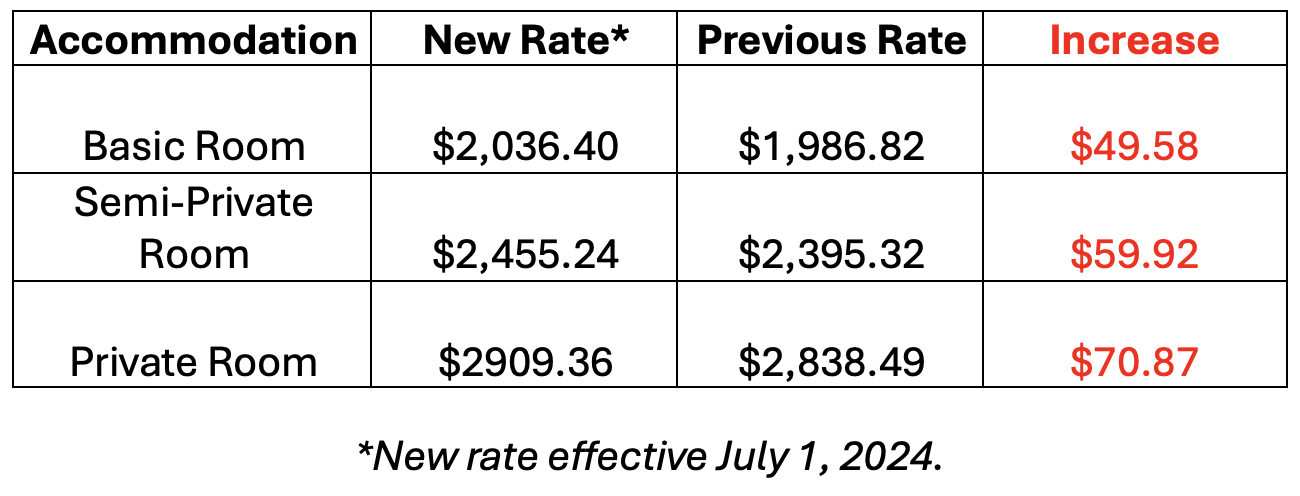
    The new rates for long-term care are out, and much like everything else these days, prices are going up.

    New long-term care rates beginning July 1, 2024

    It's typical for long-term care rates to nudge up every year. On July 1, 2024 the monthly rate for a basic room in long-term care is going up $49.58 to $2,036.40. Semi private rooms see a $59.92 bump up to $2,455.24. And private rooms see the biggest increase of $70.87 to $2,909.36.

    image

    Long-term care rate reductions

    Rate reductions continue to be available to low-income individuals living in a basic room, or partners living together in a two-bed semi-private room that has been redesignated as basic accommodation.

    From the Ministry of Long-Term Care

    All residents receiving a rate reduction should re-apply for a reduction in the basic co-payment rate for the 2024-25 cycle, beginning on July 1, 2024. Staff at your LTC home will provide you with the application form and will help you to submit your application to the Ministry of Long-Term Care.

  • Elderado Receives CABHI Ignite Grant to Improve Dementia Care Navigation in Ontario

    We’re proud to announce that Elderado has been selected as one of 23 innovators awarded funding through the Centre for Aging + Brain Health Innovation (CABHI)’s new Ignite program. This prestigious initiative supports early-stage Canadian companies working to improve aging and brain health, with a strong focus on dementia care, caregiver support, and care coordination.

    As part of the Ignite cohort, Elderado will receive funding and expert guidance to accelerate our mission: helping families in Ontario compare retirement homes and long-term care homes with clarity and confidence.


    What is CABHI Ignite?

    CABHI Ignite is a national innovation program powered by Baycrest, a global leader in brain health and dementia care. The Ignite program invests in promising early-stage solutions that tackle some of the biggest challenges facing older adults in Canada today.

    From AI-powered diagnostic tools to culturally safe dementia support platforms, CABHI is supporting a new generation of innovators. In total, $2.6 million in funding has been awarded to 23 organizations across six innovation themes:

    • Aging at Home
    • Caregiver Support
    • Care Coordination and Navigation
    • Cognitive and Mental Health
    • Financial Health and Wellness
    • Women’s Brain Health + FemTech

    How Elderado Supports Dementia Care in Ontario

    Elderado is a free online platform that simplifies the process of finding the right elder care option—whether you’re planning ahead or responding to a hospital discharge. We help families:

    • Compare retirement homes and long-term care homes in Ontario
    • Filter homes by language of care, cultural preferences, and services
    • Access inspection reports, video tours, menus, and activity calendars
    • Connect directly with homes that meet your needs

    This grant recognizes Elderado’s potential to improve care navigation for people living with dementia and their families—especially when language or cultural needs make the process even harder.

    Our work supports families who are often under pressure to make fast decisions without enough information. Elderado provides tools and insights that make it easier to choose the right care home with confidence.


    What the Grant Will Support

    With CABHI’s funding and expert support, Elderado will expand our platform’s ability to:

    • Highlight homes with dementia care programs
    • Make it easier to search by cultural and language preferences
    • Improve the experience for families from diverse communities across Ontario
    • Strengthen Elderado’s role as a trusted resource in dementia care navigation

    We’re especially excited to work with CABHI’s Leap validation platform to incorporate direct feedback from people living with dementia, caregivers, and health professionals.


    Why This Matters

    Dementia affects over 600,000 Canadians—and that number is growing. For many families, the search for elder care is complicated by urgent timelines, language barriers, and a lack of transparent information. Elderado was built to address that problem.

    With CABHI’s support, we’ll continue making elder care more accessible, inclusive, and transparent for all Ontarians.


    Learn More

  • Ontario Health atHome Medical Supply Shortage update

    Ontario Health atHome has acknowledged that they are critically short on medical supplies that can have serious implications for seniors receiving home care. If you or a loved one is dealing with a shortage of medical supplies, Ontario Health atHome has advised you follow these steps:

    1. Call you care coordinator.
    2. If your care coordinator is not able to help, call the medical supply escalation hotline at 1-866-377-7567.

    Additionally, Ontario Health atHome has added a reimbursement form for medical supplies to their website HERE. If you follow that link you will find the reimbursement form, as well as other contact information. Ontario Health atHome has stated:

    "Patients, their families and caregivers should not have to incur the cost of purchasing much-needed medical supplies on their own due to delivery issues. That is why we will be reimbursing any patient, caregiver or family member who has paid out of pocket for medical supplies due to delivery issues."

    We hope everyone dealing with the medical supply shortage are able to get the supplies you need.