Tag: News

  • Elder care innovation at Collision 2024

    The Collision Conference brought some of the biggest names in tech, marketing, AI, and healthtech to Toronto to talk about where we are headed, and showcase innovative startups. We were on the lookout for what's new in elder care, and these 4 startups stood out.

    ElderPRIME

    ElderPRIME helps aging adults and their families accurately track and communicate health needs and record, retain and securely share doctors' instructions to improve health outcomes, reduce diagnostic error, and prolong seniors' independence. Rob Parker, ElderPRIME Co-Founder & CEO, showed us a demo. We especially liked the ability for family members to add notes (if given permission). This can be especially helpful in a scenario where a loved one mentioned an issue or pain over the phone, but may not note it themselved on ElderPRIME. That family member can add the note so it's in the app the next time their loved one visits the doctor.

    Petalz Mosaic

    Petalz Mosaic is a private social media platform that aims to combat loneliness and build family unity. Basic plans begin at $19.99 and include a POD with 5 members. Anything shared on Petalz can only be seen by other members of your POD. This means families can feel comfortable to share images more freely than on traditional social media networks. The daily messaging feature, which is similar to an Instagram Story, is a popular feature to share a short daily video with your loved ones. Petalz Mosaic had been designed to run on Apple and most Android devices. However, Petalz Mosaic also offers an option to purchase a pre-configured device for $299.00 CAD.

    Whimble

    Whimble connects seniors and people with disabilities with on-demand support, so that no matter when unexpected issues arise, you can get the assistance you need to get back to what matters. Currently, Whimble is exclusive to Ottawa, but you can join their waitlist if you want to see Whimble near you.

    Emma, the founder of Whimble, told us care is $35/hour, and it can be arranged the same day – even with just a couple of hours of notice! Caregivers on Whimble must submit a vulnerable sector check via local police services, provide a minimum of 2 references who can speak to their relevant work experience, and undergo a live interview process to review their skills and qualifications.

    ConSoul Inc

    ConSoul aims to provide caregivers with the support and resources they need to prioritize their well-being and prevent burnout. ConSoul helps those caring for people with chronic, terminal or elderly illnesses to plan for what's next, connect with family and friends, and narrate their journey.

    ConSoul was born from the shared belief that everyone should have access to tools that support their individual health journeys and bring them closer to those who want to support and rally around them.
  • Delayed long-term care projects, a new Minister of Long-Term Care, and more. This is the week in elder care news

    Long-term care projects that still haven't broken ground, a new Minister of Long-Term Care, a call for comment on the role of resident support personnel, and 15,000 new caregivers from abroad. It's June 7, 2024, this is the week in elder care news.

    Four Windsor-Essex long-term care projects still haven't broken ground

    CBC is reporting that construction on 4 long-term care homes in the Windors-Essex area that was supposed to begin sometime over the last 2 years still hasn't begun. These 4 projects represent 200 news beds, and 504 upgraded beds, that were part of the plan to add 30,000 new beds by 2028. Advocates and community members say these delays are frustrating and show that seniors aren't a priority.

    The 2022 announcement promised that the following four homes would receive upgrades:

    • Banwell Gardens Care Centre: 192 upgraded care beds. Construction was supposed to begin summer 2022.
    • Berkshire Care Centre: 11 new and 181 upgraded beds in a new facility. Construction was expected to begin summer 2023.
    • Chateau Park Long-Term Care Home: 101 new and 59 upgraded beds in a new facility. The home will move from Windsor to Amherstburg. Construction was expected to start fall 2023.
    • Regency Park Long-Term Care Home: replaced by a brand-new building with 88 new and 72 upgraded beds. Construction was supposed to start winter 2023.

    CLICK HERE for the full story.

    Natalia Kusendova-Bashta is the new Minister of Long-Term Care

    Natalia Kusendova-Bashta is taking over as the Minister of Long-Term Care. Since March 28, Natalia has been Parliamentary Assistant to the Minister of Long-Term Care, and Parliamentary Assistant to the Minister for Seniors and Accessibility. Stan Cho, the outgoing Minister of Long-Term Care, is taking over the role of Minister of Tourism, Culture and Gaming, with responsibility for OLG.

    Global News coverd the entire cabinet reshuffle HERE.

    Have your say on the formalization of the role of resident support personnel in long-term care

    You have until June 15, 2024 to reply to the call for comment regarding formalizing the role of resident support personnel in long-term care. You can read our dedicated blog to this story HERE.

    Canada to provide permanent residence to 15,000 caregivers

    Canada has announced two programs to attract 15,000 new caregivers to move here to work with the promise of permanent residence. Through these new pilot programs, candidates interested in working in Canada’s home care sector will be eligible to apply if they meet the following criteria:

    • Attain a minimum of level 4 based on the Canadian Language Benchmarks (CLB)
    • Hold the equivalent of a Canadian high school diploma
    • Have recent and relevant work experience
    • Receive an offer for a full-time home care job

    You can find the details HERE.

  • The Role of Resident Support Personnel in Long-Term Care Homes

    Are Resident Support Personnel going to replace PSWs in long-term care?

    Resident Support Personnel

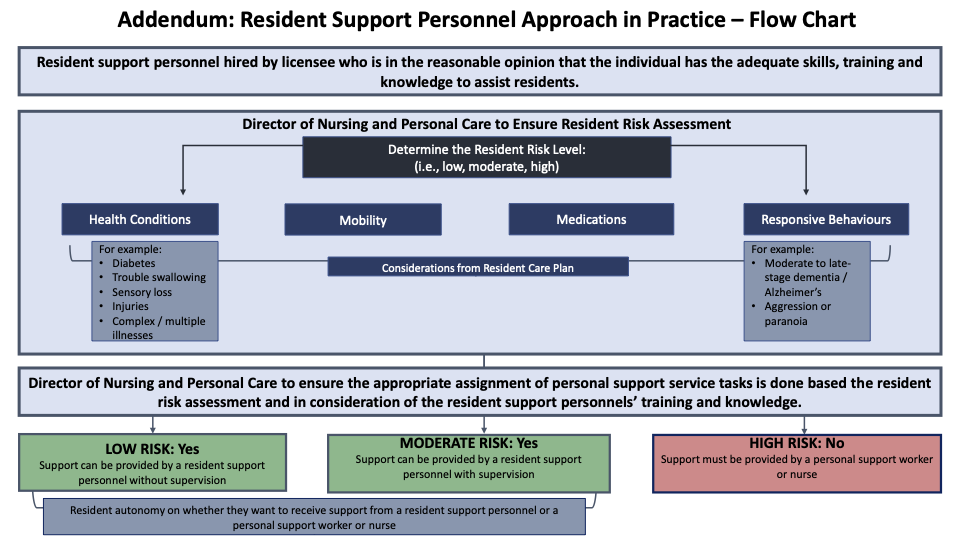
    Resident Support Personnel, or RSPs, provide some personal support services to low-risk residents (for example, helping brush a resident's hair or teeth). RSPs have acted as a stopgap solution to help support largely understaffed healthcare teams in long-term care. The Ministry is currently seeking feedback to amend the Fixing Long-Term Care Act, 2021 to give RSPs a more formalized role.

    The Ministry is working to stabilize the role of resident support personnel beyond July 1, 2025. To achieve this, they consulted the Regulatory Registry from September 29, 2023, to November 20, 2023. The consultation focused on whether these personnel should be allowed to permanently provide personal support services to low-risk residents or if their role should be limited after July 1, 2025.

    The feedback from the consultation generally supported maintaining the role of resident support personnel in long-term care as a supplement to personal support workers. Key points from the feedback include:

    • Resident support personnel provide timely care and help reduce the workload of personal support workers and nurses, allowing them to focus on specialized tasks.
    • This role offers a pathway for individuals to enter and explore careers in the long-term care sector.
    • Concerns were raised about whether resident support personnel have sufficient training to provide direct care without supervision.
    • There is a call for the Ministry to provide additional guidance on the role of resident support personnel.

    Resident Support Personnel Plan

    The Ministry is planning to change a rule so that long-term care homes can keep using resident support personnel after July 1, 2025. Here's what they are proposing:

    • Long-term care homes can hire people to work as resident support personnel, even if they don't have personal support worker education, as long as they have the right skills and the Director of Nursing agrees.
    • The Director of Nursing will make sure that the right staff member is assigned to each resident, based on their care plan and needs.
    • Resident support personnel can help low-risk residents with personal care, but they might be supervised by a nurse or personal support worker, depending on the resident's needs.
    • Resident support personnel cannot provide personal care to high-risk residents.
    • Care plans must always be based on what residents need and prefer, including their choice of caregiver (like a nurse or personal support worker).
    • The ministry will give guidelines to homes on how to safely use resident support personnel, including what tasks they can and cannot do.
    • The ministry also supports resident support personnel in becoming personal support workers through the Learn & Earn Accelerated Program, and they will look for more ways to help them advance their skills.

    image
    CLICK HERE

    What do you think?

    What do you think of the plan to formalize the role of RSPs in long-term care? Is it a good idea to improve staffing levels, or a slippery slope that could leave us with even fewer healthcare professionals in long-term care homes?

    Want your voice heard? Make sure you respond to the public call for comment that's open until June 15, 2024.

  • Housing prices need to remain high for retirees, nurses get a raise, and the Ontario NDP calls on the provincial government to protect retirement home residents

    Trudeau says housing needs to retain its value to protect people's retirement, Long-term care nurses get a raise, the NDP calls for an amendment to stop retirement home evictions. It's Friday May 31, 2024, this is the week in elder care news.

    Trudeau says housing needs to retain value for peoples' retirement

    Prime Minister Trudeau commented on the Globe and Mails City Space Podcast, “Housing needs to retain its value…It’s a huge part of people’s potential for retirement and future nest egg.” Many Canadians view their homes as their single largest asset and as a way to support their retirement, but this makes it more challenging for renters and Canadians looking to purchase their first home.

    You can listen to the podcast HERE.
    You can read the full story HERE.

    Ontario long-term care nurses get a raise

    Nurses in Ontario long-term care homes are getting a much deserved raise! A recent arbitration decision grants members of the Ontario Nurses’ Association a pay raise of approximately 11.5% over two years. The top rate for nurses will increase $5.82 to $54.60 over 2 years.

    Learn more HERE.

    NDP call for amendments to the Residential Tenancies Act to prevent the eviction of Ontario retirement home residents

    The Ontario NDP are calling for changes to amend the Residential Tenancies Act to prevent the eviction of Ontario retirement home residents. The demand comes in the wake of the eviction of more than 200 residents of Heritage Glen Retirement Residence in Mississauga. Chartwell says it has helped more than 170 Heritage Glen residents find alternative accommodations as part of an assistance package, but some residents and their families say the eviction has turned their life upside down.

    Find the full story HERE.

  • A new approach to caring for seniors with dementia, Community Paramedicine, and a new class of PSWs

    A new approach to caring for seniors with dementia, Community Paramedicine helping seniors stay out of the hospital, and a new class of PSW graduates. It's May 24, 2024, this is the week in elder care news.

    A new approach to long-term care for seniors with dementia

    A new long-term care home has opened in Châteauguay, Quebec, that is using a 'small household' model to care for residents. Each of the 10 small households have 12 residents that share a large communal space and kitchen, which makes it welcoming for family and friends to visit, and even cook a meal together. Families say it feels welcoming, and they notice their loved ones feel cared for – not pushed aside. 46 long-term care homes like this have been planned for Quebec.

    Find the full story HERE.

    Community Paramedicine for Long-Term Care program is helping keep seniors out of the hospital

    Sudbury’s community services committee says the Community Paramedicine for Long-Term Care program has reduced emergency department visits by 24%. Last year Community Paramedicine attended to 975 calls, and of those calls there were 700 instances where residents were able to avoid going to the hospital. The program is helping keep seniors out of the hospital who don't need to be there, and saving the healthcare system money.

    HERE is a link to the full story.

    165 new PSWs graduate from Fanshawe College

    Fanshawe College said it graduated 165 students in the winter term. Many of the new PSWs will be working in retirement homes and long-term care, and we want to take a moment to celebrate them, and wish them a long and fulfilling career.

    Read more HERE.

  • GERIMEDRISK Expands, a Peterborough LTC home forced to halt admissions, and a special perfomance at Leacock Lodge

    GERIMEDRISK expands across Ontario, a Peterborough long-term care home is forced to halt admissions, and Leacock Lodge residents got a special performance. It's Friday May 17, 2024 this is the week in Elder Care News.

    GERIMEDRISK expands across Ontario

    GERIMEDRISK received $4.1 million in Provincial funding to expand from Kitchener to all of Ontario. GERIMEDRISK connects health-care professionals with geriatric specialists to work collaboratively to address the needs of patients. GERIMEDRISK also helps prevent overlap of medication that could give an adverse reaction and send seniors to hospital.

    Find the full story HERE.

    St. Joseph’s at Fleming forced to suspend admissions

    New resident admissions have been suspended at Peterborough’s St. Joseph’s at Fleming long-term care. Brad Robinson, director of Ontario's long-term care inspections branch, issued the suspension on new resident admissions based on his belief there is a risk of harm to the health and well-being of the home’s residents, or anyone who might be admitted as a resident.

    Find the full story HERE.
    Find the 118-page inspection report HERE.

    Leacock Retirement Lodge get a special performance

    Leacock Retirement Lodge was rocking as Rick Stephenson and the Orillia Concert Band performed hits made famous by Frank Sinatra. The band and Stephenson presented back-to-back performances at the St. Paul's Centre in Orillia over the weekend, but recognized some residents aren't able to travel to concert venues, so they brought the show to them! "The smiles on the residents' faces as the band and Rick performed made playing the third day in a row worth every second," said a band official.

    Find the full story HERE.

  • Ontario Caregiver Support Benefit – $400/month for caregivers proposed by MPP Wayne Gates

    Could you use an extra $400/month as a caregiver?

    Wayne Gates, MPP for Niagara Falls, and the official Opposition critic for long-term care, introduced legislation for an Ontario Caregiver Support Benefit. The Caregiver Support Benefit would provide a $400/month caregiver allowance to help offset some of the financial challenges of caregiving for a loved one. Caregivers are often spending 10-20 hours a week or more providing care, and 77% of caregivers are having to dip into their savings. According to Gates the Caregiver Support Benefit can save Ontario $480-million on long-term care.

    Ontario Caregiver Support Benefit supporters

    The Caregiver Support Benefit is supported by a number of organizations including the Ontario Caregivers Coalition, the Young Caregivers Association, the Alzheimers Society, the Canadian Centre for Caregiving Excellence, the Canadian Cancer Society, MS Canada, and Community Living Ontario. It's also supported by Liberal MPP John Fraser & Green Party Leader Mike Schreiner.

    If you support the motion for an Ontario Caregiver Support Benefit, Wayne Gates is asking you to write a letter of support to your MPP, which can be done HERE.

    Conservative Response

    Conservative MPP Nolan Quinn provided a rebuttal to the Caregiver Support Benefit. Although Quinn agreed the status quo for home care is not working, Quinn promoted investments in the current budget, including $2-billion over the next 3 years for Home and Community Care.

    What do you think?

    So what do you think? Is the Ontario Caregiver Support Benefit a good step to supporting caregivers, or would you rather see those resources go towards home and community care?