Tag: Family and Caregivers

  • Crashing 9 Chartwell Retirement Home’s Open Houses!

    On January 17 and 18, Chartwell hosted a National Open House event – and I crashed it!

    Friday

    I set out to hit as many Chartwell retirement homes as I could. Along the way I made a video at each home I toured to give you a peek inside, and tell you more about retirement living.
    image

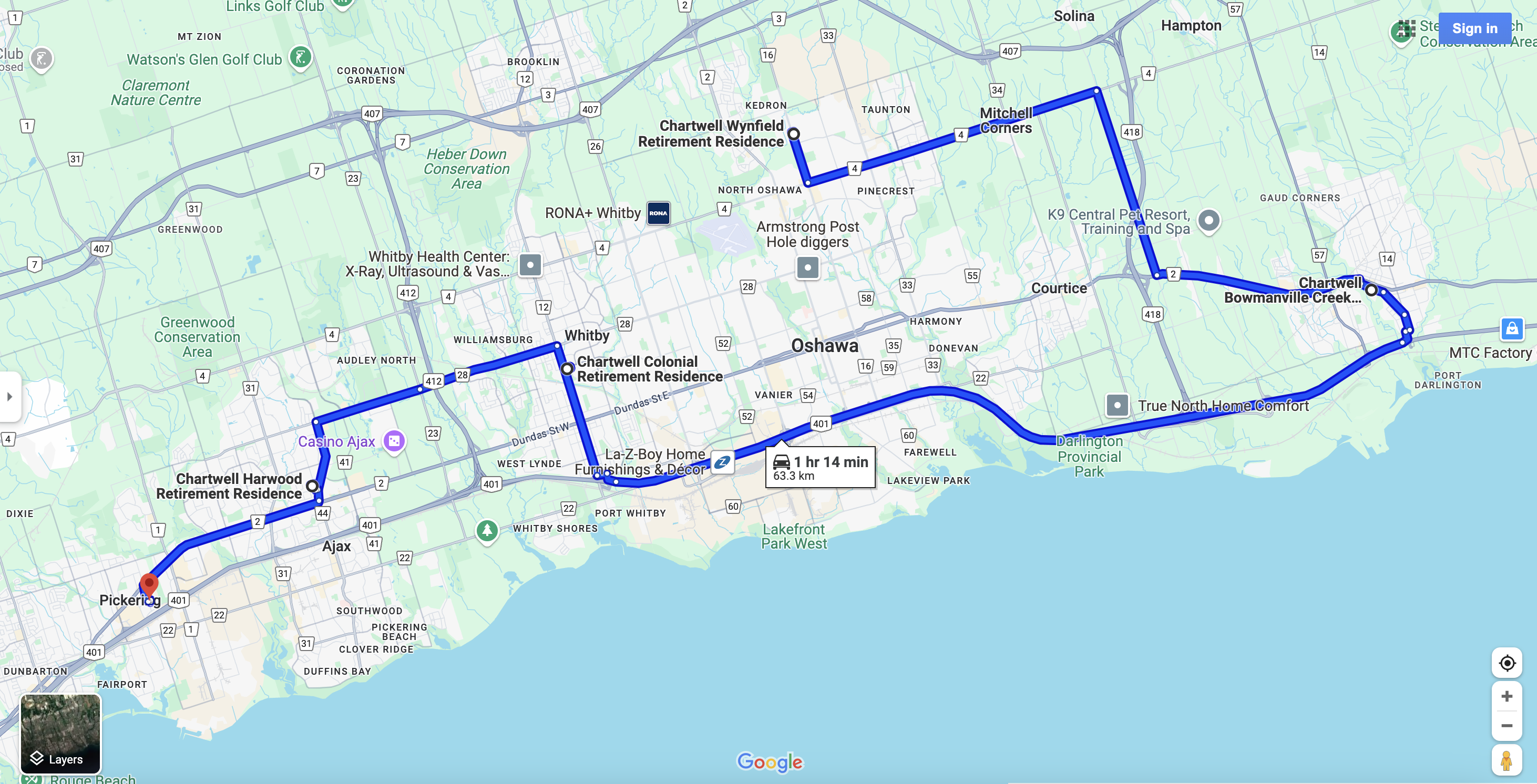
    My planned route on Friday started at Chartwell Wynfield in North Oshawa. From there I'd head east to Chartwell Bowmanville Creek in Bowmanville, before working my way back west. I'd hit Chartwell Colonial, Chartwell Harwood, and finish my day off at Chartwell Pickering City Centre. It was an ambitious plan – I'd never toured more than 2 retirement homes in a day, but I figured I could manage.

    Chartwell Wynfield – Options to check out a retirement home

    A bit about Chartwell Wynfield in Oshawa

    • Independent living and assisted living
    • Suites start from $4,040/month (at the time of writing)
    • Studios, one-bedroom, one-bedroom plus den, and two-bedroom suites
    • Amenities include a bistro, library, and covered patio

    At Chartwell Wynfield I talked about the different ways you can check out a retirement home.

    If you want to have a look around inside you can:

    • check out an open house, like the one I'm at
    • schedule a tour (and if you go on a tour, most homes will offer you lunch so you can try the food – which I highly suggest doing)

    Or if you want to get a feel for retirement homes without visiting each one you can:

    • use Elderado to review and compare every retirement home
    • likely find people from local retirement homes at 55+ events in your neighbourhood
    • visit to each retirement home website

    Chartwell Bowmanville Creek – 3 things to lookout for on a retirement home tour

    A bit about Chartwell Bowmanville Creek in Bowmanville.

    • Independent living
    • Suites start at $4,521/month (at the time of writing)
    • Studios, one-bedroom, one-bedroom plus den, and two-bedroom suites
    • Amenities include an indoor pool, indoor putting green, demonstration kitchen, and cafe

    At Chartwell Bowmanville Creek I shared 3 things to keep an eye out for when you're looking at retirement homes:

    1. Do staff acknowledge residents? Homes where staff acknowledge the residents when they pass in hallways tend to have a warmer feel and higher resident satisfaction. And bonus points if staff acknowledge residents by name.
    2. Are there spaces outside your room where you can see yourself spending time? A lot of residents are downsizing, the transition to a smaller living area is a lot smoother if there's other places in the retirement home where you're comfortable.
    3. Are activity calendars and menus posted throughout the home up to date? It's not the end of the world if they're not, but it can be a sign the home lets the details fall through the cracks.

    And don't forget to trust your gut. This is your home, if it doesn't feel right, keep looking – you can always circle back.

    Chartwell Colonial – What is the RHRA?

    A bit about Chartwell Colonial in Whitby

    • Independent living
    • Suites start at $3,021/month (at the time of writing)
    • Studio, and one-bedroom suites
    • Amenities include a movie theatre, bistro, country kitchen, and renovated patio

    At Chartwell Colonial I explained what the Retirement Home Regulatory Authority, or RHRA, is.

    • The RHRAs responsible for licensing and inspecting retirement homes in Ontario
    • If you have a complaint or need to report harm, the RHRAs there to help.
    • RHRA inspection reports are public and free to view.
    • There are some retirement communities that look like but are NOT retirement homes, and those residents aren't protected by the RHRAs safeguards.
    • You'll know a retirement home's licensed because their RHRA licence will be on display, usually near the front door.
    • At Elderado we only include licensed retirement homes, as well as long-term care homes.
    • You may have virtually no contact with the RHRA, but it's good to know they're there if you need them.

    Chartwell Harwood – How much does it cost to live in a retirement home?

    Some information about Chartwell Harwood in Ajax.

    • Independent living
    • Suites starting from $4,226/month (at the time of writing)
    • Studios, one-bedroom, one-bedroom plus den, and two-bedroom suites
    • Amenities include a library, fitness room, pub & lounge, and courtsey van

    At Chartwell Harwood I tackled one of the most popular topics when it comes to retirement living – PRICE!

    • Not all retirement home prices are created equal.
    • Some homes have a la carte pricing, while others are all inclusive.
    • Typically, as your care needs increase, so does the price.
    • You may be able to offset some of these costs if you qualify for free home care from Ontario Health atHome, but that's likely not going to be enough – whether you're in a retirement home or private residence.

    I want to give props to Chartwell for including prices on their website. Only about 1/3 of retirement homes do this. I think public price transparency should be required across the board.

    Chartwell Pickering – What's in the local area?

    Here's some info about Chartwell Pickering City Centre in Pickering.

    • Independent living
    • Suites starting from $4,227/month (at the time of writing)
    • One-bedroom and two-bedroom suites
    • Amenities include a games room, fitness studio, movie theatre, and library

    Saturday

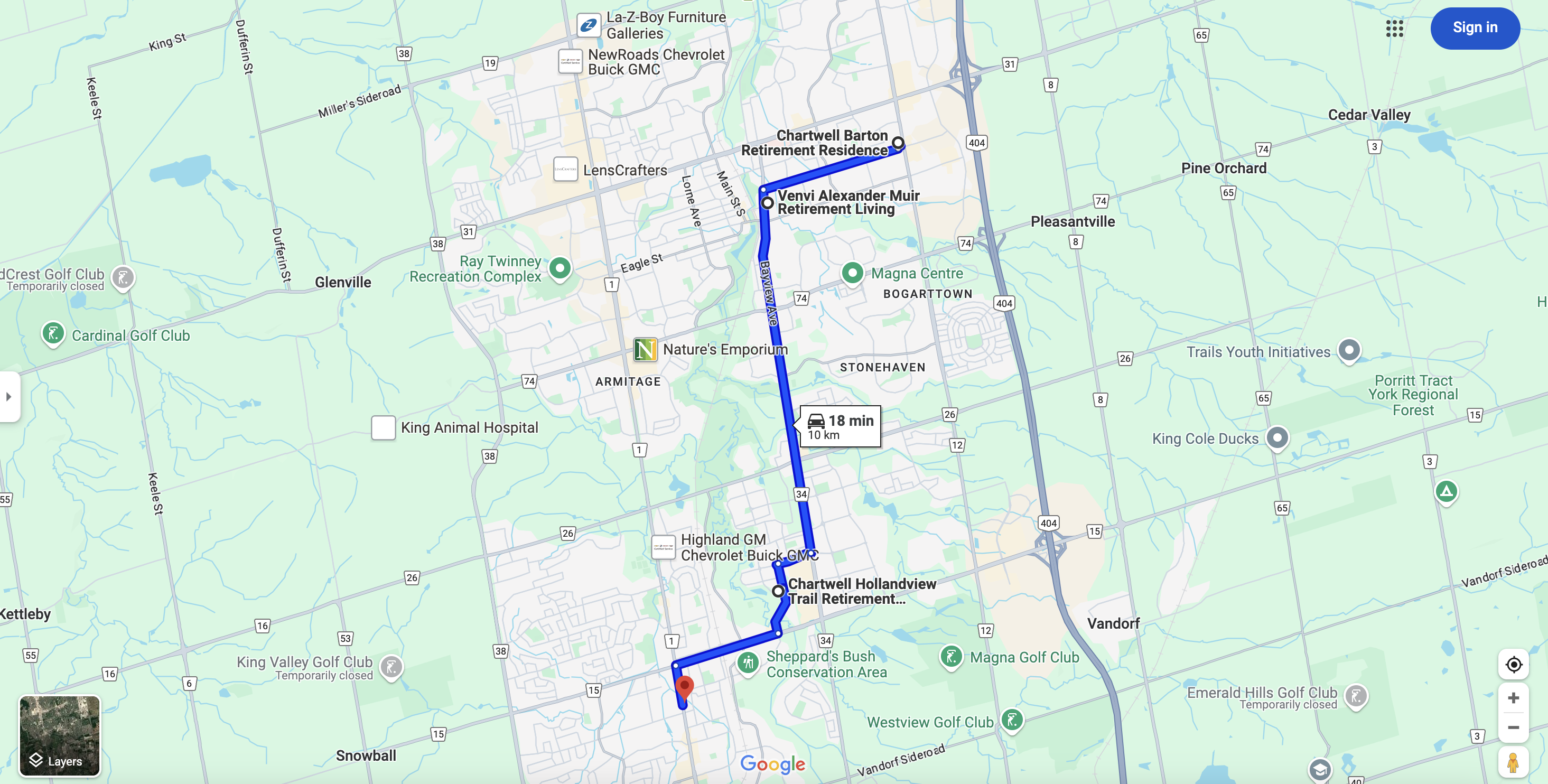
    On Saturday I started at Chartwell Barton in Newmarket, and worked my way south to Chartwell Park Place in Aurora.
    image

    Chartwell Barton – Long-term care vs. Retirement homes

    A bit about Chartwell Barton in Newmarket.

    • Independent living
    • Suites start at $3,288/month (at the time of writing)
    • Studio, one-bedroom, and two-bedroom suites
    • Amenities include a library, fitness studio, activities and games room, and a tranquil backyard.

    At Chartwell Barton I went over the difference between long-term care and retirement homes.

    • Long-term care is subsidized by the provincial government and typically cheaper, while retirement homes are private care and costs go up as care needs rise.
    • Most long-term care has a sterile feeling, while some retirement homes can rival high end real estate.
    • Long-term care has long waitlists, while retirement homes average less than 85% occupancy.

    Alexander Muir – Are you in the same cohort as the other residents?

    Chartwell Alexander Muir has since changed ownership, and it's now Venvi Alexander Muir Retirement Residence in Newmarket.

    • Independent living
    • Studio and one-bedroom suites
    • Amenities include a lounge, theatre, billiards room, and patio

    At Alexander Muir I talked about the importance of being in the same cohort as your fellow residents to get the most out of retirement living.

    • Leigh and Lori from Discerning Seniors are big advocates of this, and they were the ones who brought it to my attention.
    • If you're active or social, you'll probably have more fun with other active and social residents. If that's you, you should have a look at an activity calendar and the amenities. Find something you can see yourself doing if you moved in, and ask the salesperson if you can drop in and take part. I bet they say yes. I get it, this can be a little outside our comfort zone, but if you're serious about moving in, it's worth it to get an idea of the neighbours and amenities.

    Chartwell Hollandview Trail – Do you know about the Residents Bill of Rights?

    A bit about Chartwell Hollandview Trail in Aurora.

    • Independent living and assisted living
    • Suites starting from $5,450/month (at the time of writing)
    • Studios, one-bedroom, one-bedroom plus den, and two-bedroom suites
    • Amenities include a country kitchen, a variety of common areas, a grand piano, and movie theatre

    At Chartwell Hollandview Trail I talked about the Residents Bill of Rights – it goes hand-in-hand with the RHRA. There's a few rights I think are worth highlighting:

    • The right to apply for publicly funded care.
    • The right receive care from an external care provider.
    • The right to have his or her choice of care services provided by staff who are suitably qualified and trained.
    • The right not to be restrained except in accordance with the law.
    • The right to have his or her lifestyle and choices respected as long as nobody crosses a reasonable line.

    Nothing crazy, but it's important to know your rights.

    Chartwell Park Place – Questions to ask on a retirement home tour

    A bit about Chartwell Park Place in Aurora.

    • Independent living
    • Suites start at $2,995/month (at the time of writing)
    • Studio and one-bedroom suites
    • Amenities include a library, movie room, lounge, and pub

    At Chartwell Park Place I touched on having questions prepared when you tour a retirement home. It's easy to get caught up in the moment during a tour, so it helps to have questions prepared when you come in for a tour.

    • Do I have quality of life questions? Medical concerns (both in the short term and long run)?

    The more open you can be, the better the salesperson can help. Asking questions is gonna help you find the retirement home that's right for you.


  • A Night To Remember with A Rose For Grandma

    On February 22, 2025 I got to attend the A Night To Remember Gala hosted by A Rose For Grandma. There was good food, great people, and my favourite part was the caregivers who shared their stories. It was both inspiring and humbling to hear so many people share their why!

    Dementia support in the BIPOC community

    A Rose For Grandma Wellness Hub is working to improve dementia care for Black, Indigenous, and People of Colour (BIPOC) communities, who often face significant challenges in accessing high-quality care. Barriers such as limited access to healthcare, transportation difficulties, and language differences contribute to delayed diagnosis and reduced access to support. Cultural stigma around dementia can also discourage families from seeking help, while BIPOC communities are often underrepresented in dementia research, limiting the development of culturally appropriate resources and care strategies.

    A Rose For Grandma Wellness Hub is taking a collaborative approach, working with individuals living with dementia, their families, healthcare providers, governments, and other organizations. The goal is to create culturally responsive care that reflects the unique beliefs and needs of BIPOC communities, while also advocating for better representation in research and improved access to services. By addressing these gaps, the Wellness Hub aims to improve the overall quality of life for people living with dementia and their families.

    Supporting local, community charities

    I think the Alzheimer's Society, Heart & Stroke Foundation, and other big charities do incredible, important work, but we can't overlook local charities in the community that are likely underfunded, but sure can stretch a dollar.

    What was clear from A Night To Remember was the tangible impact A Rose For Grandma is able to have.

    There's a million worthy causes. The next time you are looking for a charity to support, don't shy away from taking a look at smaller, local organizations.

    They might not have the name recognition or the best website, but you may find they're having an oversized impact on a shoestring budget.

  • Aspira Open House Event

    Aspira Retirement Living hosted an open house event yesterday – I checked it out!

    Before yesterday I hadn't spent a ton of time in Aspira retirement homes, so I was excited to find out they were hosting a National Open House event on February 22, 2025.

    But Aspira, I do have to call out that it's got to be easier for people to know you have an open house going on. If you posted about it on your social media accounts I couldn't find it.

    My original plan was to start at Aspira Douglas Crossing Retirement Living in Uxbridge, and then work my way south, but plans changed when I found out they're under outbreak. Instead I decided I would start at Aspira Empire Crossing Retirement Living in Port Hope, and then make my way west.

    Aspira Empire Crossing Retirement Living in Port Hope

    Aspira Empire Crossing retirement home in Port Hope, Ontario offers independent living. Suites start at $3,990/month.

    A few notes from my tour:

    • Pet friendly
    • Every suite has a balcony or walk out
    • Smaller, intimate home, with good sized suites
    • Small, but engaging activity space
    • About 10 year old building
    • Independent living – need to be independent, or cognitively and physically able to ask for help

    After a quick stop at McDonalds – for whaver reason my guilty pleasure on these big retirement home days, I was off to Aspira Traditions of Durham in Oshawa.

    Aspira Traditions of Durham retirement home in Oshawa

    Aspira Traditions of Durham offers independent living and assisted living. Studio suites in independent living start at $3,425/month.

    A few notes from my tour:

    • Big spacious dining room
    • 2 seatings at meal times
    • South facing suites on upper floors have a view of green space and Lake Ontario
    • A lot of residents were actively engaged in open house activities
    • Wide hallways so 2 people in wheelchairs can easily pass each other
    • Spacious bathrooms compared to many retirement homes

    April 1, 2023

    On April 1, 2023, a 79 year-old resident died after being locked out of Traditions of Durham overnight. 3 ex-employees and the retirement home itself have been charged with criminal negligence causing death. This is an incredibly tragic event, and my thoughts are with the deceased and their loved ones.

    I don't have any insights into this case beyond what has been widely reported in the news (for example CBC). But my understanding is that there have been widespread changes to the care and management teams. One of those new team members is Razeea Khan, Sales Advisor at Traditions of Durham. She joined less than a year ago. Razeea and I have crossed paths a dozen times at networking events. I would trust my loved one would be safe in a home where Razeea worked. You need to have a level of trust with any retirement home, long-term care home, or home care provider, and I'd have more trust knowing Razeea is there. Take that for what you will.
    image


    My final stop would be Aspira Lynde Creek Gardens Retirement Living in Whitby.

    Aspira Lynde Creek Gardens retirement home in Whitby

    Aspira Lynde Creek Gardens offers independent living. Studio suites start at $2,985/month.

    A few notes from my tour:

    • Nestled in a private community, surrounded by life lease townhomes
    • Coffee shops, grocery stores, and more within a 10-15 minute walk
    • Recently renovated with a warm, open aesthetic when you walk in the front doors
    • Backs onto a ravine with walking trails close by

    Location, location, location

    For me personally, there's a lot Aspira Lynde Creek Gardens has going for it. I love the location. If you drive, you could pick up your groceries, drop into the LCBO, grab a coffee, play pickleball, and walk some great trails whenever you want, AND only have to fill your gas tank 4 times a year. But the even bigger benefit of it is that for as long as I can walk, all that stuff is close enough that I can make a morning out of walking there. I like the idea of retiring somewhere peaceful, but having most of what I need within a long walk, and in that maner Aspira Lynde Creek Gardens delivers.

    Next Open House Event

    I don't know when the next big retirement home open house event will be, I'll keep my ear to the ground. But if you come across an open house for a retirement home in your area, check it out. It doesn't hurt to have an idea of what retirement living can look like – it might surprise you.

  • New Pilot to Prioritize Cultural Matches in Long-Term Care Homes in Ontario

    The Ministry of Long-Term Care in Ontario is planning to test a new system to help people find spots in long-term care (LTC) homes that match their culture, religion, language, or ethnicity, and there is an open call for comment HERE. This project, called the Long-Term Care Homes Cultural Pilot Project, will try to make it easier for people to get into homes where they feel more at home culturally.

    Some LTC homes in Ontario focus on serving specific cultural or religious groups. But recently, these homes have seen fewer residents who match the culture they aim to support, and fewer spots are available that meet applicants' cultural needs. This makes it harder for these homes to offer the cultural, religious, and language support their residents need.

    The current system puts people on a waiting list for LTC homes based on how urgently they need a spot. In this pilot project, the Ministry wants to test a new way of organizing these waitlists for people in crisis (those in category 1). For the homes selected to participate, people on the crisis waiting list who share the culture or religion that the home primarily serves could be prioritized, even if others on the list are also in crisis.

    To make this pilot work, the Ministry would change the rules for ranking applicants. In designated homes, people with an urgent need for care would still be ranked first, but if two or more people have the same level of urgency, the applicant who matches the home’s cultural focus would get priority.

    The goal is to see if this new ranking system can help improve access to culturally appropriate long-term care for Ontarians.

    CLICK HERE to read the full proposal or to comment. Comments are open until November 26.

  • Ontario Health atHome Medical Supply Shortage update

    Ontario Health atHome has acknowledged that they are critically short on medical supplies that can have serious implications for seniors receiving home care. If you or a loved one is dealing with a shortage of medical supplies, Ontario Health atHome has advised you follow these steps:

    1. Call you care coordinator.
    2. If your care coordinator is not able to help, call the medical supply escalation hotline at 1-866-377-7567.

    Additionally, Ontario Health atHome has added a reimbursement form for medical supplies to their website HERE. If you follow that link you will find the reimbursement form, as well as other contact information. Ontario Health atHome has stated:

    "Patients, their families and caregivers should not have to incur the cost of purchasing much-needed medical supplies on their own due to delivery issues. That is why we will be reimbursing any patient, caregiver or family member who has paid out of pocket for medical supplies due to delivery issues."

    We hope everyone dealing with the medical supply shortage are able to get the supplies you need.

  • What you need to know about Adult Guardianship?

    Rachel Merucci from TBH Legal joined us to answer all our questions about adult guardianship. Adult guardianship in Ontario is a legal mechanism designed to protect individuals who are unable to make certain decisions for themselves due to physical or mental incapacity. It allows a designated guardian to make decisions on behalf of an adult who has been deemed incapable, with the goal of safeguarding the person’s well-being and managing their affairs. Someone might need an adult guardian instead of a Power of Attorney (POA) if they didn’t establish a POA before becoming mentally or physically incapable.

    What if it's too late to create a Powers of Attorney?

    We all know we should have a Will and Powers of Attorney (POA), but what do we do if we need a POA and don’t have one? That’s what Adult Guardianship is for.

    Powers of Attorney vs. Adult Guardianship

    In general, Powers of Attorney are created by someone when they are mentally capable in case they need it in the future, and they pick who they want to step in to make decisions for them. An adult guardian is someone who steps up and asks to be picked for the responsibility because their loved one has been proven to be mentally incapable.

    What are the two types of Adult Guardians?

    Adult guardianship appears to be modelled after Powers of Attorney. There's guardianship of personal care, and personal care of property.

    What age does someone need an Adult Guardian?

    In Ontario as soon as someone is 18 years-old they are assumed to be mentally capable to make their own decisions. If someone is not mentally capable they could require an adult guardian at 18 years-old.

    Why might you need to be an Adult Guardian?

    Caregivers to incapable adults have to have the legal authority before they can step in to make decisions, apply for benefits, pay bills, etc.

    How do I become an Adult Guardian?

    There are two ways to become an adult guardian – through a judge in court, or through an application process through the Office of the Public Guardian and Trustee.

    What is the process to become Adult Guardian of Property?

    If you are to apply to be an adult guardian of procerty through the application process, the process involved picking a capacity a assessor for your loved one, answering questions about the incapable adults expenses and assets, and reading and understanding the responsibilities of an adult guardian. Everything is sent to the Office of the Public Guardian and Trustee, who is responsibile for granting adult guardianship.

    How long does it take to be granted Adult Guardian of Property?

    It usually takes about 1 month to complete the Adult Guardian of Property application, and once the application has been submittied it typically takes 3 weeks to 6 months to be approved.

    Is the process to become an Adult Guardian different at different ages?

    No, it's the same at all ages as long as the incapable adult is at least age 18.

  • Can Cannabis Be Used in Long-Term Care Homes in Ontario?

    Disclaimer: Elderado is not suggesting or encouraging the use of cannabis in any form.

    Since the legalization of recreational cannabis in Canada in 2018, its use among seniors has been steadily increasing. Cannabis, once a taboo topic, is now becoming a conversation starter, including in settings like long-term care homes where health, comfort, and quality of life are key concerns. But with this rise in popularity comes questions about the rules and regulations surrounding cannabis use in these environments. Can residents of long-term care homes in Ontario legally use cannabis, and if so, under what conditions?

    The short answer is, sort of – the Fixing Long-Term Care Act states:

    (2) Nothing in this Regulation prevents a resident from cultivating, acquiring, consuming, administering, possessing, storing or disposing of recreational cannabis in accordance with the licensee’s policies and procedures as required by subsection (1).

    One long-term care home told us:

    "Residents are able to consume alcohol and cannabis unless the doctor deems that it would not be safe due to a health condition/medication. Residents would either store their alcohol/cannabis locked in their room, or locked in the medication room with the nurse, depending on a capacity assessment that is completed (goes over risk, abilities, etc.). Residents have choice and can consume at their leisure, however there are rules in place for where they can/can’t."

    In this blog, we'll explore the key regulations and considerations related to cannabis use in long-term care homes in Ontario, referencing both the Cannabis Control Act and the Fixing Long-Term Care Act. We’ll also look at the increasing usage of cannabis by seniors, supported by recent studies.

    The Growing Popularity of Cannabis Among Seniors

    Since Canada legalized cannabis in 2018, the stigma around its use has slowly faded, and many people, including seniors, have begun exploring its potential benefits. According to a 2021 study by the Canadian Institute for Health Information (CIHI), the use of cannabis among seniors (aged 65 and older) more than doubled from 2017 to 2019. Many seniors are turning to cannabis as an alternative treatment for conditions like chronic pain, insomnia, and anxiety, with both recreational and medicinal cannabis use rising.

    A 2020 study published in the Journal of the American Geriatrics Society found that 15% of Canadian seniors reported using cannabis, with most of them doing so for medical reasons. For long-term care residents, the potential benefits of cannabis include helping to manage pain, reduce the need for opioids, and improve overall well-being.

    The Cannabis Act and Long-Term Care Homes

    The Cannabis Act, which came into effect in October 2018, legalized the recreational use of cannabis across Canada. It allows adults to possess and share up to 30 grams of dried cannabis or its equivalent in other forms, grow up to four plants per household, and purchase cannabis from licensed retailers. However, the act also gives provinces and territories the authority to implement additional rules and restrictions, particularly when it comes to where cannabis can be consumed.

    In Ontario, cannabis use is regulated by a combination of laws, including the Cannabis Control Act, 2017, the Cannabis Licence Act, 2018, and the Smoke-Free Ontario Act, 2017. While adults are generally allowed to use cannabis in private residences, the rules for public consumption are stricter and aligned with those for tobacco. In institutional settings like long-term care homes, the regulations can vary depending on the facility’s policies and whether the use is recreational or medicinal. Exemptions to public consumption rules may apply in certain long-term care or retirement homes under specific conditions.

    The Fixing Long-Term Care Act, 2021

    The Fixing Long-Term Care Act, 2021 is a key piece of legislation in Ontario that governs long-term care homes. It establishes standards for the safety, care, and rights of residents in these facilities. When it comes to cannabis use, long-term care homes must balance the residents' rights to make personal choices with the need to ensure the safety and well-being of all residents.

    There is no blanket prohibition on cannabis use in long-term care homes, but individual homes may have specific policies that residents must follow. These policies are usually designed to ensure that cannabis use does not interfere with the care environment, the safety of residents, or the legal obligations of the home. For instance, some homes may require residents to consume cannabis only in designated areas, and smoking or vaping cannabis indoors is generally prohibited under Ontario’s Smoke-Free Ontario Act.

    Medicinal Cannabis in Long-Term Care Homes

    For residents who use cannabis for medical reasons, the situation can be more straightforward. Under Canadian law, individuals with a medical authorization can legally access cannabis products to treat various health conditions. Long-term care homes in Ontario are required to accommodate residents' medical needs, including those who have been prescribed cannabis by a healthcare professional.

    However, the use of medical cannabis in long-term care homes may come with additional regulations. Homes must ensure that cannabis products are stored securely, administered safely, and do not pose a risk to other residents. In some cases, residents may be required to provide a medical prescription, and the home’s staff may be involved in managing the resident's cannabis use, similar to how they handle other medications.

    Key Considerations for Residents and Families

    If you or a loved one is considering using cannabis while living in a long-term care home in Ontario, here are a few key points to keep in mind:

    1. Check the Home's Policies: Each long-term care home may have its own rules about cannabis use. Be sure to ask about these policies before bringing cannabis into the home.

    2. Consider Medical Authorization: If you plan to use cannabis for medical purposes, having a prescription from a healthcare provider can simplify the process. It also ensures that the long-term care home is aware of your medical needs and can provide appropriate support.

    3. Respect Other Residents: Remember that cannabis use, especially smoking or vaping, can affect others. Be mindful of the designated areas for cannabis use, and always follow the home’s guidelines.

    4. Safety First: Long-term care homes have a responsibility to maintain a safe environment for all residents. This means that cannabis products, like any other medications, must be stored securely to prevent accidental ingestion by others.

    Conclusion

    The Cannabis Act provides the legal framework for cannabis use across Canada, while the Fixing Long-Term Care Act governs how long-term care homes manage cannabis use among residents. If you or a loved one is living in a long-term care home and considering cannabis, it’s important to understand the home’s policies and ensure that your use complies with all laws, rules, and guidelines.

    Cannabis use among seniors has been on the rise since its legalization in 2018, with many finding it beneficial for managing chronic pain and other health conditions. While cannabis is generally legal in Ontario, the use of cannabis in long-term care homes is subject to specific regulations that balance individual rights with the safety and well-being of all residents.

  • Naturally Occurring Retirement Communities (NORCs) – A New Approach to Home Care in Ontario

    In April 2024 the NORC Innovation Centre at University Health Network published A Home Care Model for Natrually Occuring Retirement Communities in Ontario. This is a summary of our key takeaways from that report.

    With an aging population, the demand for home care services in Ontario is increasing, and the current system is straining to keep up. Naturally Occurring Retirement Communities (NORCs) are a new-ish concept designed to improve home care in Ontario, making it easier for older adults to receive the care they need while remaining in their homes.

    What Are NORCs?

    Naturally Occurring Retirement Communities, or NORCs, are residential areas where a large number of older adults live, even though these areas were not specifically designed for seniors. In Ontario, nearly 2,000 such communities have been identified, housing over 200,000 older adults. These communities provide a unique opportunity to improve home care delivery due to the high concentration of seniors living in close proximity.

    Current State of Home Care in NORCs

    Challenges Faced by Residents

    Residents in NORCs face several challenges with the current home care system:

    • Confusion and Frustration: Many older adults are confused about how the home care system works and what services they are eligible for. This leads to frustration with scheduling and coordinating care from multiple agencies.
    • Underfunding: The home care sector is underfunded, which limits the ability to provide adequate compensation and training for staff.
    • Fragmentation: Over one-third of NORC buildings in Ontario have four or more home care agencies providing services, leading to a lack of coordination and inefficiency.

    Statistics

    • Service Hours: Personal support workers (PSWs) delivered nearly 3.5 million hours of home care services in Ontario's NORCs in 2022-23, valued at over $120 million.

    Proposed NORC-Based Home Care Model

    The report suggests a new model for delivering home care in NORCs that is client-centered, efficient, and better for workers. Here are the key features:

    • Single Lead Agency: Each NORC would have one lead home care agency responsible for coordinating and providing care. This would reduce fragmentation and improve coordination.
    • Dedicated PSWs: Personal support workers would be dedicated to specific NORCs, allowing them to work full-time or part-time shifts with minimal travel. This would enable PSWs to provide more consistent and personalized care.
    • Local Decision-Making: The lead home care agency would make day-to-day care scheduling decisions, making the system more responsive to the needs of residents.
    • Population-Based Funding: Funding would be based on the population of the NORC rather than individual service episodes, providing more flexibility to meet the needs of residents.

    Benefits of the New Model

    Implementing this new model across all NORCs in Ontario could significantly improve home care services:

    • Increased Efficiency: The model could provide an additional 754,976 hours of PSW services annually, worth $26.8 million, without requiring significant new funding.
    • Improved Quality of Care: By having dedicated PSWs and a single coordinating agency, the quality and consistency of care would improve, leading to better health outcomes for residents.
    • Better Working Conditions for PSWs: The new model would improve working conditions for PSWs by reducing travel time and providing more stable employment, which could help address the chronic shortage of home care workers.

    Recommendations for Implementation

    To implement this new model, the report makes several recommendations for the Government of Ontario:

    1. Adopt and Promote the New Model: The government should adopt and promote the new NORC-based home care model.
    2. Establish Thresholds: Criteria should be established to identify which NORCs are best suited for the new model.
    3. Pilot the Model: The model should be piloted by selected Ontario Health Teams to refine and evaluate its effectiveness.
    4. Develop Population-Based Funding: A funding formula based on the population of NORCs should be developed to support the new model.
    5. Enable Staffing Model Changes: Home care agencies should be enabled to develop new staffing models that are place- and shift-based.

    Conclusion

    With the demand for home care expected to grow by 50% by 2031, it is crucial to find new ways to deliver these services effectively. The proposed NORC-based home care model offers a promising solution to improve the quality and efficiency of care for older adults in Ontario's naturally occurring retirement communities. By leveraging the natural densities of these communities, we can create a system that is better for both residents and workers, ultimately leading to a healthier and more sustainable home care system.

    References

    This article provides an overview of the proposed improvements to home care in NORCs, highlighting the benefits and recommendations for implementation. By adopting this new model, Ontario can ensure that its aging population receives the care they need in a more efficient and coordinated manner.

  • What Caregivers need to know about Adult Guardianship

    Written by: Rachel Merucci, Licensed Paralegal

    Note: Information applies to residents of Ontario, Canada only.

    About 6 years ago (2018), I was faced with the challenge of jumping into caregiving together with my dad, who was quickly losing the ability to care for my mom (his wife) later diagnosed with severe dementia (suspected Alzheimer's). My parents refused all help, and by the time I was "allowed" into their world my mother was not "mentally capable" of creating a Power of Attorney (POA) of any kind.

    With much research, pieces of information eventually led me to the idea of "Adult Guardianship". It was (and still is) difficult to find a lawyer providing this service. And the legal fee to attempt the Guardianship process was much higher than my father or I could afford.
    Inspired by my experience as a caregiver, I recently became an Ontario licensed Paralegal. Equipped with this knowledge, I want to share how Adult Guardianship can support your caregiving journey.

    Ideally, every adult should have a legal Will and Powers of Attorney properly prepared and in place, but unfortunately many adults do not. Sometimes, people who suffer from various forms of dementia are diagnosed "too late" and the individual is no longer mentally capable of creating Powers of Attorney. Sometimes our care recipients develop or are born with a developmental disability and therefore may not have the mental capacity to create Powers of Attorney. In either of these scenarios, caregivers, or Substitute Decision Makers (SDM) of the individual should be referred to information regarding how to obtain "Adult Guardianship" to ensure their care recipient's personal care and their property finances are properly and securely managed.

    There are two types of Powers of Attorney:

    1. Continuing Power of Attorney for Personal Care
    2. Continuing Power of Attorney for Property

    You must be considered "mentally capable" to create these documents, and the definition of "mentally capable" is different for each document. When Powers of Attorney have not been, or cannot be created, Adult Guardianship may be the solution.

    Adult Guardianship is when someone steps in, of their own volition, and is appointed by the Office of the Public Guardian and Trustee, or appointed by a judge in court, to make decisions for the adult person who is incapable.

    There are two main types of Adult Guardianships

    1. Guardian of Personal Care
    2. Guardian of Property

    These guardianships essentially "mirror" the purpose of Powers of Attorney. To date, legal fees for seeking Guardianship of Personal Care, Guardianship of Property, or both which is called Guardianship of the Person, can cost caregivers up to approximately $25,000.00.

    Fortunately, for a resident of Ontario, Canada, a default "Substitute Decision Maker" is AUTOMATICALLY appointed to them for medical decisions they are incapable of making, under the Health Care Consent Act. Having an "Automatic SDM" gives the caregiver the opportunity to decide if obtaining Guardianship of Personal Care (or Guardianship of the Person) is necessary since medical decisions can and are made without this legal documentation.

    To learn more about Substitute Decision Maker in Ontario, please review the Ontario Making Substitute health Care Decisions document.

    But what happens to the incapable adult's property?

    "Property" in this context means not only real estate, but also managing the incapable adult's bills, belongings, bank accounts, taxes, etc. It contains many required, daily tasks the incapable adult cannot manage. Without legal documentation such as a POA/or Guardianship of Property, caregivers are unable to act on behalf of the incapable adult, REGARDLESS of their relationship. That means even spouses cannot step in to act on behalf of their husband/wife, and parents cannot step in to act on behalf of their incapable adult child once they are 18 years old.

    There are two ways to become someone's Guardian:

    1. Through a judge in court – for one or both guardianship types. (If seeking both guardianships, together it is called "Guardian of the Person")
    2. Through the Office of the Public Guardian and Trustee (PGT) by application – only available for certain individuals, and only available for Guardian of Property.

    Things to keep in mind:

    • It is difficult to obtain Guardianship of Personal Care or Guardianship of the Person without the help of a lawyer who specializes in the area of healthcare. (ie: a health lawyer)
    • You should thoughtfully consider whether obtaining this is necessary for the benefit of your incapable care recipient.

    Process for obtaining Guardianship of the Person through a lawyer can be:

    • Lengthy in time,
    • Involves extensive paperwork,
    • A significant out of pocket expense in legal fees/disbursements.

    For most caregivers and SDMs, Guardianship of Property is the one type of Guardianship that is needed and will ultimately save them much unnecessary hardship. NOTE: If the incapable adult will be admitted to Long Term Care, POA of Property or Guardian of Property is required to apply for the government of Ontario's Long-Term Care Home Rate Reduction Program.

    Having been in your shoes, my goal is to help caregivers understand and obtain "Adult Guardianship of Property" at an affordable fee. Service is available and applicable to residents of Ontario, Canada only.

    For more information, please email info@tbhlegal.ca, visit www.tbhlegal.ca or call Rachel Merucci, Licensed Paralegal at 519-777-9303.

  • 2SLGBTQI+ Rainbow Seniors at Pride

    Wellesley Central Place is hosting a Pride Party, and you're invited!

    Who? You are invited.

    What? 2SLGBTQI+ Rainbow Seniors at Pride. It's a free events highlighting local queer performances with food, ice cream, music, & Special Guest Sofonda!

    When? Saturday, June 15, 2024 from 1:00PM–3:00PM.

    Where? The Rekai Centre at Wellesley Central Place, 160 Wellesley Street East, Toronto. (Google Maps)

    Why? For a celebrations of 2SLGBTQI+ Rainbow Seniors at Pride.

    HERE is a link to the invitation.

    image

    Home to the first 2SLGBTQI+ Rainbow Wing in Long-Term Care in North America

    The Rainbow Wing at Wellesley Central Place became the first Long-Term Care Home in North America to offer a wing designated to members of the 2SLGBTQI community in 2022. To facilitate this change staff were provided cultural education about providing care for the 2SLGBTQI+ community. Additional support and programs catering to the inclusive needs of our residents continue to be offered to staff. The physical changes to the Rainbow Wing have already begun with reflective artwork. The Rainbow Wing helps Wellesley Central Place to provide residents as well as the general community with the assurance that they offer an inclusive environment that respect and values the needs of the 2SLGBTQI+ community.

    The Rekai Centres

    The Rekai Centres, a non-profit, charitable corporation owns and operates two Long-Term Care Homes in downtown Toronto. The Rekai Centres strive to enrich the lives of their residents by transforming its long-term care model, ensuring that they remain part of their downtown community.